I've spent over a decade teaching people to trade. Students have walked in with zero knowledge, and others have walked in after losing lakhs following tips. The ones who progressed weren't the smartest or the best funded. They were the ones who picked the right course for their level and followed a sequence.
This page is built to help you do that. You'll find what the data actually says about Indian traders, the five types of trading courses and who each one suits, and a step-by-step path for learning trading. You'll also find honest comparisons of free vs paid and online vs offline learning, and a checklist for spotting a genuine trading institute.

What Are the Best Trading Courses in India?
The best trading courses in India fall into five categories: stock market (equity) courses, options and derivatives courses, forex (currency) courses, advanced price-action courses like SMC and ICT, and short introductory crash courses. Each serves a different learner. The "best" one depends entirely on where you're starting from.
| Course type | What you learn | Best for | Difficulty | DTA course |
|---|---|---|---|---|
| Stock market course | How markets work, technical and fundamental analysis, risk management | Complete beginners | Beginner | Master Course |
| Crash course | A compact overview of market basics | People testing their interest | Introductory | Crash Course |
| Options trading course | Calls, puts, option pricing, Greeks, strategy risk | Traders who know stock basics | Intermediate | Options Pro |
| Forex trading course | Currency pairs, pips, macro drivers, legal forex in India | Macro-minded learners, business owners | Beginner | FX Mastery |
| SMC and ICT course | Liquidity, order blocks, fair value gaps, market maker models | Experienced traders | Advanced | SMC & ICT Course |
Jump straight to a course
If you already know what you're looking for, here are all five programmes. If you don't, keep reading — the rest of this page is built to help you choose.
The medical education analogy: Everyone does MBBS before choosing to become a surgeon, a cardiologist or a dermatologist. A stock market foundation course is the MBBS of trading. Options, forex and SMC are the specialisations. Skipping the foundation doesn't make you a faster specialist. It makes you a dangerous one.
Before choosing, it helps to see where most Indian traders actually stand today, because the data tells a very different story from the social media version.
India's Trading Boom in Numbers, and the Gap Nobody Talks About
India has never had more people with access to the stock market, but access and skill are not the same thing. Here's what the official data shows:
| Data point | Figure | Source |
|---|---|---|
| Unique registered investors on NSE | Over 13.1 crore | NSE, as of May 31, 2026 |
| Unique trading accounts on NSE | Crossed 26 crore | NSE, June 2026 — 4.3 crore added in the past year |
| Investors actually active in the cash market | Only 1.08 crore | NSE Market Pulse, June 2026 (May 2026 data) |
| Households aware of securities market products | 63% | SEBI Investor Survey 2025 |
| Households actually investing | ~9.5% | SEBI Investor Survey 2025 — around 3.21 crore households |
| Investors with moderate or high market knowledge | Only 36% | SEBI Investor Survey 2025 |
| Investors relying on finfluencer recommendations | 62% | SEBI Investor Survey 2025 |
| Participation in formal investor education | Under 1% | SEBI Investor Survey 2025 — yet 91% of attendees found it highly useful |
| Dormant investors | ~40% | SEBI Investor Survey 2025 — mostly due to poor performance |
| Individual equity F&O traders making losses (FY22–FY24) | 93% | SEBI study — aggregate losses above ₹1.8 lakh crore |
| Individual F&O traders making losses (FY25) | Over 91% | SEBI study — net losses of ₹1,05,603 crore |
| Young traders in F&O | 31% → 43% | SEBI study — FY23 to FY24, with close to 93% of them making losses |
India Has an Access Surplus and a Competence Deficit
When I put these numbers side by side, one pattern jumps out. Opening a demat account now takes ten minutes. Learning to use it well takes months, and almost nobody budgets for that second part.
Look at the funnel: over 13 crore registered investors, but only about 1 crore active in the cash market in a given month. It's like a country where crores of people bought guitars, and only a fraction ever learned to play a song. Access has scaled much faster than skill.
The finfluencer number is the one that worries me most. More than six in ten investors act on influencer recommendations, while fewer than one in a hundred have joined a formal education programme. When nine in ten of those who did attend found it useful, the problem is clearly not that education doesn't work. The problem is that entertainment is easier to find than education.
And the F&O data shows what happens when that gap meets leverage. Young traders are entering in large numbers, and most are losing. My assumption, based on these figures and what I see in class, is that the losses have less to do with intelligence and more to do with sequence. People start with the most complex instruments before learning the basics, a bit like attempting a triple-century in a Test match without ever having faced a net session.
That's why the rest of this page focuses on one idea: learn in the right order.
Types of Trading Courses: Which Courses Are There for Trading?
Courses for trading can be sorted three ways: by market (stocks, options, forex), by level (beginner, intermediate, advanced), and by trading style (intraday, swing, positional). A good course clearly tells you where it sits on all three.
By Market
| Market | What drives prices | Personality |
|---|---|---|
| Stocks / shares | Company earnings, sectors, sentiment | The most beginner-friendly; you can understand the business behind the price |
| Options and futures | Underlying price, time decay, volatility | Powerful and unforgiving; small mistakes compound quickly |
| Forex / currencies | Interest rates, central banks, crude oil, trade flows | Macro-driven; teaches you how economies relate |
| Price-action frameworks (SMC/ICT) | Liquidity, market structure, institutional order flow | A way of reading markets, not a market itself |
By Trading Style
The easiest way to understand trading styles is through food.
| Style | Food analogy | Holding time | Screen time | Suits |
|---|---|---|---|---|
| Scalping | Pani puri: quick bites, done in minutes | Seconds–minutes | Very high | Full-time traders with fast reflexes |
| Intraday | Office lunch: planned and finished the same day | Minutes–hours | High | People with dedicated market hours |
| Swing trading | Dum biryani: slow-cooked, needs patience | Days–weeks | Moderate | Working professionals and students |
| Positional / investing | Homemade achar: set it up and let it mature | Weeks–years | Low | Long-term thinkers |
Most beginners choose intraday because it looks exciting in videos. But excitement and suitability are different things. If you have a 9-to-6 job, intraday trading means either trading distracted or not trading at all. Swing trading usually fits working .s far better. Choose the style that fits your calendar, not your adrenaline.
Now that you know the types, the next question is how to actually learn them.
How to Learn Trading: The 5-Stage Path
To learn trading properly, move through five stages in order: market foundations, analysis, risk management, specialisation, and supervised practice with review. Skipping stages is the single most common reason beginners fail.
| Stage | What you learn | Why it comes here | Where DTA covers it |
|---|---|---|---|
| 1. Foundations | How exchanges work, order types, market participants, demat and trading accounts | You can't analyse a game whose rules you don't know | Crash Course, Master Course |
| 2. Analysis | Technical analysis (charts, trends, support/resistance, candlesticks) and fundamental analysis | This is how you form a view | Master Course |
| 3. Risk management | Position sizing, stop losses, drawdown control, risk-reward | This decides whether you survive being wrong | Every DTA course |
| 4. Specialisation | Options, forex or SMC/ICT | Specialise only once the foundation is solid | Options Pro, FX Mastery, SMC & ICT |
| 5. Practice and review | Trade plans, journaling, mentor feedback, psychology | Knowledge becomes skill only through repetition and review | Every DTA course, plus our trading journal |

The Swimming Analogy
You can read every book on swimming technique and still sink the first time you jump into the deep end. You learn swimming in stages: shallow water, with a coach, one stroke at a time, before you're allowed near the diving board.
Trading works the same way. Stage 3, risk management, is your life jacket. The traders who drown are almost always the ones who skipped it to get to the "exciting" strategies in Stage 4.
Why Stage 3 Is in the Middle, Not the End
Most courses teach risk management at the end, almost as an afterthought. I put it right after analysis for a simple reason: the moment you can form a view, you need to know how much to bet on it. Here's the maths that makes this non-negotiable:
| If you lose… | You need this gain to break even |
|---|---|
| 10% | 11.1% |
| 25% | 33.3% |
| 50% | 100% |
| 75% | 300% |
Losses and gains aren't symmetrical. Protecting capital comes before growing it, at every level.
With the path clear, let's look at each type of course in more detail, starting with where most people begin.
Not sure which stage you're at?
Tell us where you are and a counsellor will map out the right starting point for you. No pressure, no obligation to enrol.
Courses to Learn Stock Market and Share Market Trading
A stock market course (also called a share market course; in India the two terms mean the same thing) teaches how equity markets work, how to analyse stocks technically and fundamentally, and how to manage risk. It's the right starting point for almost every beginner, even those who eventually want to trade options or forex.
What a Good Stock Market Course Should Cover
| Topic | What you should be able to do after |
|---|---|
| Market structure | Explain how NSE, BSE, brokers and depositories work together |
| Order types | Place market, limit and stop orders correctly |
| Technical analysis | Read candlestick charts, trends, support and resistance |
| Fundamental analysis | Read a balance sheet, P&L and cash flow statement |
| Risk management | Size a position so a single loss can't seriously damage your account |
| Trading psychology | Recognise fear, greed, revenge trading and FOMO in yourself |
| Trade planning | Write a plan before entering, and review it after exiting |
DTA Courses for Stock Market Learning
Master Course: our stock market course for beginners covers stock market basics, trading platforms, technical and fundamental analysis, risk management and trading strategies. It's designed for students, professionals and entrepreneurs starting from zero.
Crash Course: a stock market crash course is a compact introduction for those who want to understand the basics before committing to a full programme.
The language-learning analogy: A crash course is like a phrasebook before a foreign trip. You'll order food and find the station. A full course is learning the language properly, so you can have a real conversation. Both are useful. Just don't mistake the phrasebook for fluency.
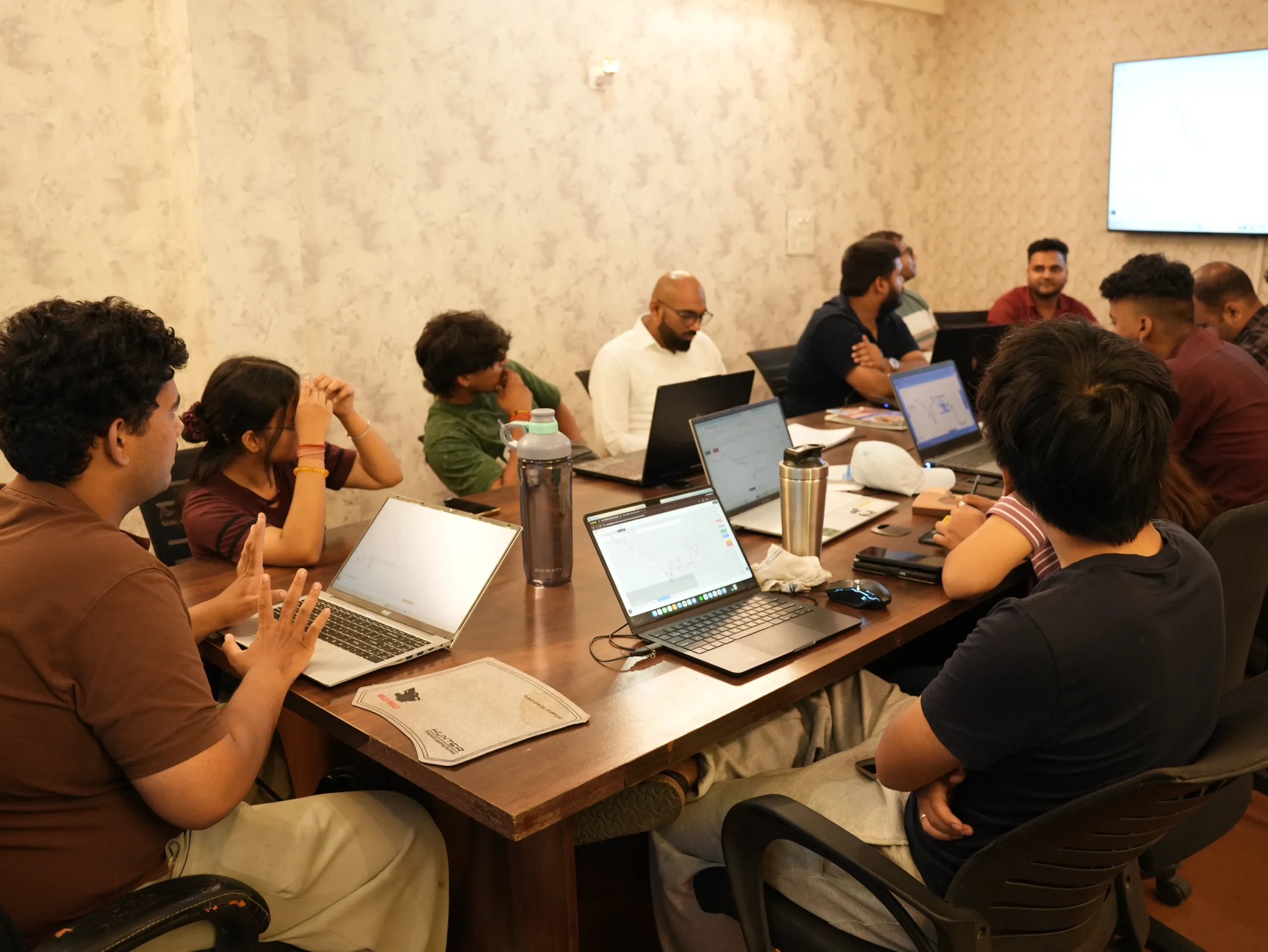
Once you're comfortable with stocks, many traders move to derivatives, which is where the stakes rise sharply.
Courses to Learn Options Trading
An options trading course teaches how options are priced, how the Greeks (delta, gamma, theta, vega) affect a position, and how different strategies change your risk. It should be taken after a stock market foundation, not instead of one.
Options deserve their own course because they behave in ways that surprise even experienced stock traders:
| Stock trading | Options trading |
|---|---|
| Price moves in your favour = profit | Price can move in your favour and you can still lose, because of time decay and volatility |
| No expiry date | Every contract expires, and time works against buyers |
| Risk is broadly linear | Risk can be highly non-linear, depending on the strategy |
| One variable: price | Several variables: price, time, volatility, interest rates |
The insurance analogy: Buying an option is like buying insurance. You pay a premium, and most of the time the policy expires unused. Selling options is like being the insurance company. You collect small premiums often, but a single disaster can cost you heavily. A good options course teaches you to think like both.
The F&O loss figures above are the strongest argument I know for structured options education. Around 93% losing isn't random bad luck. My assumption is that many of those traders were buying options with no understanding of time decay, which is like paying insurance premiums every week and wondering why you're poorer.
Options Pro: our options trading course covers option mechanics, pricing, the Greeks, strategy risk profiles and margin, taught with capital protection at the centre.
Courses to Learn Forex Trading in India
A forex trading course teaches how currency pairs work, what moves exchange rates, and how to trade currencies. In India, a good course must also teach the legal framework, because Indian residents can only trade permitted currency pairs through SEBI-registered brokers on recognised exchanges.
Forex is the largest financial market in the world. According to the BIS 2025 survey, daily turnover averaged about $9.6 trillion, around 28% higher than in 2022.
But in India, the legal side matters as much as the strategy. The RBI's Alert List names platforms that are neither authorised to deal in forex under FEMA nor to operate forex trading platforms. It also covers websites that promote them, including those claiming to provide training or advisory services.
| What to check in a forex course | Why |
|---|---|
| Does it teach legal market access in India? | Offshore platforms can expose you to penalties under FEMA |
| Does it cover INR pairs and permitted crosses? | These are what Indian residents can legally trade on exchanges |
| Does it teach macro drivers (rates, crude, RBI)? | Currencies move on economics, not just charts |
| Does it avoid recommending offshore brokers? | Promoting unauthorised platforms is a serious red flag |
The recipe analogy: A stock is a single ingredient. A currency pair is a recipe with two ingredients, and its taste depends on both. EUR/USD can fall because the euro weakened, because the dollar strengthened, or both. Learning forex teaches you to analyse relationships, not just prices, a skill that makes you a sharper stock trader too.
FX Mastery: our forex trading course for beginners covers currency pairs, pips, market sessions, trading strategies and risk management, all taught within India's RBI and SEBI framework.
Courses to Learn SMC and ICT
An SMC and ICT course teaches Smart Money Concepts (liquidity, order blocks, fair value gaps, market structure) and ICT (Inner Circle Trader) models, frameworks for reading how large institutions may be moving price. These are advanced courses, best taken after you understand basic price action and risk management.
What SMC and ICT Actually Are
| Concept | Plain-English meaning |
|---|---|
| Liquidity | Areas where many stop losses or orders cluster, which price is often drawn toward |
| Order blocks | Zones where large orders may have entered, which can act as future support or resistance |
| Fair value gaps (FVG) | Price imbalances left by fast moves, which price sometimes revisits |
| Break of structure (BOS) / Change of character (CHoCH) | Signals that a trend may be continuing or shifting |
| Market maker models | Frameworks describing how price may be engineered in phases |
SMC Is a Vocabulary, Not a Shortcut
SMC and ICT have become hugely popular online, and I understand why. They promise to show you what "the big players" are doing. But here's my honest perspective: SMC is a more detailed vocabulary for describing price action. It doesn't remove risk, and it doesn't work without the fundamentals underneath it.
Think of it like learning advanced cricket analytics: field placements, bowling plans, match-ups. That knowledge makes a good player better. It won't turn someone who can't hold a bat into a batsman. Students who jump into SMC without basic market structure knowledge usually end up seeing order blocks everywhere, which is the same as seeing them nowhere.
Our Smart Money Concepts and ICT course covers liquidity pools, order blocks, fair value gaps, market structure (BOS, CHoCH), ICT entry models and market maker models.

Now you know what each course teaches. The harder question is which one you should start with.
Which Trading Course Should You Learn First?
Most beginners should start with a stock market foundation course. Choose forex first only if currencies are your specific interest, and take options or SMC/ICT only after the basics are solid.
The 3T Test: Time, Temperament, Tolerance
Before choosing any course, answer these three questions honestly:
| Factor | Question to ask yourself | What it points to |
|---|---|---|
| Time | How many hours can I realistically give the market each week? | Less time → swing or positional styles, not intraday |
| Temperament | Do I enjoy fast decisions, or do I prefer thinking things through? | Fast → intraday later; reflective → swing, investing, macro/forex |
| Tolerance | How would I feel losing 5% of my capital in a week? | Low tolerance → master risk management and avoid leveraged products early |
Decision Matrix
| Your situation | Recommended first course | Next step |
|---|---|---|
| Complete beginner, interested in stocks | Master Course | Options Pro |
| Want to test interest before committing | Crash Course | Master Course |
| Complete beginner, interested in currencies | FX Mastery | SMC & ICT Course |
| Know stock basics, want derivatives | Options Pro | Advanced practice and review |
| Experienced trader, want institutional concepts | SMC & ICT Course | Refine through journaling and review |
| Business owner with currency exposure | FX Mastery | Hedging-focused practice |
| Still unsure | Free demo class | A mentor recommends your path |
Quick Readiness Check
Answer yes or no to each question:
- Can I explain the difference between a market order and a limit order?
- Can I read a basic candlestick chart?
- Do I know how to calculate how much I'd lose if my stop loss is hit?
- Have I ever written a trade plan before placing a trade?
- Can I explain what happens to an option's value as expiry approaches?
Still not sure where you land?
Send us your answers to the five questions above and a mentor will tell you honestly which course fits — including if the answer is "wait a bit longer."
Compare All DTA Trading Courses
| Course | Level | Market | Prerequisite | Focus |
|---|---|---|---|---|
| Crash Course | Introductory | Stocks | None | Market basics overview |
| Master Course | Beginner | Stocks | None | Complete foundation |
| Options Pro | Intermediate | Options and futures | Stock basics | Derivatives and risk |
| FX Mastery | Beginner | Currencies | None | Forex within Indian law |
| SMC & ICT Course | Advanced | Forex and price action | Trading foundations | Institutional concepts |
What Every DTA Course Includes
| Included | Why it matters |
|---|---|
| Risk management | It decides whether you survive being wrong |
| Trading psychology | Fear and greed ruin more accounts than bad analysis |
| Trade journaling | Every trade becomes a lesson instead of a memory |
| Mentor interaction | Mistakes get corrected early, before they become habits |
| Regulatory awareness | Knowing SEBI and RBI rules keeps you on the right side of the law |
Online vs Offline Trading Courses: Which Is Better?
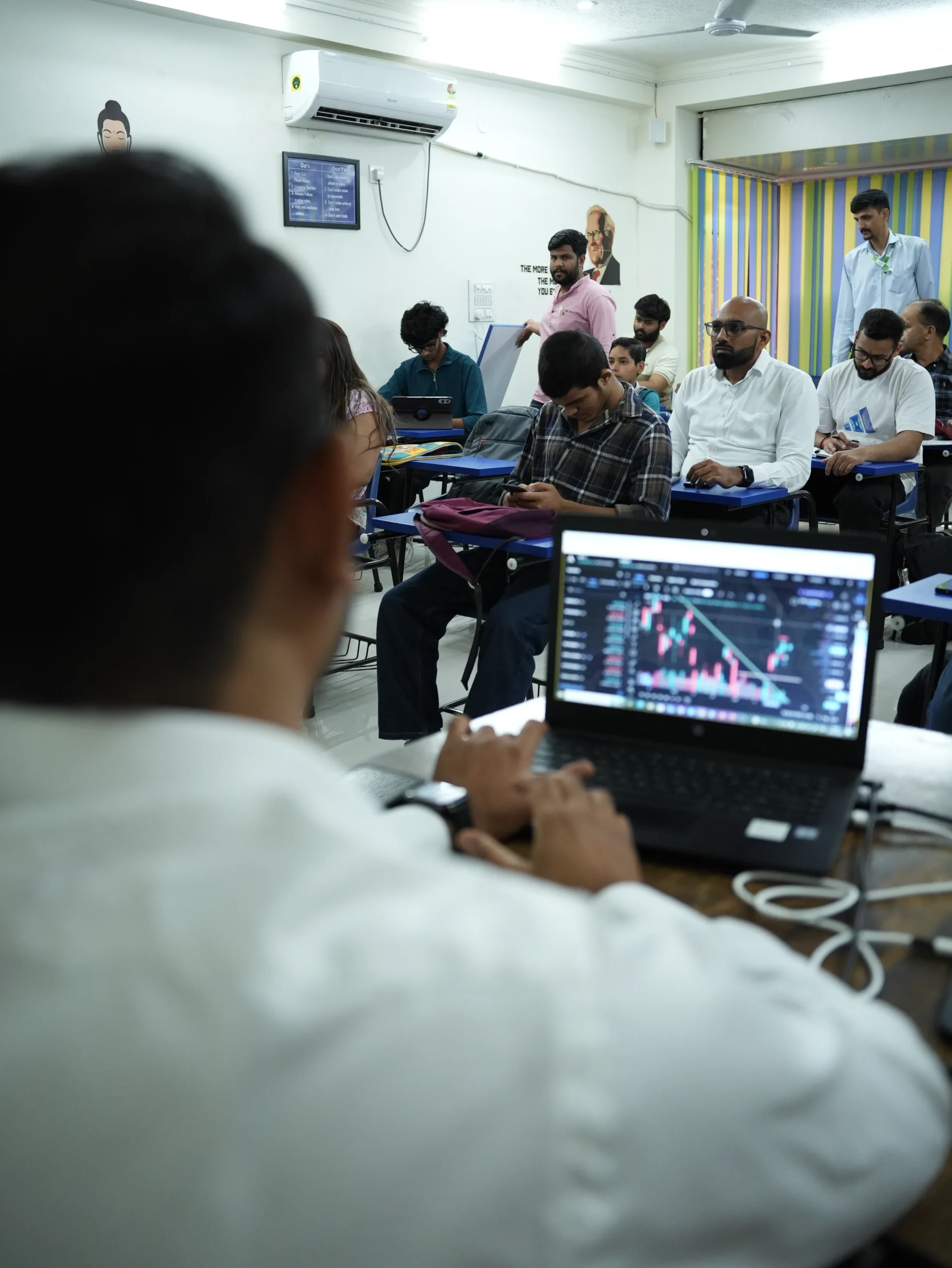
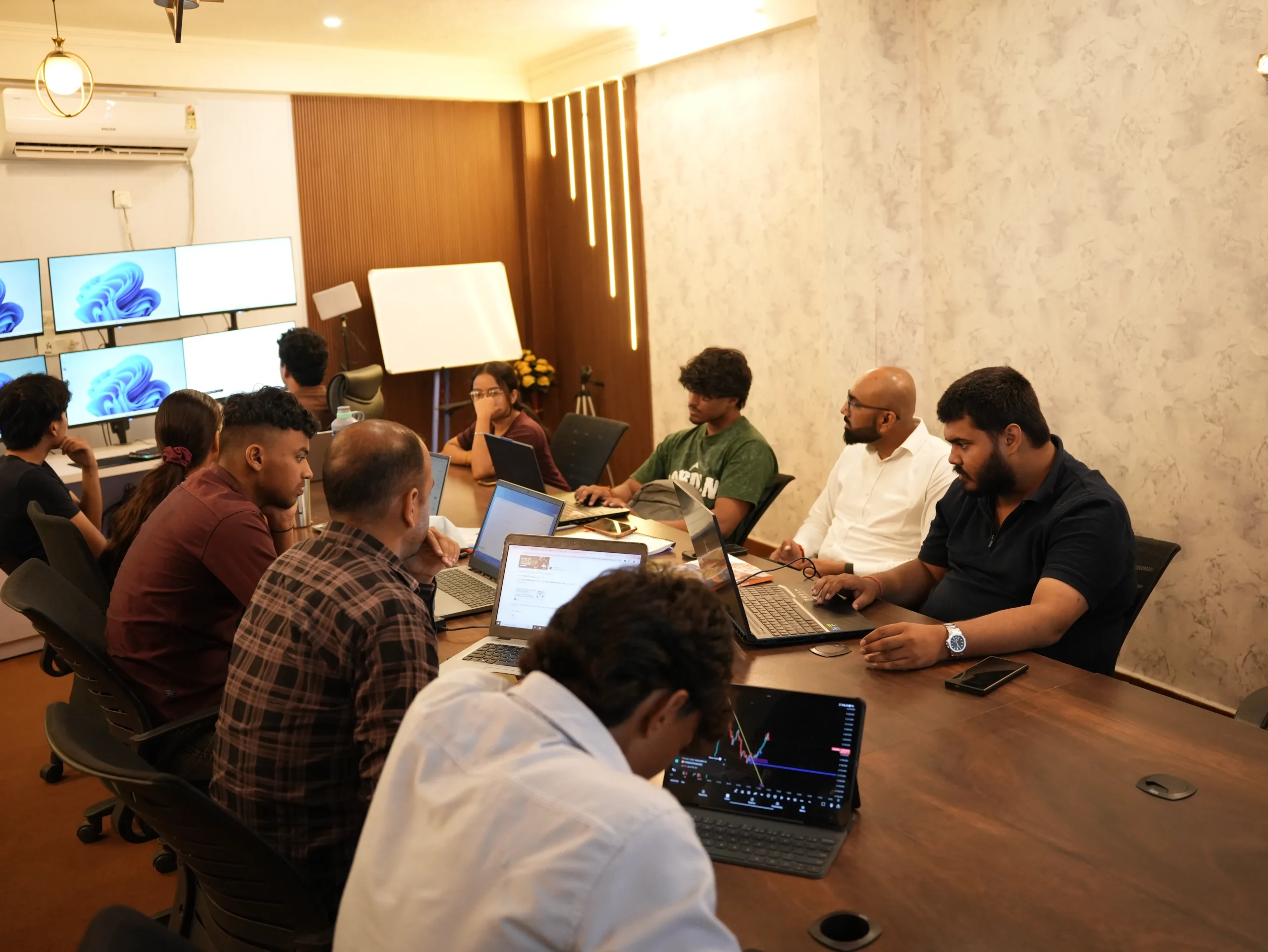
Offline trading courses are better for learners who need accountability and face-to-face mentoring; online courses suit working professionals and those outside major cities. Neither is automatically better. The format should fit your discipline level.
| Factor | Offline (classroom) | Online |
|---|---|---|
| Accountability | High: fixed schedule, physical presence | Depends on self-discipline |
| Mentor interaction | Immediate, face-to-face | Scheduled, via video or chat |
| Peer learning | Strong batch community | Varies |
| Flexibility | Lower | Higher |
| Travel | Required | None |
| Best for | Beginners who need structure | Self-driven learners and professionals |
The gym analogy: Some people work out consistently alone with an app. Others only show up because a trainer is waiting for them at 7 AM. Neither is wrong. Know which one you are before choosing.
DTA runs classroom batches in Dehradun, Chandigarh and Moradabad, plus online options. For a deeper comparison, read our guide to online vs offline stock market courses in India.
How Long Does It Take to Learn Trading?
Most people can learn the fundamentals of trading in a few weeks to a few months, but becoming consistently disciplined usually takes much longer, often a year or more of practice and review. Learning the rules and learning the skill are two different timelines.
The figures below are our estimates based on classroom experience, not published data. Individual progress varies widely.
| Milestone | Typical time (estimate) | What it looks like |
|---|---|---|
| Understand market basics | 2–4 weeks | You know how orders, exchanges and charts work |
| Form your own analysis | 2–3 months | You can read charts and explain your view |
| Apply risk management consistently | 3–6 months | Every trade has a planned stop and position size |
| Develop a personal trading plan | 6–12 months | You have a tested process you follow |
| Trade with emotional discipline | 12+ months | You follow your plan even after losses |
The driving analogy: You can learn the controls of a car in a day and pass your licence test in a few weeks. But confidence on a crowded highway at night takes months of real driving. No course can compress that experience entirely. A good one makes sure you build it safely.
The most dangerous period is months 2 to 4. That's when you know enough to feel confident but not enough to be consistent. I've noticed that this is exactly when many beginners increase position sizes. If you remember one thing from this page, remember this: keep your position sizes small until your process is proven, not just until you feel ready.
What Does a Trading Course Really Cost?
A trading course costs its fee plus your time, but the more useful question is what learning without one costs. Every trader pays tuition. The only choice is whether you pay it to a teacher or to the market.
| Cost type | Structured course | Learning only from the market |
|---|---|---|
| Tuition fee | Fixed and known upfront | Zero upfront |
| Market losses while learning | Potentially lower, if you learn risk management before trading real money | Unknown; often discovered the hard way |
| Time to competence | Shorter, with a defined sequence | Longer; lots of trial and error |
| Bad habits formed | Corrected early by mentors | Often discovered only after losses |
The SEBI study found that loss-making F&O traders lost an average of about ₹2 lakh each over three years. I'm not claiming any course prevents losses; no honest educator can. But when I compare that figure to the cost of structured education, I believe learning risk management before trading with real money is one of the better-value decisions a new trader can make.
DTA course fees vary by programme. See each course page, or contact us for details. Our payment and refund policy explains the terms. For a balanced view, read are paid stock market courses worth the money?
Free vs Paid Trading Courses: An Honest Comparison
Free resources are excellent for building awareness, while paid courses add structure, sequence and personal feedback. The smartest learners use both.
| Learning source | Cost | Structure | Feedback | Reliability | Best use |
|---|---|---|---|---|---|
| YouTube and social media | Free | Scattered | None | Mixed; hard to verify | Exploring topics |
| Finfluencer tips and signal groups | Often paid | None | None | Low; often unregistered advice | Best avoided |
| Books | Low | Good | None | Generally high | Deepening concepts |
| NISM certifications | Exam fee | Syllabus-based | Exam only | High; regulator-linked | Formal knowledge credentials |
| Regulator and exchange investor education | Free | Basic | None | High | Understanding rights and risks |
| Structured institute course | Paid | Sequenced | Direct mentor feedback | Depends on the institute | Building applied skill |
I actively encourage students to use free regulator and exchange resources alongside our courses. They're reliable, and they reinforce the same principles we teach. What free content usually can't give you is sequence and correction, someone who tells you which video to watch next and why your last trade went wrong. See our comparison of self-learning vs professional training.
How to Identify the Best Trading Institute in India
The best trading institutes teach, rather than tip; they are open about risk; they employ experienced, verifiable mentors; and they make no promises of returns. Here's how to check.
Green Flags vs Red Flags
- Clear syllabus with a stated level and prerequisites
- Mentors with verifiable experience and credentials
- Risk management taught early and repeatedly
- Free demo class with no pressure
- States clearly that it does not give tips or advice
- Guides you to SEBI-registered brokers only
- Honest about loss statistics
- Vague "become a profitable trader" promises
- Anonymous "experts" or only screenshots of profits
- Strategy-only courses that barely mention risk
- "Offer ends tonight" pressure tactics
- Sells trade calls or signals without SEBI registration
- Recommends offshore forex apps
- Claims of guaranteed or fixed monthly returns
Why "Education, Not Advice" Matters Legally
SEBI draws a clear line between education and advice. Its rules say unregistered persons cannot offer investment advice, make performance claims or indirectly suggest future prices, and regulated entities cannot associate with them. SEBI enforces this. In one case, it barred a finfluencer from the securities market and ordered disgorgement of ₹17.2 crore, alleging he gave trading recommendations disguised as paid educational courses.
A genuine institute will tell you plainly what it does and doesn't do. For a detailed checklist, read how to identify a genuine trading institute and our complete guide to choosing a stock market institute in India.
Why Learn Trading at Doon Trading Academy?
| What we offer | Details |
|---|---|
| Experience | 10+ years of market education |
| Students | 8,559+ learners trained |
| Rating | 4.9★ across 100+ verified Google reviews |
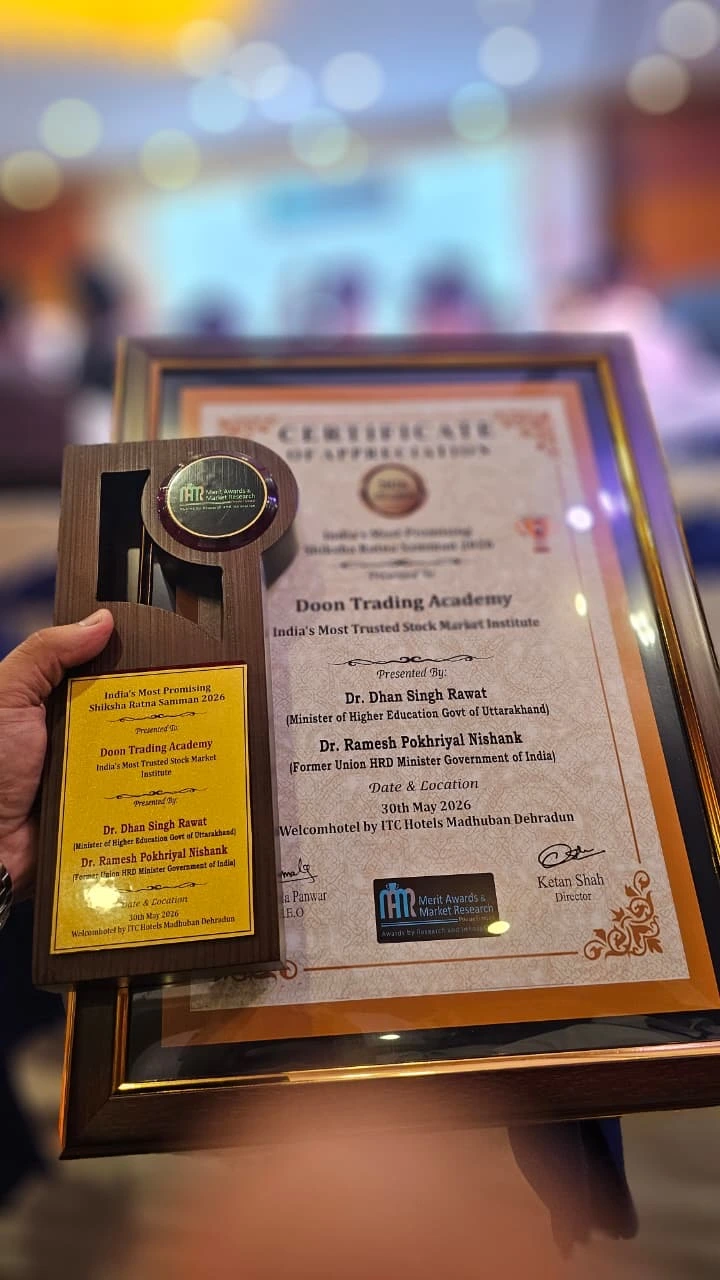
| Recognition | "Most Trusted Stock Market Institute" at India's Most Promising Shiksha Ratna Samman 2026 |
| Mentor specialisations | Technical analysis, options, forex, and SMC & ICT |
| Philosophy | Education only. No investment advice, stock tips or guaranteed returns. |
| Centres | Dehradun, Chandigarh, Moradabad, plus online |

Meet our mentors and read our story →
The DTA Perspective: 7 Beliefs About Learning Trading
These are the principles behind how we design every course. You won't find them in most course brochures, but they shape everything we teach.
Learn to lose small before you learn to win big.
Every trader loses. The difference between beginners and professionals isn't how often they're wrong. It's how much being wrong costs them.
Your first strategy should be boring.
Exciting strategies are usually complex, and complexity hides mistakes. A simple, repeatable process you actually follow beats a brilliant one you abandon after three losses.
A course is a sequence, not a certificate.
What matters isn't the paper at the end. It's whether you learned things in an order that let each skill build on the last. Here's our take on whether course certificates actually matter.
Choose the market that fits your calendar, not your excitement.
The best market for you is the one you can give proper attention to. A working professional trading scalps during meetings is setting themselves up to fail.
Skill compounds; tips expire.
A tip works once, if at all. A skill works for the rest of your life, across every market you ever trade.
Your journal teaches you more than any indicator.
Indicators tell you about the market. A journal tells you about yourself, and that's usually where the real problems are.
The market is the most expensive teacher.
It will teach you everything eventually. But it charges full price, has no refund policy, and never explains its lessons.
Frequently Asked Questions
What is the best trading course in India for beginners?
For most beginners, a stock market foundation course that covers market basics, technical and fundamental analysis, and risk management is the best start. At DTA, that's the Master Course.
Are stock market courses and share market courses the same?
Yes. In India, "stock market" and "share market" are used interchangeably. Both refer to trading and investing in company shares on exchanges like NSE and BSE.
How can I learn trading from scratch?
Follow five stages in order: market foundations, analysis, risk management, specialisation, and supervised practice with review. Starting with a structured beginner course and a demo class is the easiest way in.
Which is better to learn first: stocks, options or forex?
Stocks, for most people. Options build on stock market knowledge, and forex requires understanding India's legal framework. Choose forex first only if currencies are your specific interest.
Is forex trading legal in India?
Yes, when done through SEBI-registered brokers on recognised Indian exchanges in permitted currency pairs. Trading on unauthorised offshore platforms is not permitted under FEMA.
What is an SMC and ICT course?
It teaches Smart Money Concepts, such as liquidity, order blocks and fair value gaps, along with ICT trading models for reading institutional price action. It's an advanced course best taken after the basics.
How long does it take to learn trading?
The fundamentals can be learned in weeks to a few months. Consistent, disciplined trading usually takes a year or more of practice and review.
Can I learn trading while working a full-time job?
Yes. Many of our students are working professionals. Swing and positional trading styles don't require watching screens during office hours.
Are online trading courses as good as offline classes?
They can be, if you're self-disciplined. Offline classes suit learners who benefit from fixed schedules and face-to-face mentoring.
Do trading courses guarantee profits?
No. No legitimate course can guarantee profits. A good course teaches skills, structure and risk management; results depend on each trader's discipline.
Does DTA give stock tips or trading calls?
No. DTA is an education provider. Specific buy/sell recommendations require SEBI registration as an Investment Adviser or Research Analyst.
Do I need money to start learning trading?
No. You can learn market concepts and practise planning trades before committing any capital. When you do start, use only money you can afford to lose.
What should I ask during a trading course demo class?
Ask about the syllabus sequence, mentor experience, how risk management is taught, and what support is available after the course. Here's a full list of questions to ask during a demo class.
Where are DTA's trading classes held?
We have centres in Dehradun, Chandigarh and Moradabad, plus online options.
Start With a Free Demo Class
You don't need to choose a course today. Attend a free demo, meet a mentor, ask your questions, and let us help you find the right starting point.