


I remember the first time I sat down to find a stock market institute. Eleven browser tabs, three phone numbers I had already handed out, and no way at all to tell one promise from another. Every website said the same four things. Expert mentors. Practical training. Lifetime support. Proven results. None of it told me anything, because all of it was identical.
What finally helped was not a better comparison chart. It was learning where the real dividing lines sit: between education and advice, between a certificate and a credential, between a mentor and a man with a microphone. Once I could see those lines, the eleven tabs sorted themselves out in about twenty minutes.
This is the version of that process I wish someone had handed me.
Quick summary
Focus on curriculum fit, practical exposure, recognised certifications, faculty quality and clear post-course support. Look for structured practice on historical data, simulators and mentor review rather than lecture-only classes. Verify NISM certifications directly and check whether faculty have market experience you can confirm independently. Compare de.ry modes and the technology actually taught. Then run a short checklist before paying: syllabus review, demo session, alumni feedback, fee against what is included, and written refund terms.
Let me start with chai, because it explains this better than any framework

Every one of us knows someone who makes exceptional chai. And every one of us has also had the version at a wedding buffet that tastes like sweet brown water. Same ingredients. Completely different outcome.
Here is what I have noticed about the difference, and stay with me, because it maps onto trading education almost exactly.
The flame matters more than the recipe. Good chai needs the right heat at the right stage. Too high and the milk catches and turns bitter. Too low and the leaves never release anything at all. A recipe card gives you ingredients, but the flame is judgement, and judgement only comes from someone standing beside you saying “not yet, wait, now.” This is precisely what a syllabus cannot give you. A syllabus lists modules. Whether you learn anything depends on whether somebody is watching your pace and adjusting the flame for you specifically. That is mentorship, and it is why batch size matters more than module count.
The milk is your capital. You can redo the leaves. You can add more sugar. You cannot un-burn milk. Once it catches at the bottom of the pan, the whole batch is finished and you start again from nothing. Most people entering markets are focused entirely on the leaves, which is to say the strategy, the indicator, the setup. Almost nobody is thinking about the milk. A course that spends five hours on chart patterns and twenty minutes on position sizing has the ratio backwards, and you will not notice until the milk is gone.
Texture is the thing you cannot fake. You can tell good chai from the first sip, and it is not really the taste, it is the body. That comes from time, from the boil being allowed to happen properly instead of being rushed. Trading skill has the same property. Someone who has actually traded through a bad six months carries something in how they explain a drawdown that no amount of slide preparation reproduces. When you sit in a demo class, you are not really evaluating the content. You are checking for texture.
And the honest chaiwala tells you his ratio. This is the part I find most useful of all. The ones who are genuinely good will tell you exactly what they do, because they know the ratio is not the secret. The secret is ten thousand repetitions. It is the ones guarding a “secret formula” who usually do not have one. When an institute is cagey about its syllabus, hides its instructors, or hints at a proprietary method that can only be revealed after payment, that is not protection of intellectual property. That is usually the absence of it.
Hold that image. I will come back to it at the end.
Why choosing the right institute matters
Picking the right institute affects how quickly you learn, how much of that learning survives contact with a . account, and whether you build habits that protect you or habits that eventually cost you.

A good institute teaches methods rather than conclusions. It builds process: risk management, position sizing, journaling, review. A bad one teaches you to feel confident, which is honestly the most expensive thing anyone can teach you about a market.
The wrong choice costs money and time, but the real damage is habitual. Overtrading. Sizing by conviction instead of by rule. Waiting for someone else to tell you what to do. Those are far harder to unlearn than they were to learn, and I have watched people spend two years undoing six weeks.
Before anything else, understand the line SEBI drew
I am putting this early because it did not exist in this form two years ago, and it changes how you should read every institute’s marketing.
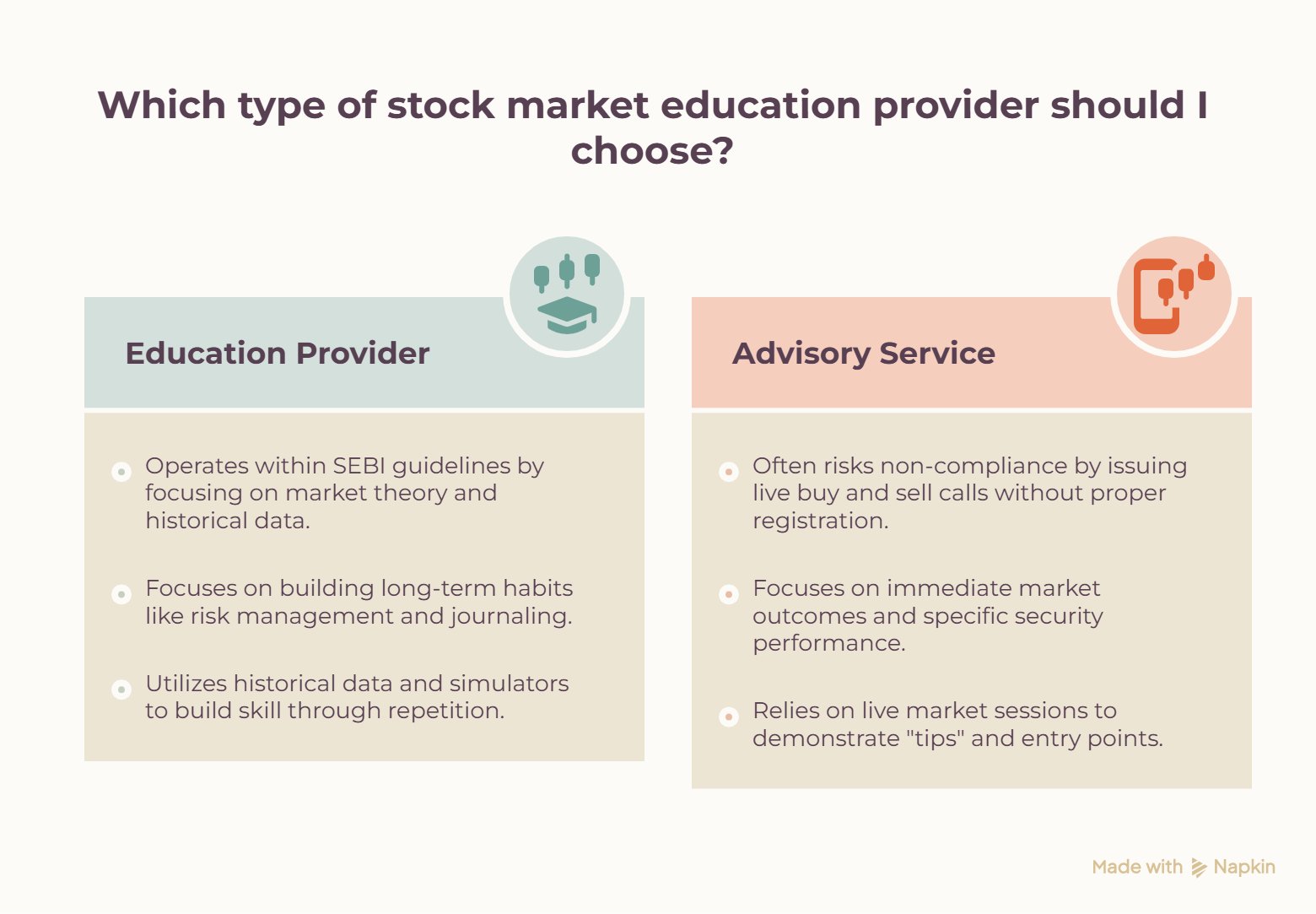
In January 2025, SEBI issued guidance distinguishing education from advice and recommendation, and barred regulated entities including brokers, portfolio managers and investment advisers from any direct or indirect association with unregistered finfluencers. The same circular barred unregistered educators from using . or recent market data, permitting price references only with a three-month lag, specifically to stop real-time trading tips being handed out under the label of education. The line drawn was sharp: a person engaged solely in education must not reference the price of a security, including through code names.
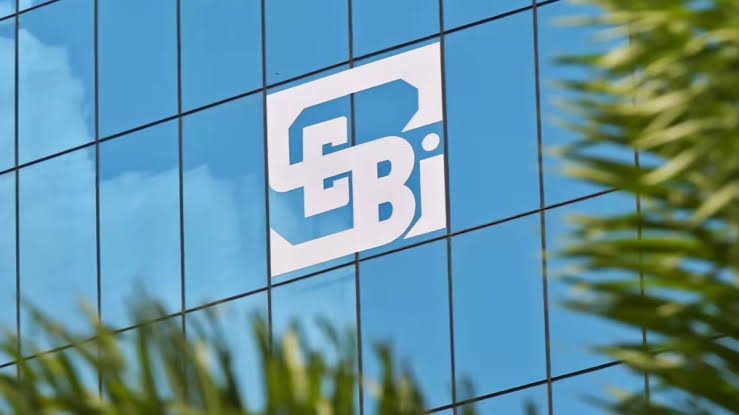
I want to flag something here that contradicts advice you will find in almost every other article on this topic, including older versions of this one. Live market sessions are no longer automatically a sign of quality. For an unregistered education provider, they are now closer to a compliance problem.
This is not a technicality. In December 2025, SEBI acted against Avadhut Sathe and the Avadhut Sathe Trading Academy, concluding that the operation was effectively providing unregistered investment advisory and research services under the cover of education while collecting hundreds of crores, and impounded over Rs 546 crore. The investigation began with complaints that the academy was not only running courses but issuing buy and sell calls during . sessions.
So here is the test I now apply within the first fifteen minutes of any demo class.
Education teaches method. How a chart is structured, how options are priced, how to size a position, how to keep a journal. It works from history and from worked examples.
Advice tells you what to do with a specific security right now. Buy this. Exit here. Target that.
The second requires SEBI registration. The first does not. An institute doing the second while marketing itself as the first is exactly what the regulator is currently dismantling, and being a paying student of one is not a comfortable place to be.
If an institute is calling . entries in class, ask directly whether it holds SEBI Research Analyst or Investment Adviser registration. Then verify the number yourself rather than trusting the one printed on the website:
How to evaluate a stock market institute
1. Accreditation, and what that word actually means here
I need to be blunt about this one, because it is where most people get misled first.
No regulator accredits trading institutes in India. SEBI does not inspect their syllabus, vet their trainers or approve their courses. There is no body that certifies an institute as legitimate. Any institute implying it is “SEBI approved” or “government recognised” is either confused or hoping that you are.
What genuinely exists:
NISM, the National Institute of Securities Markets. It was established by SEBI in 2006, and its certifications carry real regulatory weight because they are the mandated qualification for a range of market roles. NISM also publishes its official workbooks free, updated in line with regulatory changes. That last detail is worth sitting with for a moment. The syllabus a paid course is charging you Rs 40,000 to de.r is, in its regulatory form, downloadable at no cost.
NCFM, NSE Academy Certification in Financial Markets. Launched in 1998, offering more than fifty modules across Foundation, Intermediate and Advanced levels. It is generally not mandatory for regulatory compliance, though it is respected in the industry as a signal of practical knowledge.
The institute’s own certificate. Worth precisely what that institute’s name is worth in a hiring conversation, which for most of them is nothing. It is not a credential. It is a receipt with a border.
The question worth asking is not “are you accredited.” It is: which specific NISM series does this prepare me for, and do I sit that exam directly through NISM? If they are issuing their own certification and implying it carries regulatory standing, you have learned something important about them.
Verify a person’s NISM certification at https://www.nism.ac.in/ and verify the company itself at https://www.mca.gov.in/
2. Curriculum and syllabus alignment
Read the syllabus properly, not the module titles.
A serious curriculum covers fundamentals (how to read a financial statement, what valuation actually means) and practical skill (chart structure, order types, position sizing, psychology). What separates a good trading syllabus from a padded one is whether it explains when and why a technique applies, rather than simply naming it.

Be sceptical of any syllabus that reads as a list of indicators. RSI, MACD, Bollinger, Supertrend, Ichimoku. Naming ten indicators is not depth, it is inventory. What you want to see instead is backtesting, walk-forward validation, system development and portfolio construction. Those are the modules that teach you to evaluate the next idea you meet, including the ones you invent yourself at two in the morning.
3. Faculty credentials and mentorship
Judge faculty on two separate things, because they really are different: track record and teaching clarity. Plenty of profitable traders are terrible teachers. Plenty of excellent teachers have never traded size.
What I look for is verifiability. Does this person exist outside the institute’s own website? Is there a LinkedIn profile, published work, a prior role at a broking or research firm, a conference talk, anything at all with a date attached? A biography that .s only on the homepage selling you the course is not a biography, it is marketing copy.
Then ask the question most people forget: which specific person is teaching my batch? The founder on the YouTube thumbnail is very often not the person who will be standing in your classroom. This matters enormously at franchise-model institutes, and I will come back to it.
Batch size and post-course mentorship duration matter more than almost anything else on this list. A cohort of ten to fifteen allows individual trade review. A hundred-person webinar does not, whatever the brochure says about personalised attention.
4. Practical exposure, within the current rules
Practical work still separates real training from a lecture series. What has changed is the form it should take.
What you want: simulators, paper trading, historical backtests, a capstone project where you build a strategy and test it on data you did not choose. Assignments with de.rables. A journal you maintain and a mentor who actually reads it.
What you should now treat with caution: real-time market commentary from an unregistered provider, given the three-month lag requirement. Good practical training on historical data is legitimate, rigorous, and often harder than watching somebody call a trade .. Live calls are a different product wearing the same clothes.
Broker tie-ups for demo accounts and sandbox API access remain genuinely valuable, particularly if you are heading toward systematic trading.
5. Technology, tools and resources
Ask which platforms are actually taught and whether access is included in the fee or billed separately. TradingView with Pine Script, Python basics, Amibroker, or a proper backtesting environment are concrete, portable skills. Platform-agnostic theory is not.
Ask about version currency too. If the screenshots in the course material are from software that looks five years old, the syllabus probably is as well. And confirm whether you keep access to the learning portal and recordings after the course ends, or whether it quietly expires the day you stop paying.
6. Student outcomes, placements and alumni
Here I would separate two very different claims that institutes tend to blur together.
Placement claims belong to institutes training people for jobs in broking, research or wealth management. If that is your goal, ask for alumni names and roles, then verify them on LinkedIn yourself. Reluctance to connect you with past students tells you more than the statistic did.
Trading outcome claims are a different animal, and my honest position is that you should treat all of them as noise. Nobody can verify them, they are not audited, and under the current rules they should not be made at all.
An active alumni community is genuinely valuable though, for a reason people underrate: it is where you find out what the course did not cover.
7. Fees, refund policy and return on investment
Get the total figure in writing, GST inclusive, with every separate charge spelled out. Tool licences. Retakes. Advanced modules. Certificate fees. Optional mentorship upgrades that turn out not to be optional.
Then get the refund policy in writing before you pay. I want to be emphatic here: a strict policy stated clearly is completely fine. A vague policy, or no policy at all, is the single strongest predictor of trouble I know of. An institute that has not written down what happens when a student is unhappy has not thought about it, and you will be the one discovering the answer in real time.
On ROI, do not calculate against a promised income. Calculate against what is included: months of mentorship, batch size, tool access, alumni network. Those are the things you are actually buying.
8. Reviews, transparency and red flags
Read reviews, but read them properly. There is a technique to it that almost nobody uses, and I have given it a full section below.
The disqualifying red flag, above all others: any quoted income figure. A monthly earnings number, a payback period, a success rate, a student who “makes Rs 40,000 a month.” It does not matter how it is framed or how sincerely it is de.red. SEBI’s guidance explicitly requires that unregistered educators refrain from making return or performance claims. An institute making them is either non-compliant or careless, and neither is a quality I want in whoever is teaching me risk management.
The second thing this reminds me of: a gym
I find this analogy useful for a slightly different reason than the chai one, so let me lay it out properly.
Nobody walks into a gym expecting the gym to give them a body. You understand instinctively that you are buying access and instruction, and that the result depends almost entirely on what you do over the following eighteen months. Yet somehow, with trading education, people expect the institute to de.r the outcome.
The parallels are precise:
The transformation photos on the wall are the testimonial section. Real people, possibly. Representative, definitely not. You are looking at the top one percent of outcomes presented as the typical one, and both industries do this for the same reason. It works.
Equipment is not instruction. A gym with better machines does not produce better results than a gym with a good coach and rusty ones. An institute with a trading lab and dual monitors is not automatically better than one where somebody actually reads your journal. Infrastructure photographs well, which is exactly why there is so much photography of it.
A trainer who does not train is a warning. You would not take lifting advice from somebody who has never lifted. Apply the same instinct to a trainer who has never held a position through a bad quarter.
Progressive overload is the entire game. In the gym you start light, add gradually, and do not max out in week one. In trading this is position sizing and paper trading, and it is the part everyone wants to skip. The people who get hurt are the ones who load the bar to their aspiration rather than their current capacity.
And nobody gets fit in five days. If a gym advertised a five-day intensive that would transform your physique, you would laugh out loud. Somehow a five-day intensive that transforms your trading gets taken seriously. Compressed formats can hand you a framework. They cannot build a skill, because skills are built by repetition under supervision, and five days does not contain enough repetitions of anything.
Which brings me to the part I think matters most, and that you will not find on any institute’s website.
What almost nobody tells you
This section comes from community forums, review threads and conversations rather than from anyone’s marketing. Some of it is uncomfortable.
The franchise problem. A number of large Indian institutes run on a franchise model, sometimes with hundreds of centres. What this means practically is that the founder whose videos convinced you is not teaching your batch, has probably never met the person who is, and your entire experience depends on which franchisee happens to operate in your city. The brand is centralised. The teaching is not. Before enrolling at a branded centre, ask who owns that specific branch and who teaches there, then evaluate that person rather than the brand. This is the single biggest gap between what people believe they are buying and what actually arrives.
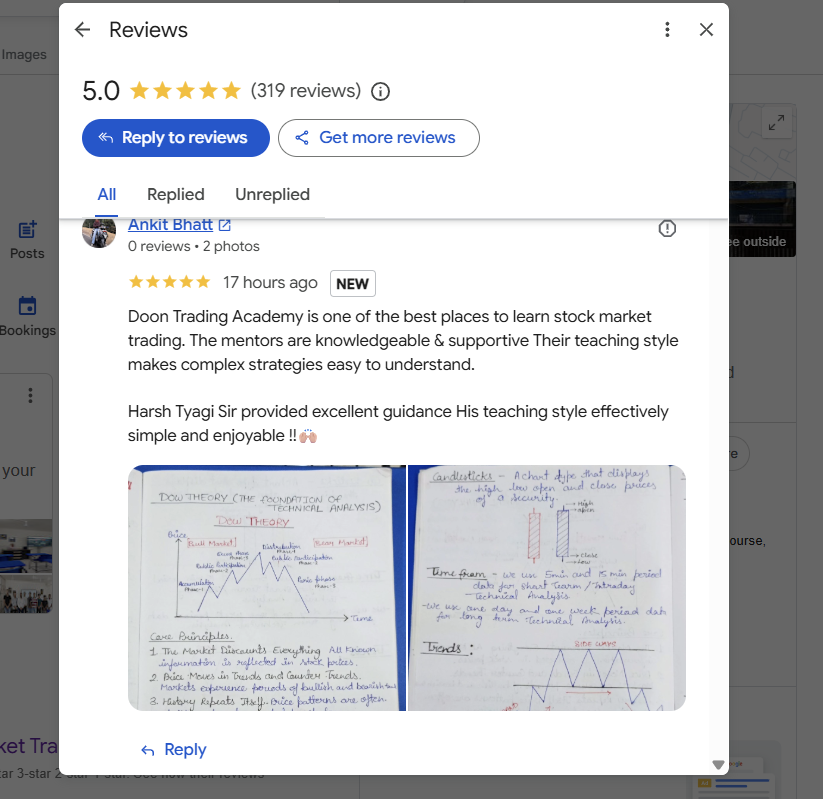
Read reviews by date, not by rating. Here is a technique I picked up from a forum thread on detecting fake reviews. Sort chronologically and look at the distribution. Genuine review flow is uneven but continuous. Manufactured review flow arrives in clusters: fifty five-star reviews across two days, silence for three months, then another cluster. Check the reviewers too. Accounts with exactly one review ever posted, generic names and no other activity are a recognisable pattern. One community discussion I came across documented precisely this on a well-known trading education brand: over a thousand five-star reviews concentrated on two specific dates, from accounts with no history whatsoever.
Go straight to the one and two star reviews. Not to check whether complaints exist, because they always do, but to see what kind. Complaints about scheduling and pace are ordinary operational friction. Complaints saying “I paid Rs 10,000 to learn what NSE and BSE are” tell you the course was mispriced against its actual depth. Complaints about refunds not being honoured tell you something else entirely. And an institute with four hundred reviews and nothing below four stars is not better than one with fifty and a few complaints. It is just managing its reviews.
The refund policy loophole. This comes up repeatedly in course-review communities across industries, and the mechanism is always the same. The refund is real, but conditional on “active participation” or “completion of assigned work,” and those terms are defined loosely enough that the provider can always argue you did not meet them. One detailed account I read described a mentorship where the refund depended on not landing a project within four weeks; when the buyer requested his refund, he was offered a vague project with no timeline and no de.rable, which technically disqualified him. Read the conditions, not the headline. Ask specifically what you would have to do to qualify, and who decides.
“Lifetime mentorship” usually means a WhatsApp group. This is the most common gap between promise and de.ry in the Indian market. Lifetime access to recorded content is real and cheap to provide. Lifetime access to a human being who reviews your trades is expensive and rarely what is meant. Ask the operational question: six months from now, if I message you about a specific trade, who responds, and within what timeframe? The answer is very often “the group,” which means other students who know as little as you do.
Group Zoom is not mentorship. Related but worth stating separately. Mentorship implies somebody knows your particular patterns and mistakes. If the format is twenty people on a call receiving generic feedback, that is a class, and it should be priced as one.
The alpha decay argument. This is the objection I found hardest to dismiss when I first met it in trading communities, and it deserves an honest hearing rather than a brush-off. If somebody has a genuinely profitable edge, teaching it to five thousand people erodes it, because crowded trades stop working. So why sell the course at all?
There is a legitimate answer. Most trading education is not selling an edge, it is selling a framework. Risk management, position sizing, journaling, psychology and market structure do not decay when shared, because the constraint is not secrecy, it is execution. Ten thousand people knowing they should risk one percent per trade does not stop it from working. But that answer only holds if the institute is honest about which one it is selling. An institute selling a framework is durable. An institute selling a proprietary strategy is either lying about the proprietary part or damaging its own students by scaling it. Ask which one you are being sold, and watch closely how they answer.
Watch what happens after the course ends. A pattern documented repeatedly in consumer complaints and news reports: the course leads to a community group, the group starts carrying tips, the tips lead to losses. Sometimes the institute is running it. Sometimes it is a scammer who joined the alumni group. Either way, the handoff from “here is how to analyse” to “here is what to buy” is where most of the harm in this industry actually happens. Be conscious of that transition, and treat any group that starts carrying calls as something to leave rather than something you earned.
Nobody discusses the opportunity cost of your trading capital. If a course costs Rs 45,000 and you have Rs 1,00,000 in total, you have just committed forty-five percent of your capital to education and left yourself fifty-five percent to practise position sizing with. That ratio makes disciplined trading nearly impossible, because meaningful positions on Rs 55,000 are either too small to matter or large enough to hurt. Either the fee or the capital needs to change. Most people run this arithmetic only afterwards.
Ask what the course does not teach. An institute that can articulate the limits of its own method is thinking clearly and has been through the humility that markets impose. One that claims completeness is selling. This single question has told me more about institutes than any other I have asked.
Comparison: course de.ry modes
| Mode | Works best for | The trade-off |
| In-person classroom | Beginners who need structure and accountability; people who learn through peer discussion | Highest cost, fixed timings, limited to your city, and quality depends entirely on your local branch |
| Online . classes | Working professionals who want interaction with flexibility | Quality collapses as batch size grows. Ask for the number before enrolling, not after |
| Self-paced recorded | Disciplined learners on a budget, or revision after a . course | No feedback loop, no accountability. Completion rates are low and nobody advertises them |
| Hybrid | Most working professionals, most of the time | Only genuinely better if the . component is small-batch. Otherwise it is recorded content with a webinar attached |
Hybrid usually wins in my experience, but only if you verify that the . portion is not a two-hundred-person session doing ceremonial duty while the recordings quietly do all the actual work.
Five insights beyond the obvious
Backtesting is the skill that transfers. Learning an indicator teaches you one pattern that worked in one market regime. Learning to validate it across several regimes teaches you how to assess every future idea you meet, including the ones you generate yourself. Institutes that include walk-forward analysis produce traders who adapt. Those that do not produce traders who are excellent at the last two years and helpless in the next one.
Trade meta-data beats additional technique. Recording your entry rationale, your emotional state and a pre-trade checklist creates a feedback loop that compounds faster than any new strategy. Almost no syllabus includes it, which is odd, because it costs nothing. Do it from day one whether or not your course asks you to.
Broker API and sandbox access is increasingly decisive. Tie-ups giving you a real testing environment make the move to systematic or semi-automated trading dramatically easier. As execution gets more automated, this is shifting from a pleasant extra to a genuine differentiator.
Certification and skill sit on separate axes. NISM makes you employable and teaches you compliance. It does not teach you to sit through a drawdown without abandoning your system. Formal certification and practical mentorship are complements, and neither substitutes for the other. Institutes that conflate the two are usually strong at one and covering for the other.
Batch size has a hard threshold, not a gradient. Somewhere between fifteen and twenty-five students, individual trade review stops being possible and the format silently becomes a lecture. It does not degrade smoothly, it breaks. Which is why that number matters more than nearly any other data point you can collect.
Questions to ask before enrolling
- Can I see the full detailed syllabus and attend one complete class, start to finish?
- Which specific NISM or NCFM modules does this prepare me for, and do I sit those exams directly?
- Are you registered with SEBI as a Research Analyst or Investment Adviser? If yes, what is the number?
- Who specifically teaches my batch, and where can I verify their background independently of your website?
- If this is a franchise branch, who owns and operates it?
- What is the batch size, and how long does mentorship continue after the final session?
- What does “lifetime support” include operationally, and who responds?
- Is simulator, broker demo or backtesting tool access included, or billed separately?
- Can I speak to three alumni whom you do not select for me?
- What is the total fee including GST, and what is the written refund policy?
If any of these gets a vague answer, that is not a gap in their communication. That is the answer.
Troubleshooting common problems
If the course content feels too theoretical. When content skews theoretical I ask for a practical assignment immediately, and I ask for it that same week. A small project: backtest a simple strategy, keep a journal for ten trades, present the execution detail including every place I deviated from plan. If an institute cannot supply a practical exercise within a week of being asked, they do not have one prepared, which tells you what the remainder of the course looks like.
If I do not see improvement after the course. This happened to me, and my instinct was completely wrong. I wanted to buy the advanced course. What actually helped was reducing rather than adding: smaller positions, one strategy only, and a line-by-line journal review with a mentor. Complexity was the problem, not the solution. Almost nobody struggling after a course needs more material. They need more repetitions of less material.
If placement support is weak or unclear. I look up alumni on LinkedIn myself and ask for introductions directly. If an institute is reluctant to connect me with past students, I stop treating its placement claims as data. Programmes confident in their outcomes tend to be enthusiastic about introductions, because their alumni are the best salespeople they have.
If the technology or tools taught are outdated. I check version numbers and ask for access to current platforms. If I find outdated software I ask specifically whether migration support is included or whether additional licence fees will appear later. That question tends to produce a revealing pause.
If I face pressure from sales teams. I decline anything time-limited that lacks a written date, and I ask for trial or refund terms in writing before discussing price at all. In my experience, institutes confident in their product let you think. The correlation between sales pressure and course quality is strongly negative, and I have never once regretted walking away from a countdown timer.
If the course ends and a tips group appears. Leave it. Whatever the intent behind it, a group carrying buy and sell calls is a different product from the one you paid for, and it is the point at which most documented harm in this industry occurs.
A step-by-step plan
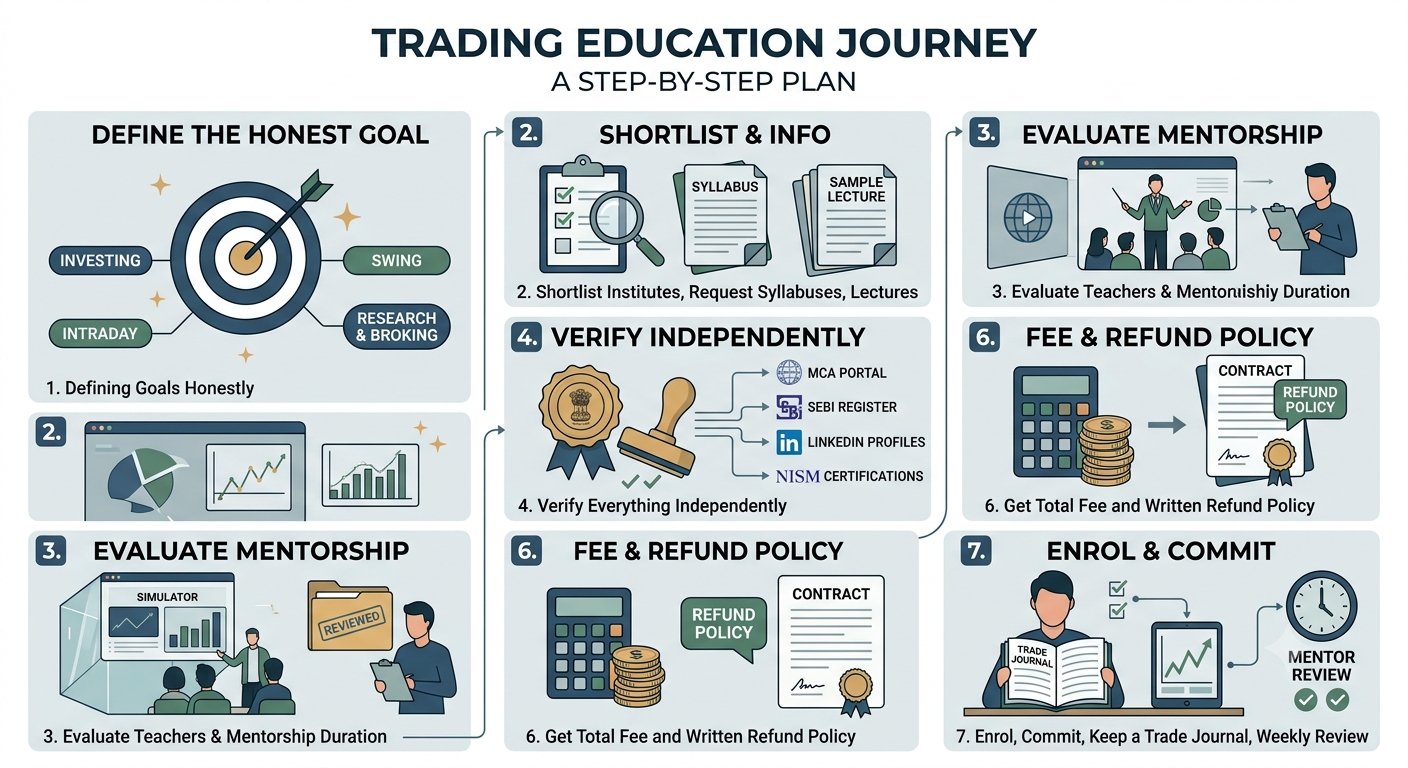
Step 1. Define the goal honestly. Investing, intraday, swing trading, or a career in research and broking. These require different programmes, and most institutes will happily sell you the wrong one.
Step 2. Shortlist three to five institutes that genuinely serve that single goal. Request full syllabuses and sample lectures in writing.
Step 3. Attend demo sessions at each. Evaluate the teacher rather than the content. Ask the batch size and mentorship duration, and write the answers down.
Step 4. Verify everything independently. The entity on the MCA portal. Any SEBI number on SEBI’s own register. The trainers on LinkedIn. The NISM certifications on the NISM site.
Step 5. Confirm the practical exposure is real. Simulator access, historical data work, a capstone project, and who reviews it.
Step 6. Get the total fee and the written refund policy. Compare cost against mentorship months and batch size, never against a promised income. Run the capital ratio arithmetic honestly.
Step 7. Enrol, then commit to the unglamorous part. A trade journal from day one, paper trading before real money, weekly mentor review for the first three months, and one strategy until it becomes boring.
Additional evaluation tools and red flags
Before committing, ask for a short practical test assignment: a two to three hour exercise reflecting what the course claims to teach. It is the fastest way to discover whether applied learning exists or whether the practical component is a slide labelled “Practical.”
Red flags, consolidated:
Guaranteed returns or any quoted income figure. Testimonials without verifiable identity. Aggressive upselling to advanced modules before you have finished the current one. Reluctance to name the specific trainer for your batch. No written refund policy. Reviews clustered on a handful of dates. Live buy and sell calls from an unregistered provider. A proprietary strategy that can only be revealed after payment. And pressure of any kind attached to a deadline that has no date.
Conclusion
Choosing the right institute changed how I approach markets, but not in the way I expected when I started looking. What helped was not finding the best course. It was learning to evaluate courses at all, and that turned out to be the same skill markets demand: check the claim, look for what is missing, and be most suspicious of the version that sounds easiest.
To recap the process. Define your objective. Shortlist institutes that actually serve it. Attend demos and judge the teacher rather than the slides. Verify the entity, the registrations and the trainers yourself. Confirm the practical component is real. Compare cost against mentorship and batch size rather than against a promised return. Then enrol and do the boring work.
And come back to the chai for a moment. The reason good chai is rare is not that the recipe is secret. Everybody knows the recipe. It is rare because getting the flame right takes attention, and most people are in a hurry. The institutes worth your money are the ones paying attention to your flame. The ones to avoid are selling you a recipe card and telling you the pan does not matter.
The genuinely good ones share one property above all others: they get more impressive the harder you check them. Everything verifies. Every question has an answer already prepared. Nothing requires the benefit of the doubt.
That is the whole test, and it takes an afternoon.
If you have been through a stock market institute in India, good or bad, I would like to hear the specifics in the comments. Not a rating, but what actually happened: what was promised, what was de.red, and what you would check differently now. That detail helps the next reader far more than any guide can.