

Building wealth has always been a major aspiration for individuals looking to secure their financial future—and from my own journey, I know how overwhelming it can feel to get started. Wealth building is simply the process of growing your financial resources through disciplined saving, investing, and prudent money management. Achieving real wealth is about more than just accumulating cash; it’s about creating the freedom to . life on your own terms, retire comfortably, and provide for your loved ones.
One of the best tools I’ve found for wealth building is the stock market. While it carries risks, history—and the stories of countless real investors—show that it remains a powerful way for everyday people to grow their money. With the right approach and a clear understanding of strategy, even those with limited starting capital can harness the stock market’s long-term compounding power. In this post, I’ll break down six proven investment strategies, combining data, real-user experiences, and what I’ve learned along the way, so you can confidently start or refine your own wealth journey.
Quick Summary
- Dollar-cost averaging helps reduce timing risks by investing set amounts consistently.
- Index fund investing offers diversification and market-matching returns with minimal effort.
- Buy and hold rewards long-term patience and harnesses the power of compounding.
- Value investing pursues undervalued stocks for long-term outperformance, as championed by Warren Buffett.
- Income strategies—using options and REITs—generate regular cash flow from investments.
- Diversification and asset allocation minimize risk and stabilize returns over time.
Understanding the Basics of the Stock Market
What is the Stock Market?
The stock market is a marketplace where shares of publicly traded companies are bought and sold. When you buy a stock, you’re purchasing a piece of ownership in a business, and you participate in both its profits and losses. The market operates through exchanges like the NYSE and NASDAQ, and prices fluctuate based on supply, demand, and company fundamentals.
The Role of Stocks in Wealth Building
Stocks have a reputation for offering higher long-term returns compared to other traditional assets like bonds or savings accounts. By participating in corporate growth, investors can unlock the power of compounding—where returns generate further gains over decades. This simple concept is the main driver behind most successful wealth-building stories, as seen in forums like Reddit’s r/investing and communities such as Bogleheads.
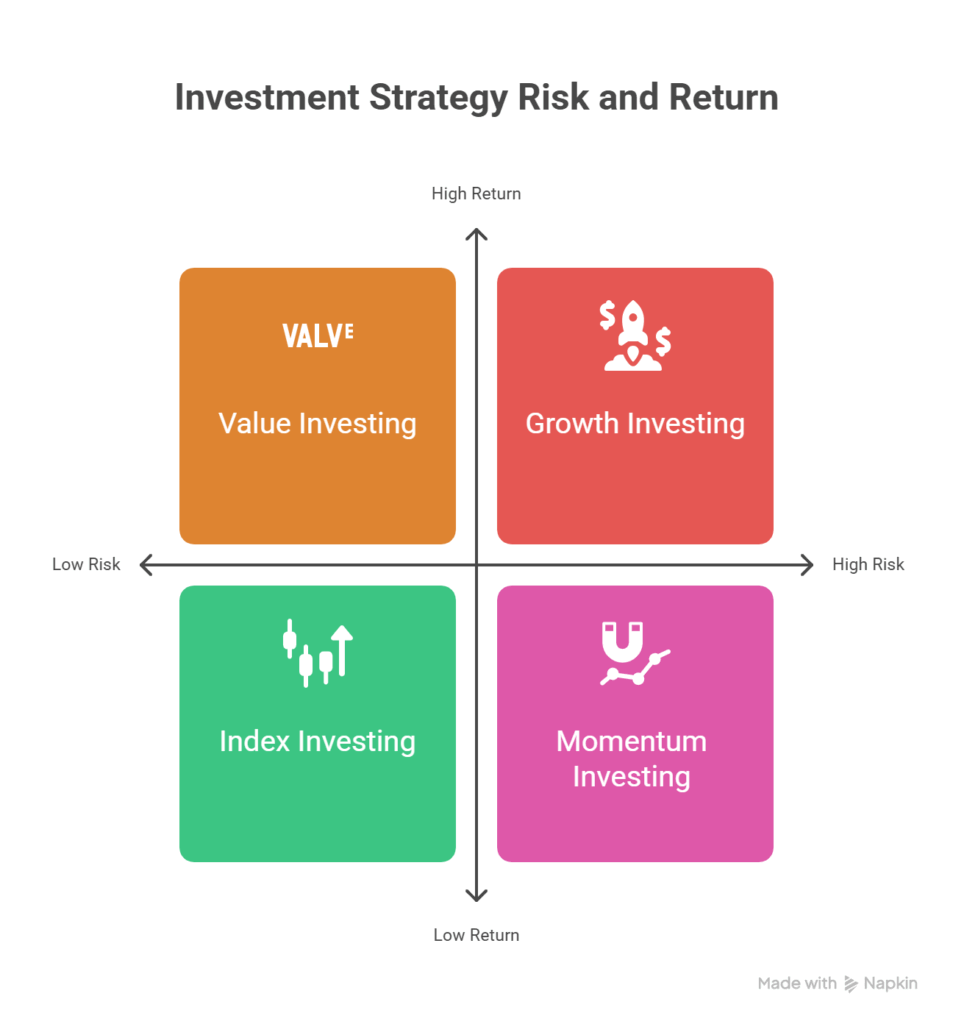
Investment Strategy 1: Value Investing
Explanation of Value Investing
Value investing is all about finding companies that are currently trading below their intrinsic worth. Legendary investor Warren Buffett defines this as “buying a dollar for fifty cents.” The strategy focuses on analyzing fundamentals—such as earnings, debt, and management quality—to uncover overlooked gems.
Famous Value Investors
Warren Buffett and his mentor Benjamin Graham are synonymous with value investing. Buffett’s own long-term record—24.7% compound annual return over nearly five decades—has inspired countless investors to learn this patient, analysis-driven method. As ValuePickr user learner25 puts it, “Buffett’s mantra of ‘margin of safety’ is the most reliable compass for anyone not looking to gamble in the markets.”
Tips for Implementing Value Investing
If you want to try value investing, start by learning to read financial statements. Seek out companies with strong balance sheets, consistent growth, and a clear competitive advantage. Prioritize stocks with low debt and a history of profitability. The key is patience—value opportunities can take years to pay off, and there will be times when your conviction is tested by market euphoria elsewhere.
Investment Strategy 2: Growth Investing
Overview of Growth Investing
Growth investing targets companies poised for rapid expansion. These firms might not look cheap based on traditional metrics, but their earnings and revenues are growing much faster than the broader market. Examples include early investments in Amazon or Tesla. While value investing focuses on what a company is worth today, growth investing bets on what it could become tomorrow.
Identifying Growth Stocks
To spot potential growth stocks, examine consistent double-digit sales and earnings growth, innovative products, and expanding market opportunities. Investors often look to tech, healthcare, and emerging sectors. A user in r/stocks wrote, “My best performers have always been those rare disruptors I bought early and held despite volatility.” However, growth stocks can be expensive and volatile, so careful research is critical.
Potential Risks and Rewards
The rewards of growth investing can be tremendous—if you pick the right companies. The risk, however, is overpaying for hype, or investing in momentum that fizzles. During bull markets, growth easily outpaces value, but the tables often turn in downturns. Diversification helps manage this risk. Also last time, we read about: Wealth Building Through Stock Market – 6 Proven Investment Strategies
Investment Strategy 3: Dividend Investing
What is Dividend Investing?
Dividend investing focuses on buying shares in companies that consistently pay out profits as dividends. These payments provide regular income, which can be reinvested for compounded growth or used to fund living expenses.
Benefits of Dividend Stocks
Dividend payers are often stable, mature companies. The steady cash flow can reduce portfolio volatility and soften the blow during market downturns. As r/dividends user DividendDieter notes, “There’s nothing more reassuring than seeing cash hit your account, no matter what the market is doing.”
Strategies for Picking Dividend Stocks
Seek out companies with a long history of increasing dividends, manageable payout ratios (so payments are sustainable), and healthy balance sheets. Utilities, consumer staples, and select REITs are common sources. Screening for “dividend aristocrats”—firms with 25+ years of consistent dividend hikes—is a popular tactic among experienced investors.
Investment Strategy 4: Index Investing
Introduction to Index Investing
Index investing means buying funds that track the performance of major market indexes (like the S&P 500). It’s considered one of the simplest and most effective strategies for individual investors, especially those without the time or expertise for detailed stock analysis.
Advantages of Index Funds
Index funds offer instant diversification, very low fees, and have outperformed most professional money managers over 15 years or more. As cited in an S&P Global report, “88% of professional investors fail to beat the S&P 500 over a 15-year horizon.” Warren Buffett’s famous advice—that most people should just buy a cheap S&P 500 index fund—stems from this evidence.
How to Get Started with Index Investing
You can start by purchasing index mutual funds or ETFs through almost any brokerage. A common Bogleheads approach is the “three-fund portfolio”—combining a total U.S. stock fund, an international stock fund, and a bond fund for broad exposure. Set your allocation based on risk tolerance and rebalance annually. Automation is your friend—set up automatic investments each month to remove emotion from the process.
Investment Strategy 5: Dollar-Cost Averaging
Explanation of Dollar-Cost Averaging (DCA)
Dollar-cost averaging is about investing a fixed amount on a regular schedule—regardless of market prices. Instead of trying to “buy the dip,” DCA smooths the purchase price over time, reducing the urge to time the market (which, as research and user stories consistently confirm, very few people do well).
Benefits of DCA
The psychological relief is just as important as the mathematical logic: You avoid paralysis over “waiting for the perfect entry,” and you keep buying through both booms and crashes. As r/investing user RoboTrader6 says, “Automating my monthly buys kept me in the game during COVID and saved me from panic selling at the wrong time.” DCA works especially well with retirement accounts and allows your wealth to compound steadily.
Practical Application of DCA
Just choose an amount you can stick with, pick an index fund or ETF, and invest that sum every paycheck or month. Don’t try to guess short-term market direction. According to research, starting early with even modest sums can add up big over decades—a worker investing $500/month from age 25 can amass over $1 million by retirement (assuming a 7% annual return), compared to about half as much if starting at 35.
Investment Strategy 6: Momentum Investing
What is Momentum Investing?
Momentum investing is about following price trends—buying what’s going up and selling when momentum fades. The logic: “The trend is your friend.” Momentum traders use tools like moving averages, volume surges, and relative strength to spot stocks on a hot streak.
Identifying Momentum Stocks
Look for stocks consistently hitting new highs or those with sustained upward moves accompanied by strong trading volumes. Finviz, SeekingAlpha, and StockTwits discussions are full of charts and technical analysis by users illustrating momentum breakouts. For example, one StockTwits user wrote, “My best monthly gains came from riding earnings breakouts—just remember to set exit stops.”
Balancing Risk and Reward
Momentum strategies can yield quick gains, but are high-risk: big surges often reverse suddenly, and chasers can get caught at the top. For most long-term wealth builders, momentum is best used as a tactical “overlay” within a diversified plan, not as the core approach.
Beyond-Common-Sense Facts and Insights
- Consistent dollar-cost averaging may mathematically underperform lump-sum investing in steadily rising markets, but its emotional benefits (helping investors stick to the plan) often outweigh the small performance gap.
- Over 15–20 years, the average index fund investor actually outperforms not just retail active traders, but 80–88% of professional fund managers due to lower fees and fewer mistakes.
- Taxes often quietly erode wealth more than fees or inflation—holding investments for over a year to get long-term capital gains rates (versus short-term) can dramatically increase net returns over time.
- REIT income is commonly taxed as ordinary income, not as qualified dividends—requiring special care for investors in high tax brackets and making tax-advantaged accounts even more valuable for such assets.
- The biggest risk of diversification isn’t just “missing out” on winners, but often the psychological discomfort of always owning some underperforming assets—which is actually a sign of healthy risk management.
Comparing Investment Strategies
| Strategy | Main Advantage |
| Value Investing | Potential for long-term outperformance via undervalued assets; backed by Buffett’s record |
| Growth Investing | Opportunity for rapid capital gains in innovation-driven sectors |
| Dividend Investing | Steady, predictable income and historical resilience in downturns |
| Index Fund Investing | Lowest fees, instant diversification, and strong evidence for reliable long-term returns |
| Dollar-Cost Averaging | Removes market-timing risk; emotionally easier to stick with |
| Momentum Investing | Potential for fast profits by riding established trends; highest risk of reversals |
Additional Resources
- The Intelligent Investor by Benjamin Graham – classic guide to value investing
- Bogleheads.org – community for index fund advocates and practical investing discussions
- J.L. Collins’ “The Simple Path to Wealth” – readable, real-world index investing strategy
- SeekingAlpha, r/investing (Reddit), and Morningstar – up-to-date analysis and user stories
- Personal Capital and Vanguard Investor Tools – for portfolio tracking and automated strategy implementation
Conclusion
In my experience, the most important lesson in wealth building through the stock market is that consistency, clarity of strategy, and patience beat the need for perfection. I’ve learned first-hand that no fancy software or secret formula replaces sticking with proven approaches and tuning out market noise. By leveraging the six core strategies discussed—value investing, growth investing, dividend investing, index fund investing, dollar-cost averaging, and momentum investing—anyone can design a wealth-building plan suited to their life stage and risk tolerance.
To recap, here’s the step-by-step process I personally recommend and follow:
- Set clear financial objectives (retirement, income, legacy).
- Establish your emergency fund before investing aggressively.
- Pick your primary strategy (or blend a few), so you’re not chasing every hot trend.
- Automate investments using index funds or DCA, and resist the urge to react to daily market swings.
- Regularly review and rebalance (but don’t over-tinker).
- Always keep learning—from books, forums, and fellow investors.
Whichever path you choose, remember: Wealth building is a marathon, not a sprint. Your experiences, questions, and lessons can help others—so I invite you to share them below. What’s worked for you? Which strategy are you considering, and what’s your biggest investing challenge? Let’s keep the conversation going and learn together.