


Finding that first winning stock can feel overwhelming, especially with thousands of options and constant market noise. From my perspective as someone who has made both rookie mistakes and celebrated solid wins, I know a clear, methodical approach makes all the difference. In this article, I’ll walk you through a comprehensive, research-backed “First Stock Selection Strategy” that boils the process down into seven practical steps—merging professional investor insights, real user experiences, and proven market data.
We’ll break down each phase: setting goals, performing due diligence, and evaluating risks. You’ll see not just how to pick stocks, but how successful investors—from Reddit users to Warren Buffett—approach the search for those elusive, winning companies. If you’re building your portfolio from scratch or revamping your investing style, these actionable steps will serve as your essential playbook.
Quick Summary
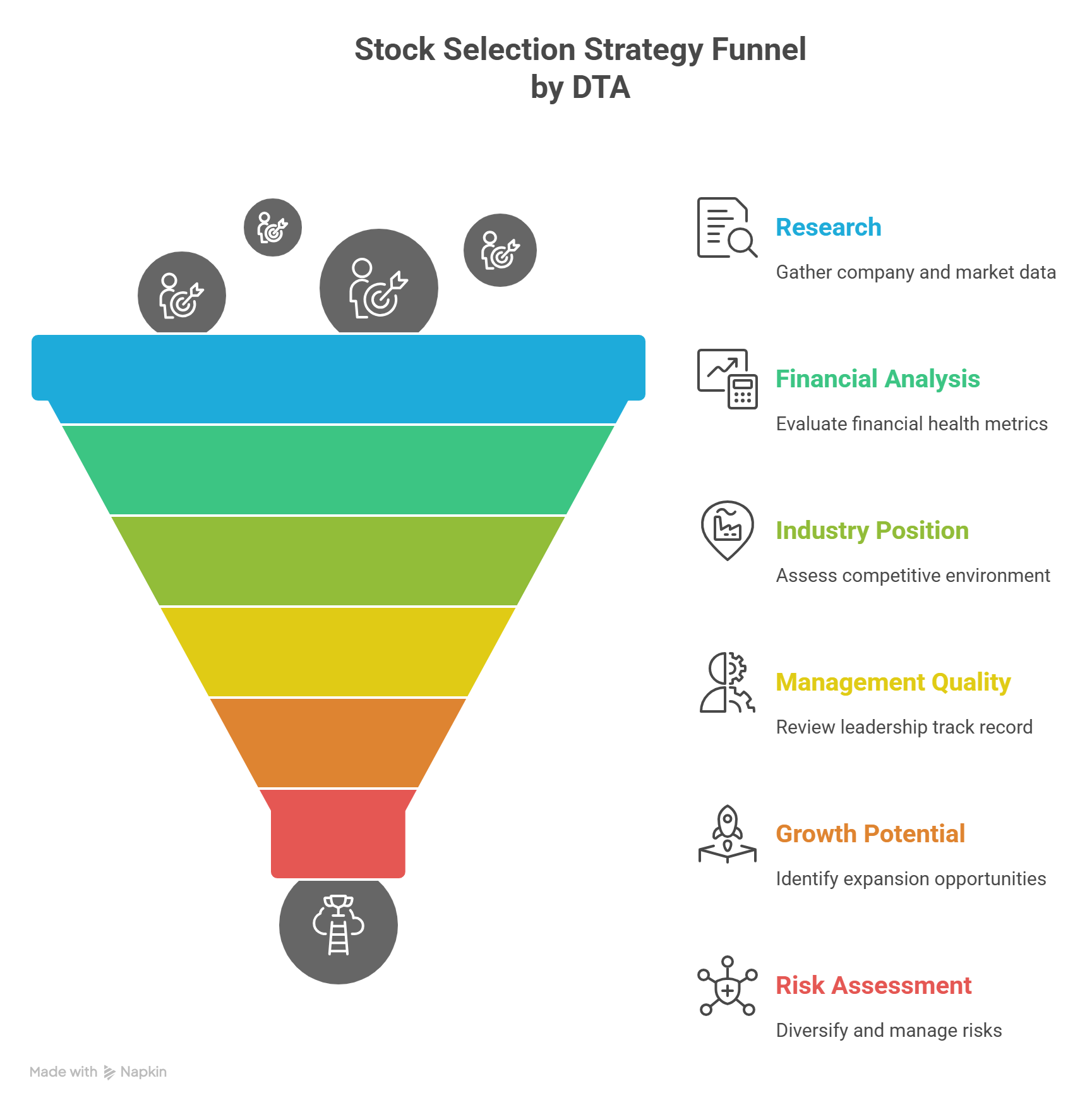
- Define your investment goals and match your stock picks to them.
- Research thoroughly—use company reports, credible financial news, and analyst data.
- Analyze company financial health focusing on profitability, debt, and cash flow.
- Assess the company’s industry position and sustainable competitive “moat.”
- Evaluate management quality—track record, strategy, and governance matter.
- Identify growth potential by looking for rising revenues, expanding markets, and innovation.
- Understand and mitigate risk through diversification and position sizing.
Step 1: Understand Your Investment Goals
The foundation of any first stock selection strategy is a crystal-clear understanding of your investment goals. Are you seeking long-term growth, recurring income, or capital preservation? Setting personal objectives shapes every stock decision from the very beginning.
- Growth-focused investors might target emerging tech firms or companies reinvesting profits for expansion.
- Income seekers favor blue-chip companies with a consistent dividend history.
- Capital preservationists might choose utility stocks or those with strong balance sheets and minimal volatility.
As one Reddit user, u/businessthrowaway2024, advised, “You can’t pick the right stock if you don’t know your destination. I learned the hard way—my early buys made no sense together.” Aligning every pick with your time horizon, risk appetite, and financial need helps prevent rash, misaligned decisions.
| Investment Goal | Example Stock Type |
|---|---|
| Growth | Small-cap tech, emerging markets |
| Income | Dividend aristocrats, REITs |
| Preservation | Blue-chip defensive, utilities |
Step 2: Research and Gather Information
Great decisions start with great information. Top-performing investors—whether on the Bogleheads forum or leading YouTube channels—emphasize deep research as non-negotiable. That means:
- Collecting company reports (SEC filings, annual and quarterly earnings)
- Studying independent analyst coverage and market news (WSJ, Bloomberg, Seeking Alpha)
- Comparing key metrics: revenue growth, profit margins, and industry benchmarks
As u/FinancialVisionary puts it: “I spend more time researching than trading—the more sources, the clearer the picture.” SoFi’s seven-step guide also insists on understanding what the business actually does before moving forward.
- Tools for efficient research: free stock screeners (Yahoo Finance, Finviz), advanced platforms (Trade Ideas)
- Focus on trends: Is revenue consistently growing? Are earnings beating expectations?
Step 3: Analyze Financial Health
Once you’ve shortlisted potential companies, a deep dive into their financial health is crucial. Financial analysis separates promising stories from sustainable performers. Focus on:
- P/E Ratio: Shows how much investors are willing to pay for each dollar of earnings. Lower is not always better—context matters.
- Debt-to-Equity Ratio: Flags overleveraged firms at risk in downturns.
- Return on Equity (ROE): Measures managerial effectiveness—higher ROE with sustainable practices is a green flag.
A recent analysis by LevelFields AI highlights how combining net margin, consistent profit growth, and healthy balance sheets helped users boost portfolio returns by up to 20% annually. Consistent winners show not just isolated good quarters, but a reliable pattern of success.
| Financial Metric | Why It Matters |
|---|---|
| P/E Ratio | Valuation relative to earnings growth |
| Debt/Equity | Financial stability, risk of insolvency |
| ROE | Management’s use of shareholder funds |
Step 4: Evaluate Industry and Market Position
The company’s competitive environment often makes or breaks its prospects. Is it the industry leader, or a small player fighting for survival? Investors on ValuePickr forum stress the importance of seeking companies with a durable moat—be it scale, brand loyalty, technological edge, or regulatory advantages.
- Compare margins, growth rates, and innovation against direct competitors.
- Check for dominant brands or products with pricing power.
- Read market share reports and news of disruptors.
As Peter Lynch famously said—and as echoed by countless forum posts—“The best companies are those that win even when the economy doesn’t.” A competitive position isn’t just current—it’s about survivability and dominance five, ten, or twenty years down the road.
Step 5: Consider Management Quality
Behind every great stock is great leadership. Management’s vision, execution, and integrity directly impact shareholder returns. As SoFi’s research notes and my own experience confirms, the best picks often emerge from companies whose teams have weathered storms and capitalized on opportunities.
- Look for a track record of wise capital allocation and strategic foresight.
- Review backgrounds via investor presentations, earnings calls, and independent press coverage.
- Scan for scandals or high turnover—it’s often a warning sign.
“I only invest in companies where I’d hire the CEO to run my own business,” says Warren Buffett—a principle reinforced by users like u/stockwatchman: “Management is the wild card. Bad leadership sunk my early picks.”
Step 6: Assess Growth Potential
Future gains hinge on scalable, sustainable growth. I scrutinize whether a company is entering new markets, releasing innovative products, or simply riding industry trends. LevelFields AI and the PTS Method both show that focusing on companies with robust expansion strategies leads to “winning stocks” more frequently than chasing hype.
- Inspect historical revenue and earnings growth rates.
- Check company roadmaps and investment in R&D.
- Evaluate acquisitions and strategic partnerships—are they “bolting on” new capabilities or markets?
Forum user u/DivGrowth shares: “What transformed my gains was filtering for companies with real market tailwinds, not just good past numbers.” Prioritize trends that indicate compounding, not just episodic, progress.
Step 7: Risk Assessment and Diversification
No stock is a sure thing. Even the best companies can be blindsided by regulatory changes, commodity price shifts, or black swan events. Wise investors, from Charles Schwab to everyday Redditors, emphasize two golden rules:
- Never risk more than you can afford to lose on a single position—use stop-loss strategies like the 7% rule (as highlighted by LevelFields AI).
- Diversify across sectors, market caps, and even geographic areas. A portfolio of 15-25 names, as many pros recommend, serves as a solid base.
As u/GrowthScout sums up: “Diversification saved my skin last year—I had losers, but winners more than made up for them.”
| Risk Type | Mitigation Tactic |
|---|---|
| Market Risk | Hedging, sector balance |
| Bad Management | Review track record, governance |
| Concentration Risk | Spread positions, size appropriately |
Beyond-Common-Sense Facts About Stock Selection Strategy
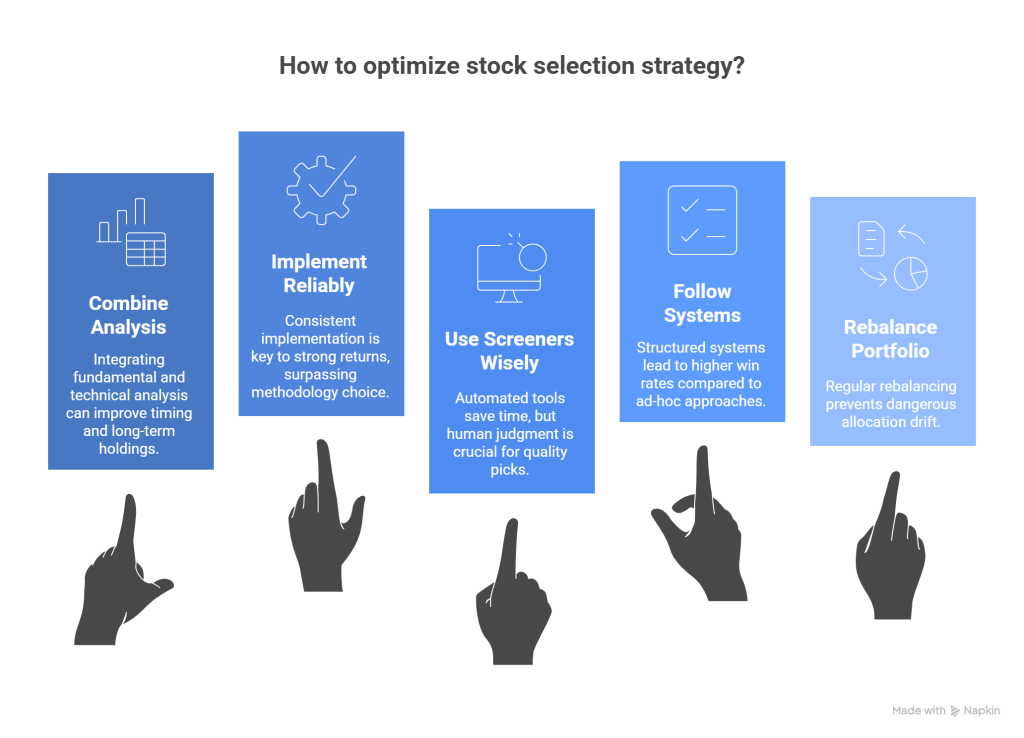
- Many pro investors combine both fundamental and technical analysis—timing entries with price patterns, even for long-term holds.
- Reliable implementation, not methodology choice, is the #1 predictor of strong returns (discipline trumps genius, as shown in Schwab’s and Reddit user experiences).
- Automated screeners greatly shorten research time, but human judgment distinguishes the “good” from the “great.”
- Performance variance between systematic and ad-hoc pickers is stark: Pros using strict seven-step systems report over 70% win rates, while new investors see much lower, inconsistent results.
- Portfolio rebalancing is often ignored but vital—left unattended, even a balanced portfolio drifts dangerously (Schwab data shows major allocation creep in just a decade).
Conclusion
In my experience, the fastest progress and least regret come from following a disciplined, step-by-step stock selection strategy. Here’s a brief recap of the practical process we’ve covered:
- Start with your investment goals as the foundation—be honest about risk, time, and financial needs.
- Research companies thoroughly using multiple, reputable sources and smart tools.
- Delve into financial health—look beyond the hype, straight into earnings, debt, and margin trends.
- Assess industry dynamics and identify firms with real, enduring competitive advantages.
- Investigate management quality, as even the best idea flounders under weak leadership.
- Pinpoint companies with proven and projected growth, not just wishful thinking.
- Finally, carefully size positions and diversify to limit impact from any single misstep—and keep monitoring, refining, and learning.
Building a winning stock portfolio isn’t about guessing or chasing trends. It’s about consistency, patience, and sticking to a robust process. I’d love to hear about your own journey—what steps have made the biggest difference, and what challenges are you still wrestling with? Drop your thoughts and questions in the comments. Here’s to your next winning pick.