

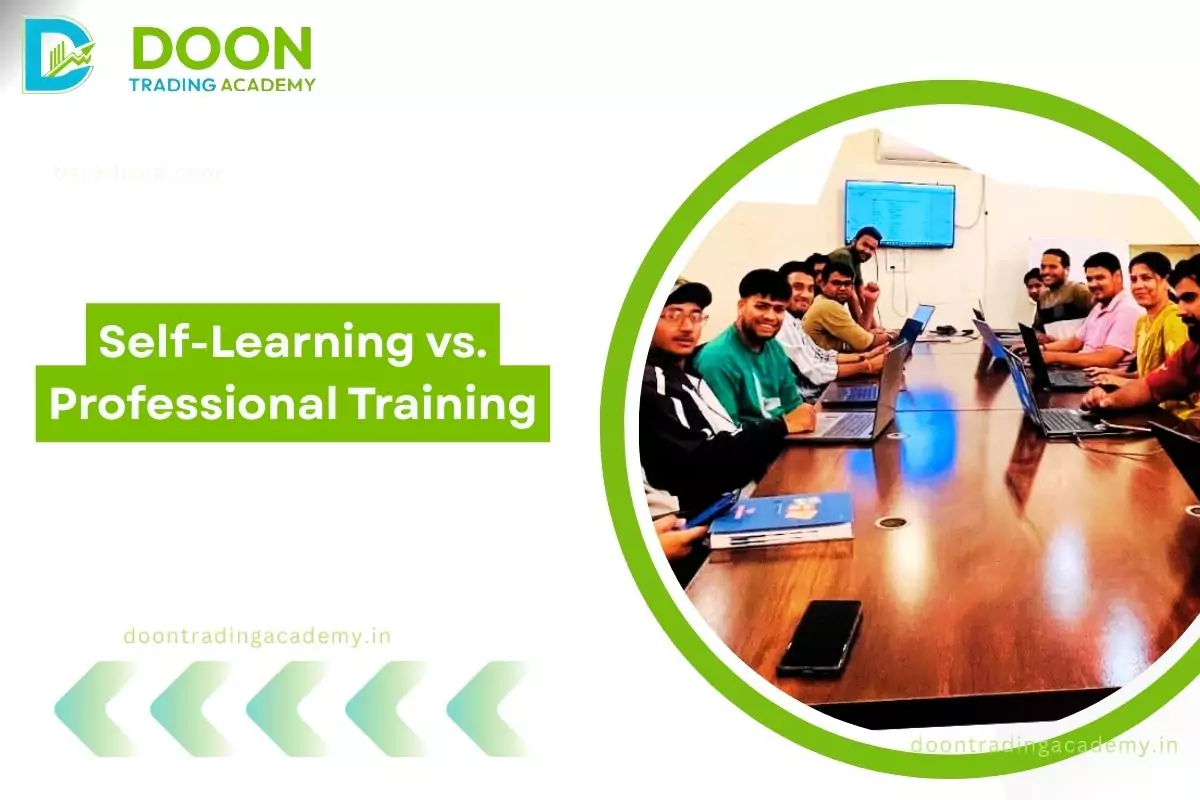
Learning to trade stocks has become one of the most popular ways people seek to build wealth or cultivate new careers. In recent years, I’ve noticed a huge rise in self-taught traders relying on free YouTube videos, blogs, or online forums. While it’s never been easier to start learning by yourself, I’ve personally experienced.. and seen firsthand in the communities I participate in… that navigating market complexity without professional guidance is exceptionally tough. The difference between self-learning and enrolling in a professional stock market education program isn’t just about cost or speed; it’s about drastically increasing your odds of success. Let’s break down these critical differences and explore why, for serious traders, a structured educational path consistently leads to better results.
Quick Summary
- Faster proficiency: Structured courses help learners reach competency in months, not years.
- Expert mentorship: Ongoing guidance significantly cuts costly mistakes, especially in risk management.
- Comprehensive coverage: Professional curricula prevent dangerous knowledge gaps common in self-study.
- Networking and support: Access to peers, alumni, and industry pros unlocks unique opportunities for growth and accountability.
1. Structured and Comprehensive Curriculum
One of the most immediate advantages of professional stock market education is a carefully structured curriculum. These programs are purpose-built by experts who know exactly which topics are vital, in what sequence, and with the right depth. Unlike piecing together online tutorials—which “has you jumping from trendlines one day to options the next” (as Reddit user hotstonkz put it)—a formal curriculum takes you step by step, ensuring you build solid foundations first.

As outlined in research and evidenced by the International Institute of Career Studies, professionally designed stock trading courses work like this:
- Start with fundamentals—market structure, basic charts, and order types.
- Progress to core topics—technical analysis, macro trends, and volume studies.
- Advance into critical risk management, psychology, and strategy modules.
- Apply skills using simulators or supervised paper trading sessions.
By following a logical sequence, learners avoid the typical pitfalls that come from a fragmented self-study approach. Qualified education also exposes students to all dimensions of trading, not just the clickbait “winning setups.” New traders who go it alone often miss fundamental areas like position sizing or behavioral biases—leading to avoidable blow-ups when real capital is at risk.
| Professional Curriculum | Self-Learning Approach |
|---|---|
| Stepwise, topic-sequenced instruction covering foundations to advanced topics | Disjointed, learner-directed path that often leaves gaps |
| Regular progress assessments and clear milestones | No objective progress tracking; easy to skip key concepts |
2. Expert Guidance and Mentorship
Ask any consistent trader what made the biggest difference in their development, and you’ll repeatedly hear: mentorship. Having access to experienced professionals is a game-changer—and forums are filled with testimonials to that effect. For example, BabyPips user Beeekeeper51 said, “I lost thousands before I started listening to a trading coach who actually walked me through my risk management plan step by step.”






Professional education puts you in direct contact with working traders and subject matter experts. This isn’t just about answering questions—it’s about:
- Watching how pros interpret . price action and major news events.
- Receiving personalized feedback on your trade journal and decision processes.
- Gaining “hard-won lessons” you literally can’t find in any book or video.
Mentors don’t just teach you the basics—they correct flawed habits before they become costly, such as letting losers run or overleveraging. According to academic research, traders with ongoing professional mentorship reach . market proficiency in 3-6 months—three to six times faster than average self-learners. As outlined in a VectorVest analysis, paying for expertise up front protects you from “years of frustration and unnecessary losses.”
| Expert-Guided Learning | Self-Directed Learning |
|---|---|
| Access to real-time feedback and best practices | Trial and error—mistakes compound and learning stalls |
| Risk management and psychology integrated from day one | Often overlooked or misunderstood, leading to big setbacks |
3. Access to Resources and Tools
I’ve learned that the right resources can make or break your learning curve. Professional education often provides premium simulation software, real historical data, advanced charting tools, and proprietary research. I remember my first experience using pro-grade simulators—it was eye-opening. I could practice strategies in real-world market conditions without risking a dime, something I would have struggled to replicate on my own.

Here’s what formal programs offer as standard:
- Multiple trading simulators with real tick data—far superior to random demo accounts found online.
- Structured exercises and . group analysis sessions to ingrain practical skills.
- Specialized toolkits and software typically unaffordable or inaccessible individually.
- Exclusive market research, trade signals, and real case studies from veteran pros.
Without these resources, self-learners find themselves limited to free charting platforms, incomplete data, or unreliable paper trades. As BearBullTraders user JansenWolf said in a review: “The . sim and guided trade recaps helped me find what actually works for me, way faster than my months of trying and failing alone.”
| Professional Education | Self-Learning |
|---|---|
| Industry-standard simulation, coaching, and analytics | Basic tools, inconsistent data, free browser charting |
| Hands-on, supervised practice in real market scenarios | Unsupervised paper trading, slow feedback loops |
4. Networking Opportunities
For me, one of the biggest surprises in pursuing professional education was the power of networking. Structured courses connect you to a curated group of committed peers and industry insiders—often forming lifelong trading friendships, accountability circles, and even business partners.
A striking statistic shows that traders who actively participate in professional alumni networks or mastermind groups double their odds of long-term market survival compared to completely solo traders. The benefits include:
- Peer review of trade strategies and daily habits—getting “eyes on your edge.”
- Access to job referrals, funding introductions, and specialist mentors.
- Support during market turbulence or burnout—something all traders face.
- Attending . events, workshops, and industry conferences you’d likely never find solo.
As one industry forum user, ValuePickr’s chandrasekari, shared, “Joining a group reduced my errors by half simply because my logic was tested by three others before any trade went ..” This kind of collaborative accountability is virtually impossible when learning alone.
| Professional Networking | Self-Learning |
|---|---|
| Industry contacts, peer masterminds, alumni platforms | No system for peer review, feedback, or job leads |
| Career growth and partnership opportunities | Limited to casual social media groups |
Advanced Insights: 5 Beyond-Common-Sense Facts About Stock Market Education
- Pro education isn’t just faster—it multiplies your odds of profit. Top prop firm data shows a 4% success rate with formal training, versus only 1–2% for self-learners.
- Completion and commitment matter: 70–85% of professional program students finish, but fewer than 30% of self-directed learners complete self-study plans.
- True ROI is hidden in mistake avoidance: Most learners “pay” thousands in lost capital by repeating common errors, while pro instruction can prevent these entirely. One YouTuber revealed $25,000 in course spend still saved him more in market losses!
- Networking doubles not just opportunity, but retention: Alumni of structured programs are far more likely to keep trading over five or more years, compared to the 75% drop-out rate among solo traders within two years.
- Best-in-class outcomes emerge from hybrids: The most successful traders combine formal initial education with custom self-study—using structure for foundation, then specialization via independent research.
Conclusion
In my journey through both self-learning and professional stock market education, I’ve come to appreciate just how big a difference structured learning, expert mentorship, quality resources, and networking make in turning knowledge into actual trading results. The data and real-world case studies we explored above prove that professional education doesn’t just add polish—it fundamentally shifts your odds of success, compresses your learning timeline, and supports your trading goals in a way self-study alone rarely can match.
To recap, the actionable steps for approaching your stock market education should be:
- Evaluate your goals and learning style honestly before committing.
- Research and choose reputable education providers—seek proof of alumni results and transparent curricula.
- Engage fully with interactive sessions, mentorship, and alumni or peer circles.
- Leverage pro-grade resources and tools to accelerate practice and feedback.
- Continue learning independently with a solid foundation, deepening your specialization or adapting to market changes.
If you’re genuinely aiming for trading as a skill, side-hustle, or new career, my experience and the evidence strongly suggest that structured, professional stock market education is a smart investment in your own financial outcome. For next steps, consider exploring leading online programs such as VectorVest’s education series, Bear Bull Traders, or in-person options through certified institutes. I encourage you to share your own learning stories or questions below—let’s discuss what has (or hasn’t) worked for you and continue learning together.