


In my experience, understanding the stock market is one of the most valuable financial skills anyone can develop; yet at first, it seems intimidating, filled with jargon, volatility, and risks. I’m writing this comprehensive guide for 2025 with beginners in mind, to demystify core concepts, share proven investing strategies, and illustrate the exact steps needed to get started. Drawing on the latest data, expert lessons, and actual user experiences from platforms like Reddit, Bogleheads, and leading investment sites, this guide will empower you to confidently enter the stock market, avoid classic mistakes, and build real wealth over time.
Quick summary
- The stock market is a platform where investors buy and sell shares of publicly traded companies, enabling those companies to raise capital for growth.
- The two main types of stocks are common and preferred; major U.S. exchanges include the NYSE and NASDAQ.
- Market performance is tracked through indices like the S&P 500 and Dow Jones.
- Starting involves setting clear financial goals, choosing a reputable broker, and investing consistently—preferably in index funds or ETFs for broad diversification.
- Long-term success relies on discipline, emotional control, and leveraging the power of compound growth.
1. Understanding the Stock Market
The stock market is a vast electronic marketplace where shares (also known as equity or stocks) of publicly traded companies are bought and sold. When you invest in a stock, you’re purchasing a piece of company ownership—entitling you to a proportional share of its assets and profits. This process funds business growth while offering investors opportunities for wealth creation.

The stock market functions via an ecosystem of exchanges, the most prominent being the New York Stock Exchange (NYSE) and NASDAQ. These exchanges list companies and facilitate seamless, secure transactions between buyers and sellers. Every day, millions of shares are exchanged, and prices constantly shift according to supply and demand.
Key market players include:
- Retail investors: Everyday individuals like you and me.
- Institutional investors: Pension funds, mutual funds, and hedge funds with vast resources.
- Brokers: Licensed firms or apps providing access to exchanges.
- Regulators: Organizations like the U.S. SEC, ensuring markets are fair and transparent.
Community insight: A Reddit user, ThrowAwayWealth, commented, “Learning how the market works made me realize you’re actually betting on growth—not just playing a game of luck.” This perspective sums up why education is key to success.
2. Key Stock Market Terms and Concepts
- Stocks (Shares): Units of ownership in a company, split into two main types—common (typical voting rights, dividends) and preferred (priority for dividends, limited/no voting rights).
- Market Indexes: Benchmarks like the S&P 500 or Dow Jones, which track the performance of select groups of stocks, letting investors measure overall market trends.
- Bull & Bear Markets: “Bull” markets trend upward, reflecting optimism and economic growth; “Bear” markets trend downward, marked by declining prices and widespread pessimism.
- IPO (Initial Public Offering): When a private company becomes public, selling shares on an exchange for the first time. IPOs are often volatile and attract both excitement and risk among beginners.
LSI keyword integration: Learn about diversification and asset allocation to build resilient wealth.
3. How to Start Investing in the Stock Market
Getting started is easier than it’s ever been, but the critical first step is defining your financial goals and assessing your risk tolerance. Ask yourself: Are you investing for retirement, a major future purchase, or simply to grow your money long-term?
Follow this step-by-step approach:
- Open a brokerage account: Choose a reputable, low-cost broker. Most leading platforms like Fidelity, Charles Schwab, and Vanguard offer user-friendly apps with zero commissions (and fractional shares, so you can start investing with as little as $1).
- Fund your account: Transfer money directly and review minimum requirements (many brokers now have no minimum).
- Choose an investment strategy: For beginners, passive investing—buying broad-market index funds or ETFs—is the safest approach. Compare this to active trading, which involves picking individual stocks (riskier and time-consuming).
- Diversify your investments: Don’t put all your money into one company or sector. Spread your risk by investing in different industries and types of assets (stocks, bonds, real estate).
Reddit insight: User finGrowthBeginner writes, “I wish someone had told me sooner how simple it was to start by setting up automatic transfers and letting time do its work with index funds.”
4. Analyzing Stocks
There are two foundational approaches:

- Fundamental Analysis: Evaluates a company’s health using metrics like P/E ratio (price-to-earnings), earnings reports, and overall financial statements. You’re asking: Is the business making money, growing, and financially stable?
- Technical Analysis: Focuses on price charts, trends, and trading volumes to predict short-term price movements. This is more relevant for active traders than most beginners.
Key reports to review include quarterly earnings and annual financial statements. With practice, you’ll get better at recognizing trends or red flags within these documents.
Bogleheads advice: “For a beginner, trying to analyze individual stocks is like jumping into the deep end of the pool. Start with broad index funds and only dabble in single stocks once you’re comfortable.”
5. Stock Market Investment Options
The main ways to invest include:
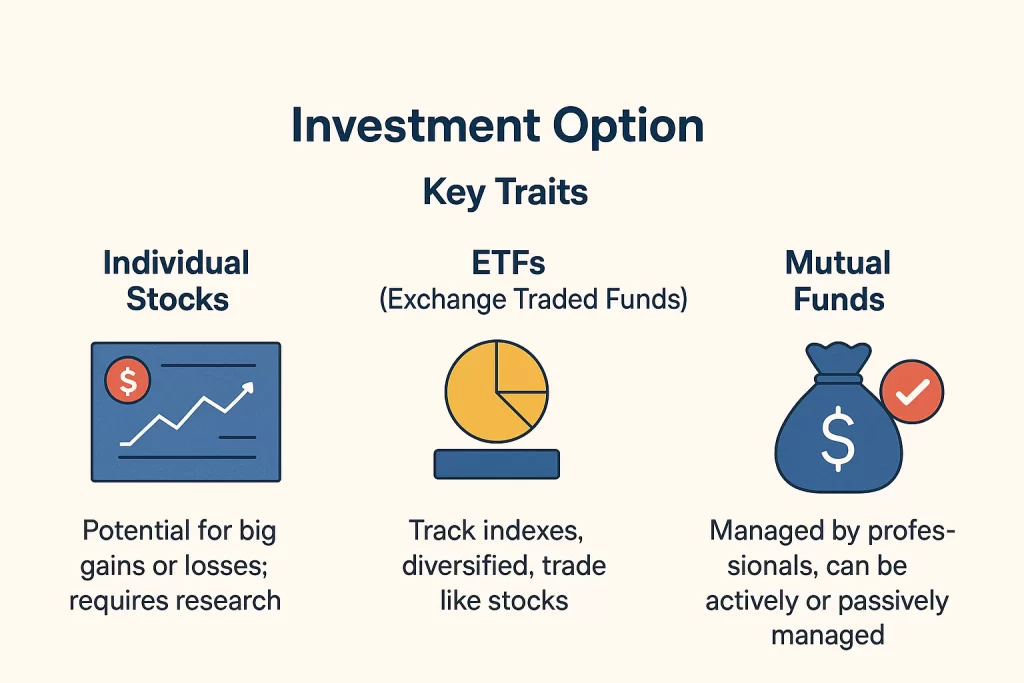
| Investment Option | Key Traits |
|---|---|
| Individual Stocks | Potential for big gains or losses; requires research |
| ETFs (Exchange Traded Funds) | Track indexes, diversified, trade like stocks |
| Mutual Funds | Managed by professionals, can be actively or passively managed |
- Dividends: Regular payments to shareholders from company profits. Not all companies pay dividends, but they can be a great source of passive income.
- Investment Apps: Many platforms (e.g., Robinhood, Webull) have made investing accessible. Easy to use, but sometimes criticized for encouraging risky behavior—be cautious and stick to your plan.
Tip: If you aren’t sure which to choose, index funds and broad-market ETFs are a smart starting point.
6. Risks and Challenges in the Stock Market
Investing always involves risk, but you can manage and reduce it by staying informed and disciplined.
- Market Volatility: Prices can swing wildly. Historical data shows that while stock prices rise over the long term, downturns are frequent and normal.
- Emotional Decisions: Panic selling when markets drop (or buying from FOMO during bull runs) is one of the biggest dangers. In my experience, remaining calm and sticking to your plan is crucial for long-term gains.
- Avoiding Common Mistakes: Don’t invest money you can’t afford to leave invested for five or more years. Avoid ‘hot stock tips’ and don’t chase short-term trends.
- Diversification: As summarised by user marketminder84 on ValuePickr: “My number one rule? Never go all-in on any single company. Look at the horror stories of people who did.”
7. Stock Market Tools and Resources
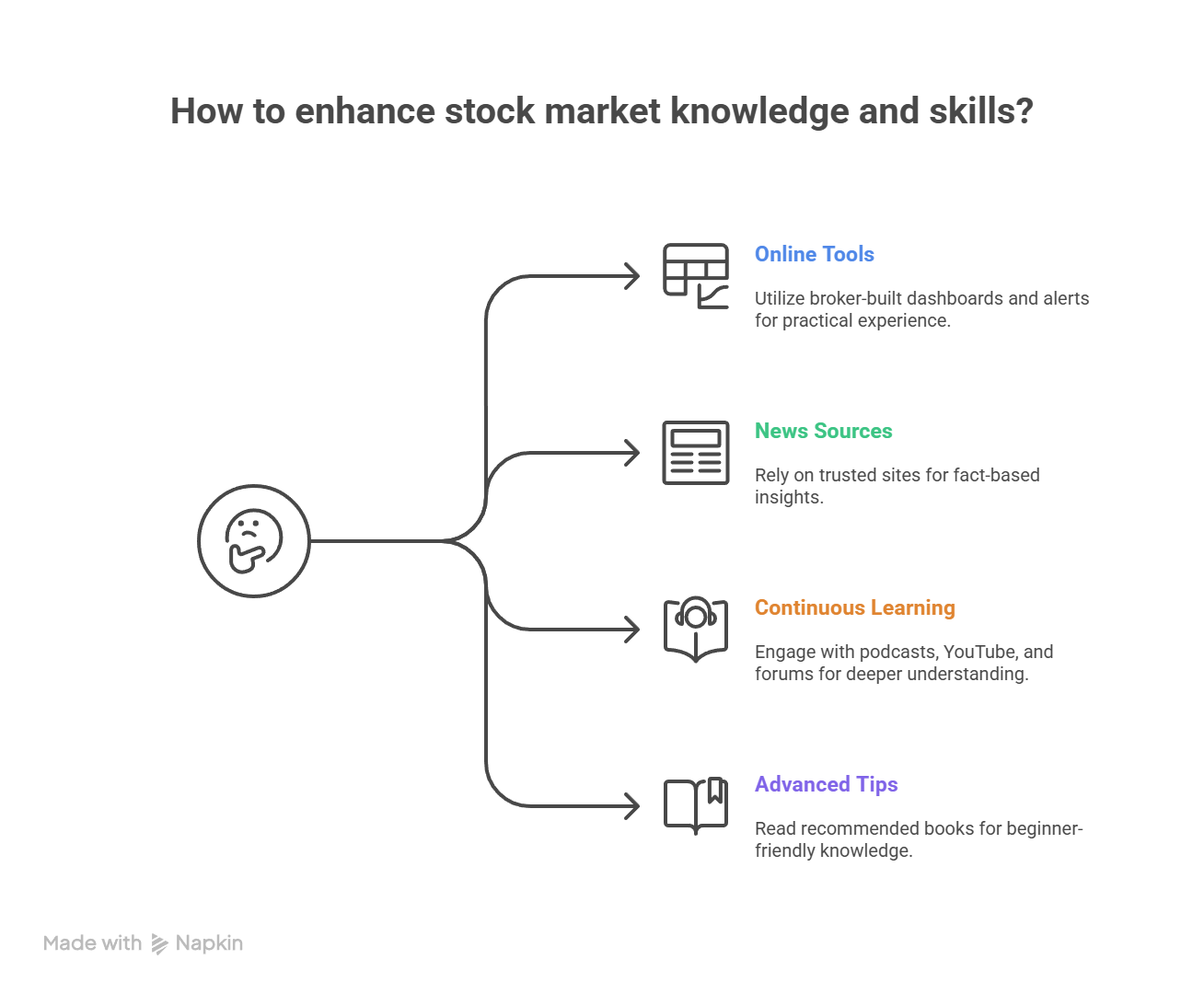
- Online Tools: Use broker-built research dashboards, price tracking alerts, and paper trading accounts for practice.
- Reliable News Sources: Trust sites like MarketWatch, Wall Street Journal, and Investopedia for fact-based insights and updates.
- Continuous Learning: Leverage podcasts, YouTube channels (e.g., Graham Stephan, The Plain Bagel), online forums (e.g., Bogleheads), and quality books to deepen your understanding.
Advanced tip: For deeper learning, the “Bogleheads’ Guide to Investing” and “The Little Book of Common Sense Investing” are exceptional beginner resources.
8. Trends and Future Outlook (2025)
The stock market is evolving rapidly, shaped by technology, new regulations, and global interconnectedness. Notable trends include:
- Fractional shares and automation: Accessibility for small investors is higher than ever. Almost every major broker now lets you buy fractions of stocks—perfect for beginners without large upfront capital.
- AI-powered investing: Robo-advisors analyze your risk and manage investments on autopilot. This technology will keep simplifying investing for new users in 2025.
- Sustainable investing: Investments focused on ESG (environmental, social, governance) factors are outpacing traditional funds, reflecting growing prioritization of ethical considerations.
- Increased focus on financial education: More platforms and schools are embedding investor literacy tools, recognizing the societal demand for responsible investing.
Fact: Index investing’s popularity—once a niche Bogleheads idea—has now made low-cost ETFs the backbone for the next generation of DIY investors.
Five Beyond-Common-Sense Facts
- Compound annual growth means even small, regular investments can snowball into major wealth over decades—starting young is more powerful than starting big.
- Even professionals rarely beat the market; S&P 500 index funds outperform most active managers after costs and taxes.
- Paper trading (simulated, risk-free investing) is a powerful way for beginners to gain real market experience—nearly every online broker offers this feature free.
- Market timing (trying to buy low, sell high) almost always underperforms steady, automated dollar-cost averaging.
- Emotional resilience and consistency matter more than IQ or advanced math. As one forum user put it, “Your temperament, not your brain, determines your net worth.”
Conclusion
Throughout my investing journey—and especially while preparing this guide for 2025—I’ve seen firsthand that the key to success isn’t outsmarting the market, but outlasting it. I began by setting clear financial goals, funding a diversified portfolio through a reliable broker, and committing to automate regular contributions over years, not weeks. By starting with index funds and gradually exploring new options as my confidence grew, I avoided costly mistakes and learned to tune out the noise of short-term volatility.
To recap, here’s the step-by-step process you should follow:
- Understand what the stock market is and how it works.
- Define your financial goals and risk tolerance.
- Open a brokerage account; select one with low fees and educational resources.
- Fund your account and start with broad-market index funds or ETFs.
- Diversify and automate contributions for consistent investing.
- Keep learning through books, trusted news, and community forums.
- Periodically review your portfolio, but resist emotional decisions.
No matter where you start, each step compounds your financial expertise and wealth-building potential. I encourage you to share your questions or first investing stories in the comments—let’s keep learning and growing together.
Appendix
Glossary of Key Stock Market Terms
- Market Capitalization: Total value of a company’s shares.
- Dividend Yield: Percentage of share price paid yearly as dividends.
- Expense Ratio: Annual cost of managing a fund, expressed as a percentage.
- Price/Earnings (P/E) Ratio: Valuation measure for comparing company stocks.
- Bull/Bear Market: Upward/downward trending market cycles.
- Recommended Books and Courses for Beginners
- “The Little Book of Common Sense Investing” by John C. Bogle
- “The Bogleheads’ Guide to Investing” by Taylor Larimore, Mel Lindauer, Michael LeBoeuf
- “A Random Walk Down Wall Street” by Burton Malkiel
- Investopedia’s Investing for Beginners Course
- Morningstar Investment Classroom