



For years, I wondered why so many smart, well-informed people lose money in the stock market. Was it just bad luck? Or was there a deeper pattern beneath the daily drama of price swings and headlines? In my own investing journey—through booms, busts, and countless late-night research sessions—I’ve realized that stock market losses are rarely random. They almost always happen for specific reasons. Understanding these recurring patterns isn’t just theory; it’s the key to long-term investing success.
Quick Summary
- Stock market losses follow predictable patterns driven by five main failure points.
- Emotional decision-making and psychological biases account for most bad investment outcomes.
- Neglecting risk management and position sizing amplifies minor mistakes into account-destroying losses.
- Overconfidence often leads to overtrading, compounding costs and magnifying risks.
- Execution gaps between trading plans and real trades frequently derail even good strategies.
- Unrealistic expectations and lack of education set investors up for disappointment and quit rates above 80% within two years.
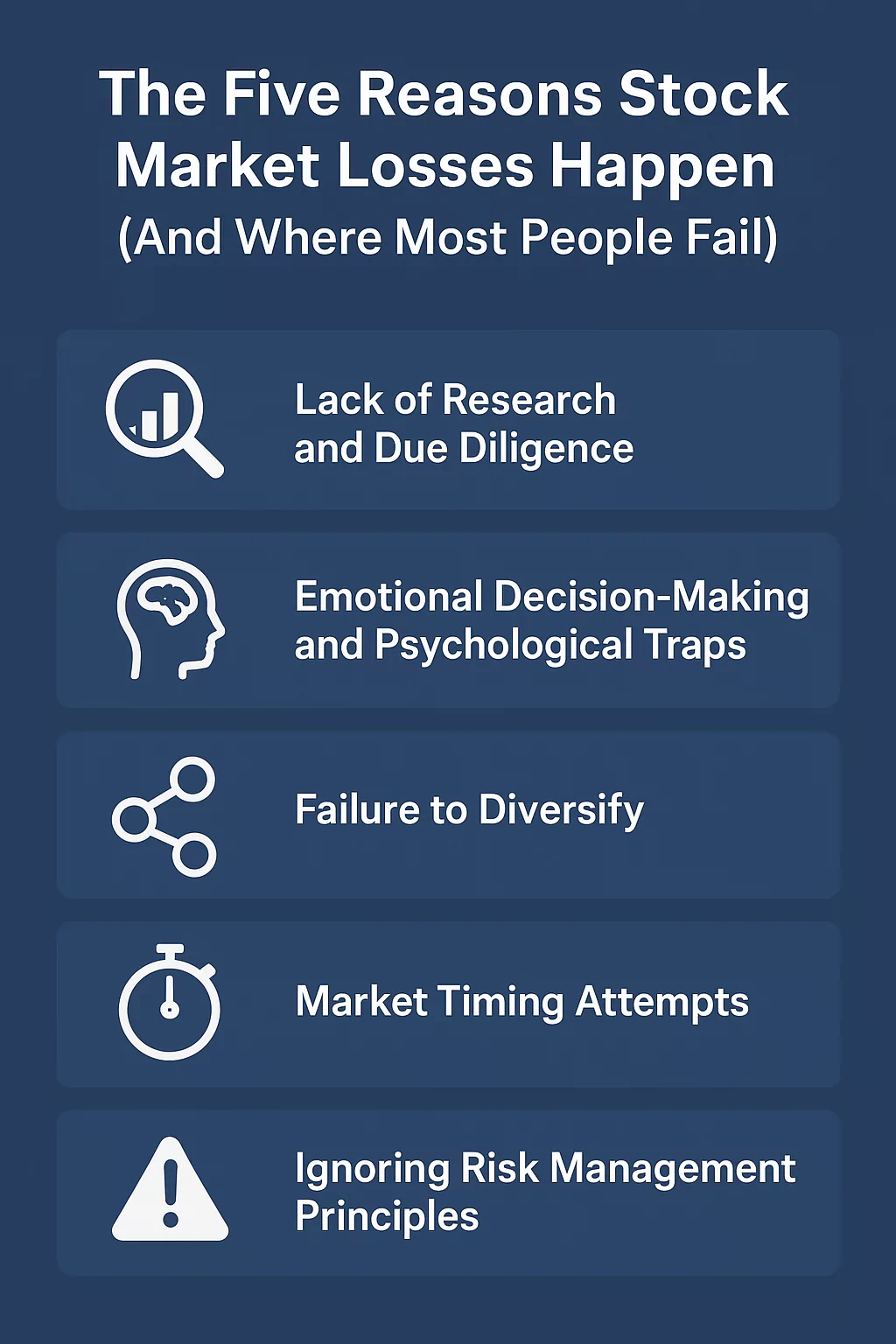
The Five Reasons Stock Market Losses Happen (And Where Most People Fail)
1. Lack of Research and Due Diligence
One of the most common—and costly—mistakes I see is jumping into trades or investments without truly understanding the company, the market, or the risks. Far too many investors rely on hearsay or follow tips from social media and forums without independently verifying facts.
In discussions on platforms like Reddit’s r/stocks, users consistently warn against “chasing the crowd.” For example, u/ValueSeeker wrote: “My worst losses came from taking hot tips at face value instead of digging into the numbers myself.” Academic analysis backs this up: over 80% of retail investors admit to trading stocks they barely researched, leading to systematic underperformance.
Consider famous cases like Enron or more recent meme stocks. Relying on surface-level narratives, many investors lost money ignoring red flags that diligent research would’ve revealed.
- Key takeaway: Dig deeper than headlines. Always verify company fundamentals, management quality, market position, and valuation before committing money.
2. Emotional Decision-Making and Psychological Traps
In my experience, the greatest danger isn’t the market—it’s our own minds. Studies and real trading diaries show that emotions drive up to 80% of investor mistakes. Psychology is the invisible force shaping market cycles. Fear of missing out (FOMO) during rallies, panic selling in market corrections, and the delusion that “this time it’s different” trap even seasoned investors.
Common biases include overconfidence, loss aversion, herd mentality, and confirmation bias. A Wall Street Oasis user shared, “It’s amazing how quickly you can go from calm to reckless. One big loss at 3AM, and all discipline was gone—just chasing, hoping, swinging bigger.”
Behavioral economists found that people are wired to sell winners too quickly and hold onto losers, hoping they’ll bounce back. This “disposition effect” eats into overall returns year after year. (You can learn more about these biases from this guide to behavioral biases in investing.)
- Tip: Use tools like investment checklists, journaling, and pre-set trading rules to distance yourself from gut reactions.
Failure to Diversify
Diversification is not just financial jargon—it’s the bedrock of risk management. When people concentrate too much money in one stock or sector, they’re exposing themselves to unpredictable events that can wipe out years of gains overnight.
According to a review by Saxo Bank, portfolios focused on just 1-2 stocks had 4x greater drawdowns during market turmoil than diversified baskets. Yet surveys show most DIY investors hold only a handful of positions.
| Non-Diversified Portfolio | Diversified Portfolio |
| Few stocks, higher risk | Spread across sectors, lower risk |
| More volatile returns | Smoother returns, shocks isolated |
If you want to build a resilient portfolio, study real-world diversification principles and ensure you’re not betting big on a single idea.
3. Market Timing Attempts
The dream of buying low and selling high seduces countless investors into endless cycles of switching strategies, jumping in and out of markets, or trying to predict the next big move. Yet all the data—from academic papers to personal trader confessions—proves that market timing is almost always a losing proposition.
Studies on brokerage accounts by University of California researchers found that frequent traders earned consistently lower returns than those who bought and held. Why? Emotions cloud judgement, transaction costs add up, and missing a handful of the best days in the market devastates long-term returns.
As one seasoned Redditor, u/CautiousTurtle, put it: “Every time I tried to time the market, I ended up chasing recoveries or selling at lows. My best results came from holding through the noise.”
- Advice: Focus on long-term investing, dollar-cost averaging, and sticking to fundamentally solid holdings instead of calling tops and bottoms.
4. Ignoring Risk Management Principles
Without risk controls, all investors—regardless of experience—are vulnerable to devastating losses. The math is brutal: lose 50% and you need a 100% gain to break even. This reality kills many trading accounts before skills can be honed.
Research from Tradeciety and proprietary trading firms agrees that successful traders rarely risk more than 1-2% per position. In dramatic contrast, failing traders often bet 10% or more—sometimes everything—on a single trade. A real-life forum story illustrates this: “I convinced myself I couldn’t lose. When the trade turned, I just kept doubling down. The margin call ended it.”
Simple habits—like using stop-loss orders, position size limits, and periodic portfolio reviews—act as seatbelts on the emotional roller coaster of markets. See more detailed risk-control approaches at Investopedia’s risk management guide.
Advanced Insights: Beyond Common Sense
- The “performance gap” is real: Most traders who fail don’t lack good strategies—they lack discipline to execute their plans consistently in real time, especially under pressure.
- Leverage is a stealth killer: Even modest borrowing (margin) drastically increases loss severity and can put accounts in unrecoverable holes with just one or two bad trades.
- Social validation is hazardous: Public success or viral trading wins often propel risky behavior as traders chase more recognition, leading to sharp reversals and drawdowns.
- Recovery math works against you: The bigger the loss, the harder it is to bounce back—this is why early, small mistakes must be limited mercilessly.
- Education and expectations are misaligned: Most people underestimate the years of study and practice required to reach consistency; even at elite trading firms, less than 5% of new hires succeed after extensive mentorship and capital access.
Step-by-Step Troubleshooting: How I Overcame the Five Failure Points
Looking back, every time I’ve blown up an account or made a serious mistake, it traced back to one of these five traps. Here’s how I addressed them:
- I set up a research and review ritual. Before every trade, I force myself to answer: What’s the company’s real edge? What risks am I ignoring?
- I journal emotions and trading decisions. If I notice impulsiveness—an urge to “win it all back”—I walk away from screens for a set period.
- My portfolio holds at least 20-30 securities across industries plus a mix of asset classes, not just stocks. I rebalance twice a year to maintain discipline.
- I never try to time the entire market. Instead, I add money regularly and review performance only quarterly, not daily.
- Every position has a pre-set dollar risk (never more than 2%), with stop-loss orders in place. I consider each trade’s impact on my entire net worth, not just the account it’s in.
By embedding these habits, my losses became both smaller and less frequent. More importantly, the stress and emotional swings dropped dramatically.
Additional Resources
- Why 95% of traders fail (Tradeciety)
- Smart investing mindset (Fidelity)
- Psychology of Trading (BabyPips)
- “Secrets of the Street” by Andrew Menaker
- Behavioral biases explained (Investopedia)
Conclusion
In my own journey as both an investor and a student of markets, I’ve learned the hard way that stock market losses almost always have a root cause. They don’t happen by accident—they’re the result of skipped research, emotional hijacking, neglecting diversification or risk management, getting lost in market timing traps, or simply lacking the foundational education. The pattern repeats: those who ignore these truths quit, while those who confront and fix them endure.
If you follow the step-by-step troubleshooting above—starting with honest self-assessment, building a research process, imposing emotional guardrails, truly diversifying, resisting the urge to time every move, and treating risk management as non-negotiable—you’ll shift the odds in your favor. It took me years to internalize these lessons, but now, facing market volatility brings far less anxiety and far more opportunity.
Are you seeing these failure points in your own investing story? What’s worked—and what hasn’t—when tackling these challenges? I’d love to hear your comments below, or your own hard-won lessons. Let’s help each other get better, one trade and one decision at a time.