


Understanding the stock market can seem daunting at first. When I started exploring investing, the maze of terminology, platforms, and processes felt overwhelming. That’s why I’m breaking down how the stock market works through its 5 key mechanisms — explained with a step-by-step approach designed for clarity. Whether you’re a curious newcomer or an aspiring investor, understanding these mechanisms will give you a solid foundation and greater confidence as you enter the world of stocks.
Quick Summary
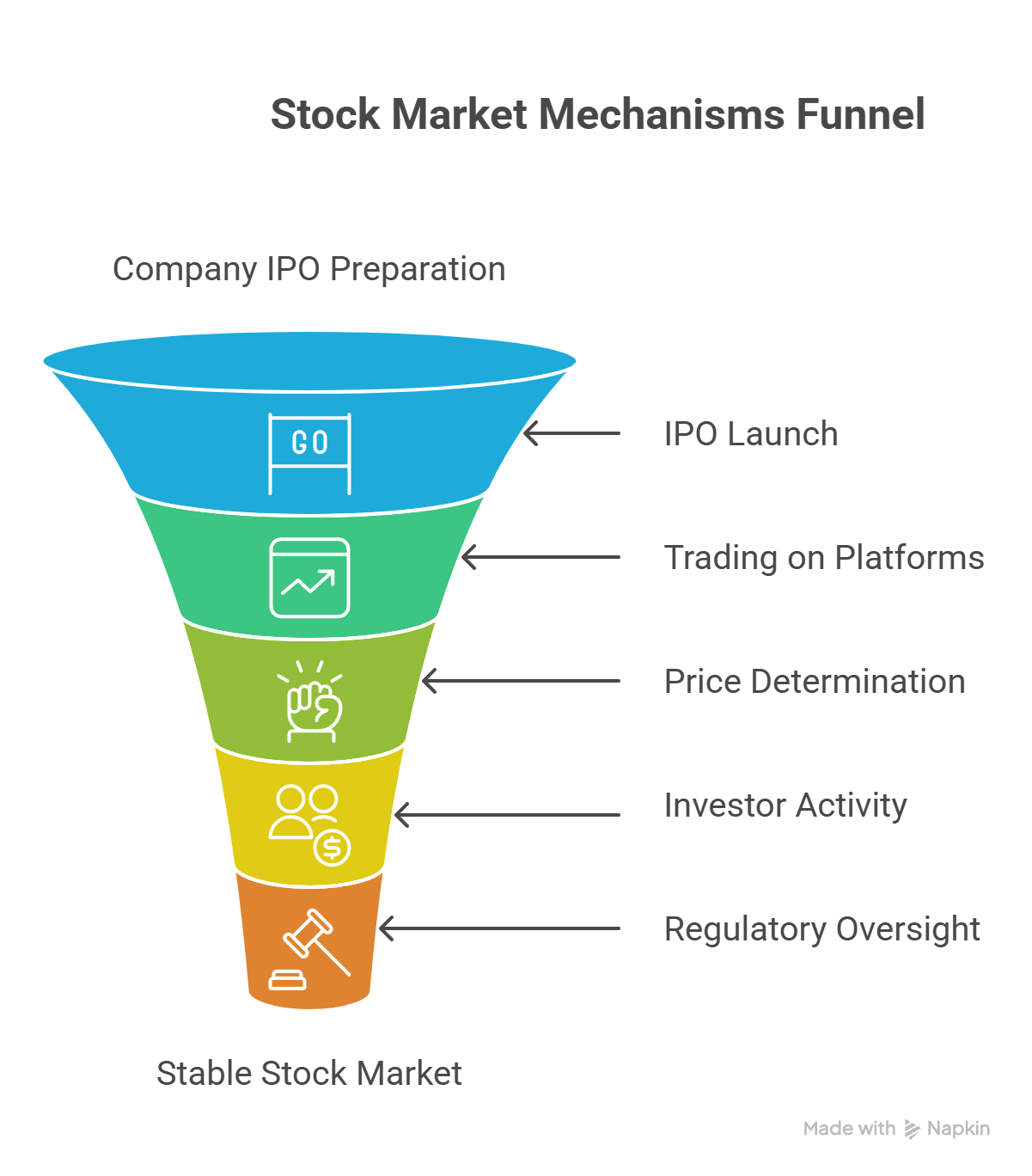
- The stock market operates via five interconnected mechanisms: IPOs, trading platforms, supply and demand pricing, investor activity, and regulatory oversight.
- IPOs open the doors for companies to become publicly traded, raising capital and offering shares to the public.
- Stock exchanges and modern digital platforms enable seamless buying and selling of stocks worldwide.
- Stock prices are set by supply and demand, influenced by company and market factors.
- Diverse market participants — from retail investors to market makers — drive daily trading activity.
- Regulatory bodies enforce rules and protect investor interests, ensuring the market remains fair and orderly.
1. Initial Public Offerings (IPOs)
An Initial Public Offering (IPO) is how a private company becomes publicly traded on the stock market. Through an IPO, a business issues shares to the public for the first time, allowing everyday investors to own a piece of the company.
- Preparation & Due Diligence: The company evaluates its readiness for public investment and partners with investment banks for guidance.
- Registration: The company files detailed disclosures (like the prospectus) with regulatory bodies, ensuring transparency for potential investors.
- Marketing (Roadshow): Management meets with institutional investors to build interest and gauge demand for the shares.
- Pricing: The final IPO share price is set, balancing what investors are willing to pay and the company’s capital needs.
- Launch: Shares begin trading publicly on a chosen stock exchange, marking the company’s official entry into the public market.
According to the NerdWallet investing guide, investment banks play a vital role here, sponsoring the IPO, underwriting shares, and facilitating the initial sale. This step allows the company to raise significant funds for expansion while enabling investors to buy into future growth.
2. Stock Exchanges and Trading Platforms
Stock exchanges — like the New York Stock Exchange (NYSE) and NASDAQ — are sophisticated networks where software matches buyers and sellers almost instantaneously.
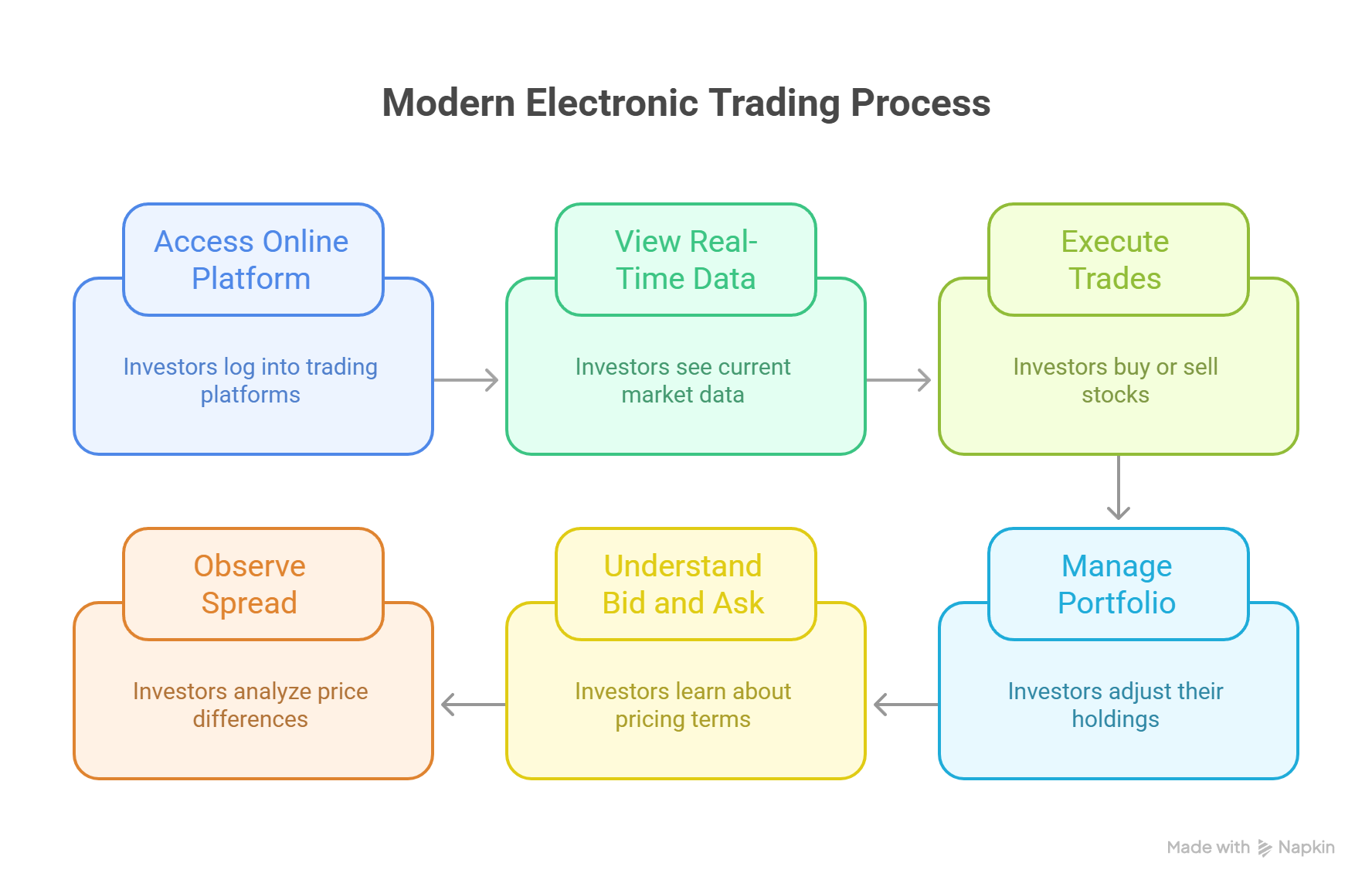
Modern trading happens almost entirely electronically. Through online trading platforms, investors can access real-time data, execute trades, and manage portfolios with a few clicks. Terms like bid (buyer’s offer), ask (seller’s request), and spread (the difference) are crucial to understanding how orders get filled. These are visible on most broker dashboards, helping you see the best available prices for any stock.
- Exchanges provide transparency, liquidity, and safety, ensuring trades are executed efficiently.
- Trading platforms level the playing field, making stock market participation accessible to everyone.
As explained in the NerdWallet overview, these platforms handle billions of dollars in trades daily, from tiny retail orders to multimillion-dollar institutional transactions.
3. The Role of Supply and Demand in Stock Pricing
The price of every stock is set by supply and demand — a constant tug-of-war between buyers and sellers. When demand for a stock increases (perhaps the company reports stellar earnings), its price climbs as buyers are willing to pay more. Conversely, if demand wanes or more shareholders try to sell, the price falls.
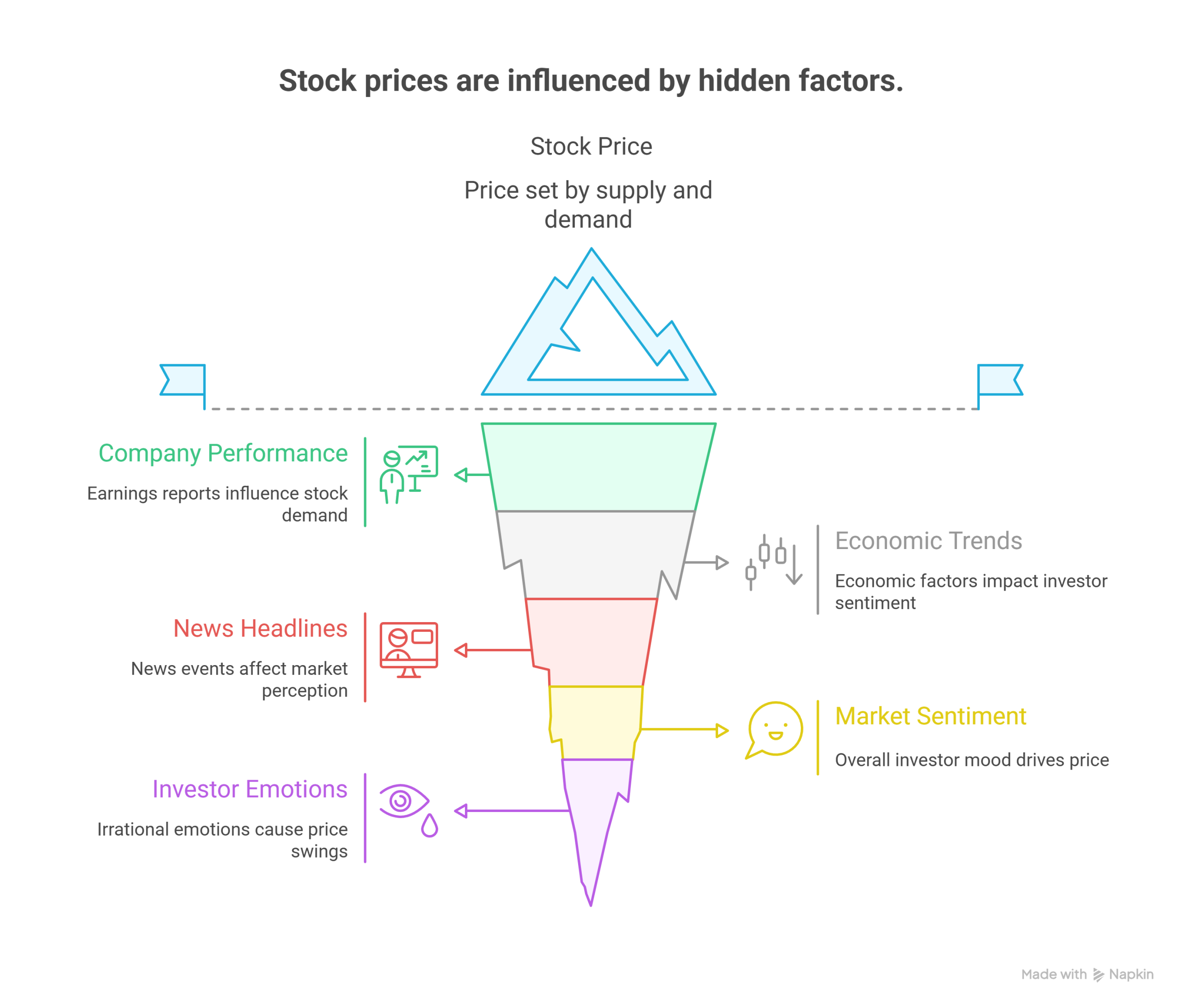
- Factors Influencing Supply & Demand: Company performance, economic trends, news headlines, and overall market sentiment all play a part.
- Market Capitalization: This simple calculation (stock price times shares outstanding) signals a company’s size and importance in the market index.
It’s important to note — as academic research points out (source) — that investor emotions often drive prices in the short term, creating swings that don’t always reflect a company’s true value.
- Pro Insight: On various financial forums, users often share how “irrational” market spikes or crashes can open up unexpected investment opportunities — highlighting both the risks and the benefits of volatility.
4. Investors and Market Participants
I’ve found that the heartbeat of the stock market comes from its diverse mix of participants:
- Retail investors: Everyday individuals investing for goals like retirement or wealth-building.
- Institutional investors: Large entities (pension funds, mutual funds) that move massive amounts of capital.
- Market makers: Entities ensuring there’s always a buyer and seller for every trade, maintaining liquidity.
- Brokers: The middlemen (or digital platforms) enabling access, order execution, and portfolio management.

Each participant’s actions — whether buying, selling, or holding — constantly reshape prices and market dynamics. As one Reddit user, ValueTrader2024, remarked: “Watching institutional trades at market open gives small investors insight into which stocks might trend that day. Their volume is just that significant.”
- For most beginners, understanding the motives of different market participants is essential to interpreting market moves and forming smart strategies.
5. Regulation and Market Oversight
The entire system is overseen by government agencies (like the SEC in the United States) and self-regulatory organizations. Their mission is to guard against fraud, ensure transparency, and keep the market running smoothly.
- Regulations: Require companies to provide truthful information, enforce fair trading, and protect investors from unethical practices.
- Oversight: Monitors volumes, investigates unusual movements, and can halt trading during panic or technical problems to prevent chaos.
From my research and investing experience, regulatory oversight may seem like a behind-the-scenes detail, but it’s absolutely critical. It builds trust and creates a foundation for long-term wealth creation — for individuals and the broader economy alike.
Advanced Insights: 5 Beyond-Common-Sense Facts
- Stock exchanges have shifted almost entirely to algorithmic, electronic matching engines, eliminating much of the old-school “shouting on the trading floor.”
- Behavioral biases — like fear of missing out (FOMO) or herd mentality — often dominate short-term price swings, providing both risk and opportunity for savvy investors.
- Most IPO shares go to large institutional investors before retail buyers can access them on public markets, influencing initial price volatility.
- The “bid-ask spread” can serve as a hidden transaction cost, especially for less-liquid stocks, occasionally eating into investor returns more than visible fees.
- Market regulations don’t just protect investors; they also help prevent systemic risks that could undermine entire economies — as seen by new rules introduced after the 2008 financial crisis.
Table: Key Mechanisms and Their Functions (Comparison)
| Mechanism | Main Function in Stock Market |
|---|---|
| IPO Process | Allows companies to raise capital and transition to public ownership |
| Trading Platforms | Provide access, liquidity, and efficient trade execution |
| Supply & Demand Pricing | Determines real-time stock prices through constant negotiation |
| Investor Participants | Drive market activity through varied buying and selling behaviors |
| Regulation & Oversight | Ensures transparency, fairness, and financial system stability |
Conclusion
When I reflect on my own journey to understanding the stock market, grasping these 5 key mechanisms was a real turning point. Knowing how companies go public through IPOs, how trades are executed on powerful digital platforms, how prices are shaped by collective psychology and economic data, the essential roles of each market participant, and the protective safeguards of regulatory bodies — all these steps add up to a system that, while complex, can be navigated with confidence.
Here’s a recap of the process: Companies launch IPOs to open the door to public investment. Trades happen on exchanges and digital platforms, matching buyers and sellers. Prices move based on supply and demand, with every participant’s order influencing the market. All of this is monitored under strict regulatory oversight to ensure fairness for everyone involved. If you’re just starting out, focus on understanding each mechanism — one by one — and how they connect to the bigger picture.
If you’d like more detail on any step or want to share your own experience, please leave a comment below or reach out directly. The more you learn, the better positioned you’ll be to make smart investment decisions in the future!