

If there’s one lesson I’ve learned in my investing journey, it’s that success in the stock market depends less on luck and more on having a clear, well-reasoned plan. Far too many investors dive in chasing quick returns, only to end up confused or disappointed. That’s why, whether you’re a beginner or someone looking to refine your approach, developing a strong stock market investment strategy is essential. In this article, I’ll break down the exact seven steps that helped me—and countless others—move from scattered stock picks to disciplined, goal-driven investing. By following this guide, you’re not just reacting to the market; you’re taking control of your financial future with clarity and confidence. Let’s walk through how you can craft a step-by-step plan that actually fits your goals, risk comfort, and learning style—and stick to it, even when the market gets noisy.
Quick Summary
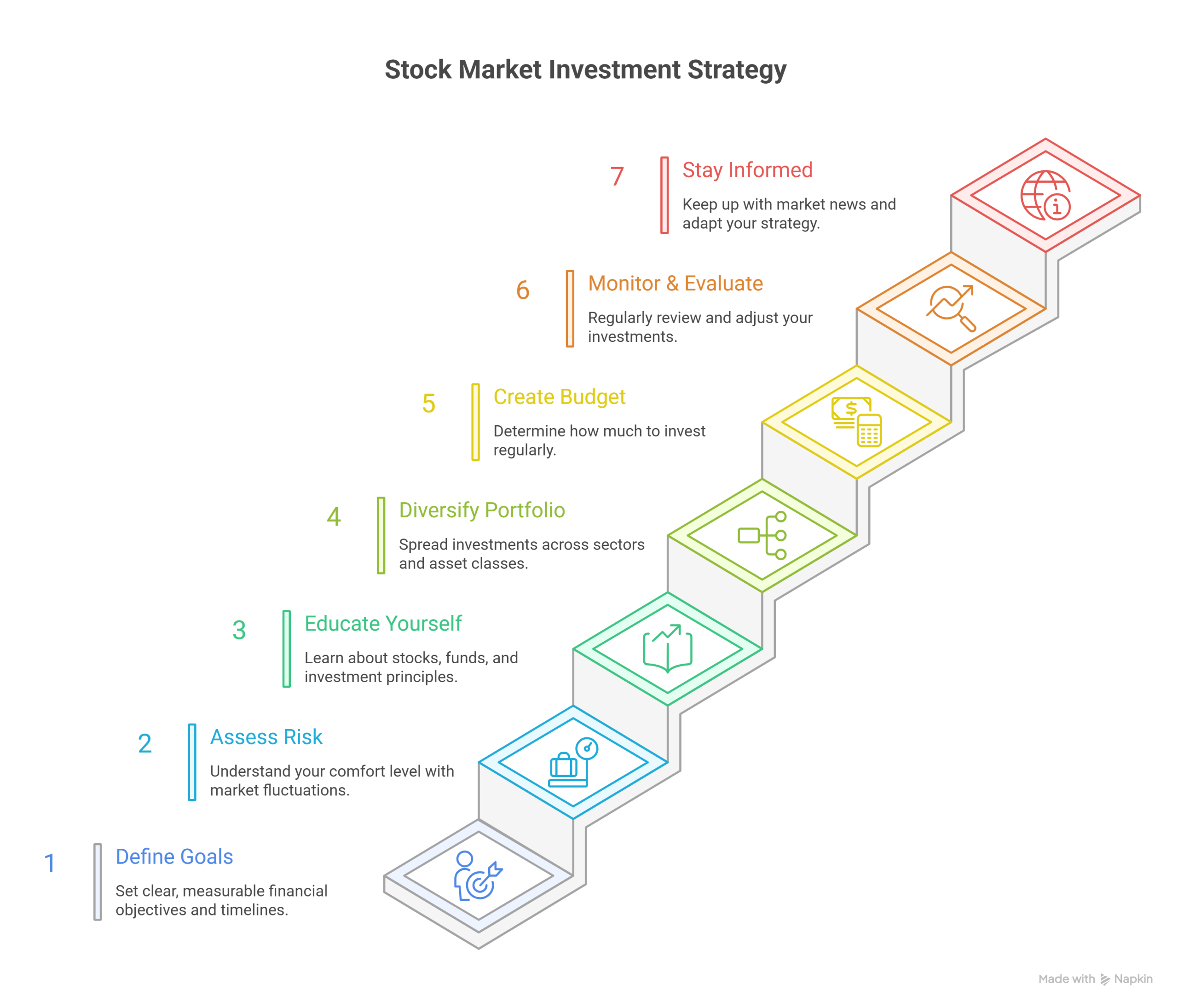
- Start by setting clear, measurable financial goals and timelines for your investments.
- Understand and honestly assess your personal risk tolerance.
- Educate yourself on stocks, funds, and basic investment principles.
- Diversify your portfolio across sectors and asset classes for better risk-adjusted returns.
- Decide on a realistic investment budget and consider automating with consistent deposits.
- Commit to regularly monitoring and rebalancing your portfolio without overreacting.
- Stay informed and flexible—continually refine your strategy as you learn and markets change.
Step 1: Define Your Investment Goals
Every successful stock market investment strategy starts with defining your investment goals. This isn’t just about saying, “I want to get rich”—it’s about being specific, realistic, and time-bound. Ask yourself: Are you investing for retirement, a large purchase like a home, or to fund a child’s education? Split your goals into short-term (1-3 years), medium-term (3-10 years), and long-term (10+ years).
As ValuePickr user prash.pera shared after analyzing their own journey: “Clarity is power. Only when I put numbers and timelines against my goals did my investing start to make sense” (ValuePickr forum).
- Write down each goal with a target amount and due date (e.g., $50,000 for a home down payment in 5 years).
- Understand how these goals impact your required investment returns and time horizon.
Step 2: Assess Your Risk Tolerance
Not everyone is wired the same when it comes to losing (or gaining) money. Risk tolerance reflects both your financial capacity to take losses and your emotional comfort with market ups and downs. Consider factors like your age, steady income, family obligations, and life stage. Many online questionnaires—like the ones on Bogleheads or SmartAsset—offer a gentle, structured way to assess yourself, but listen to your gut too.
Redditor u/OldSchoolCyrus nailed it: “Took me years and a few panic sells to accept: it’s easy to say I’m ‘aggressive’ until the market drops 20%. Only then you know your true risk tolerance.”
- If you lose sleep during market dips, a conservative portfolio might be best.
- Younger investors with long horizons can typically absorb more volatility; those nearing retirement might focus on preservation.
Step 3: Educate Yourself on Investment Options
Understanding what you’re investing in is critical. Start with the basics: individual stocks, ETFs, mutual funds, and index funds. Learn the key concepts—like what “diversification,” “expense ratio,” and “market cap” mean. It helps to dedicate a few hours a week to financial education through books (such as “The Bogleheads’ Guide to Investing”), trusted sites (like Bogleheads, Investopedia, or BabyPips for trading strategies), and YouTube channels focused on long-term investing, not hype.
One BabyPips forum member emphasized: “The best thing any trader or investor can do is keep learning. Even after a year, you’re still just getting started.”
- Make a list of reputable resources and set a schedule for ongoing education.
- Consider joining online communities for honest, real-world advice—but filter out noise and hype.
Step 4: Develop a Diversified Portfolio
Diversification is the classic way to reduce risk. This means spreading investments across different asset classes (stocks, bonds, perhaps real estate) and sectors (technology, healthcare, energy, etc.). The Bogleheads’ three-fund portfolio—U.S. stocks, international stocks, and bonds—remains a time-tested approach.
Redditor u/Dividend_Larry put it bluntly: “My biggest lesson? Putting all my money in tech stocks made my portfolio roller-coaster ride way too wild. Once I diversified, I slept better and stopped checking prices every hour.”
- Allocate your money using ratios (e.g., 60% stocks, 40% bonds).
- Within stocks, vary by both sector and geography.
- Rebalance periodically to maintain your target mix.
| Single-Stock Investing | Three-Fund Diversified Portfolio |
| High risk, potential for outsized gains/losses; difficult for non-experts | Lower volatility; easier to manage; suitable for most investors per Bogleheads |
Step 5: Create an Investment Budget
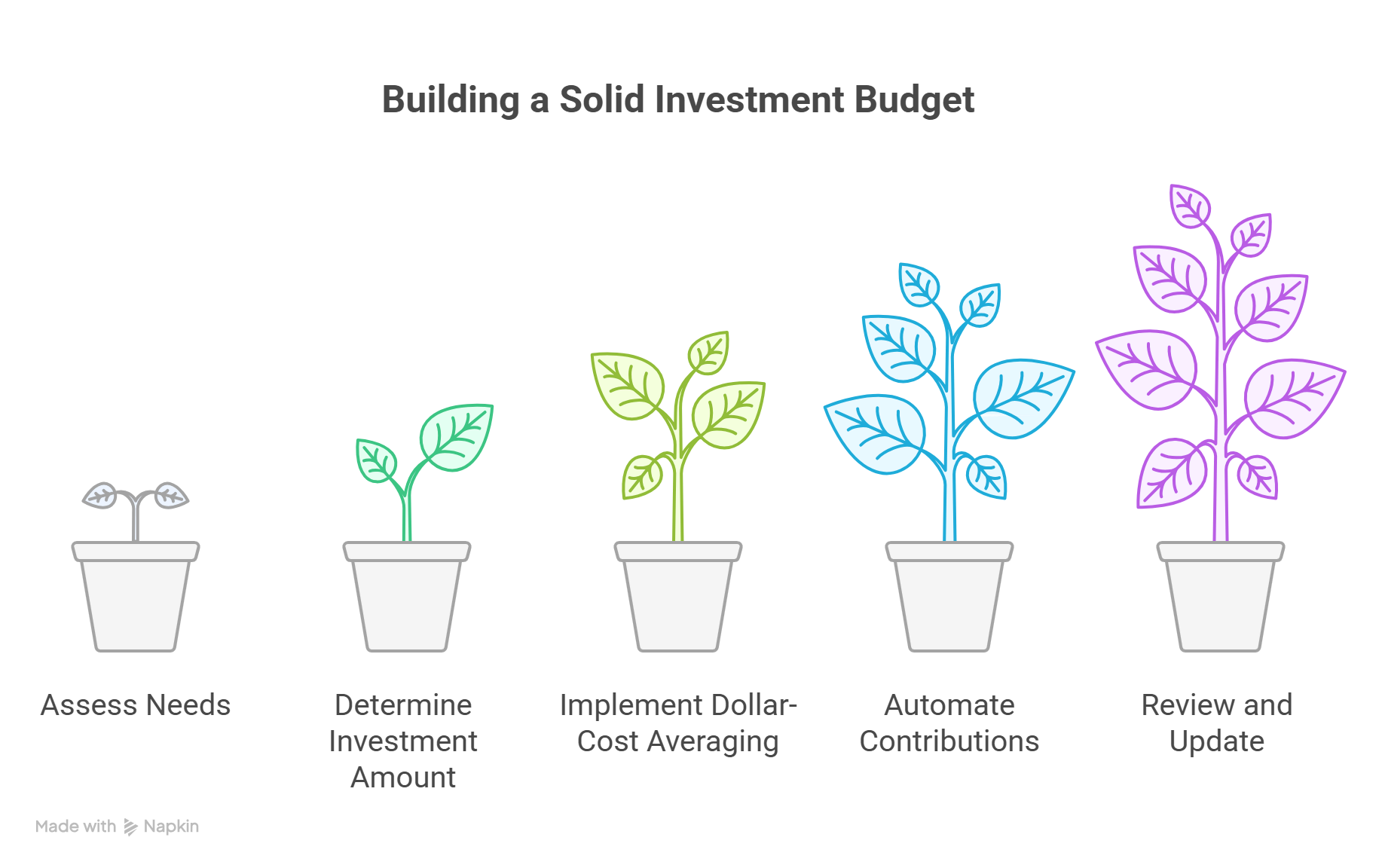
It’s exciting to start investing, but never neglect your basic needs or emergency fund. Decide how much you can realistically invest each month—after bills, minimum debt payments, and essential savings. Some investors use dollar-cost averaging: investing the same dollar amount at regular intervals, regardless of market conditions, to smooth out volatility and avoid trying to ‘time’ the market.
Bogleheads frequently say, “Investing is a marathon, not a sprint. It’s better to chip in $200 every month for years than throw in $5,000 once and quit.”
- Automate your contributions to remove emotion and inconsistency.
- Review and update your budget annually or after major life changes.
Step 6: Establish a Routine for Monitoring and Evaluation
Develop a simple system to review your investments—quarterly or semiannually is plenty for most long-term investors. Use spreadsheets, broker dashboards, or apps to check your asset allocation, returns, and progress toward goals. Avoid the temptation to micromanage; excessive fiddling is the enemy of discipline.
On the ValuePickr forum, one investor shared, “My worst moves came from panic checking and selling during 2020’s crash. Since then, I only review in-depth once a quarter and stick to my plan.”
- Set specific dates for portfolio reviews and rebalancing.
- Watch for big drifts from your asset allocation and adjust calmly—not reactively.
- Track key indicators: are you on pace for your target? Are costs in check?
Step 7: Stay Informed and Adjust Your Plan as Needed
The market changes, and so does life—so your plan isn’t “one and done.” Stay up to date with market news from reliable sources (The Wall Street Journal, Bogleheads news threads, etc.), but avoid getting swept up by daily drama. Make adjustments thoughtfully, only when your goals, risk profile, or external circumstances meaningfully change. Continuous learning—through podcasts, books, or community discussions—keeps your strategy resilient and relevant.
As Redditor u/MarketMindset wrote: “What separated my early mistakes from later wins was being willing to admit something wasn’t working and tweak my strategy—not flip-flop every week, but also not stay stuck out of stubbornness.”
- Revisit your goals, risk tolerance, and allocation at least once a year.
- Adapt calmly as your confidence, knowledge, or needs evolve—steady tweaks, not wild jumps.
Beyond-Common-Sense Insights
- Community wisdom matters: Active participation in forums (like Bogleheads or ValuePickr) can dramatically accelerate your learning curve and help you avoid classic blunders, as shown by real user journeys.
- Simple strategies work best: The widely used three-fund portfolio outperforms most actively managed accounts, especially for hands-off investors, with less stress and fewer mistakes.
- Behavior beats analysis: How you handle fear and greed matters more than your ability to pick the next hot stock—emotional discipline trumps detailed stock research.
- Diversification isn’t just about more stocks: True diversification includes spreading money across asset types, sectors, and global regions—not just increasing the number of U.S. stocks.
- The ‘perfect’ plan evolves: Some of the best investors, such as those chronicling 10+ year journeys in forums, credit their success to adapting strategies mindfully, rather than sticking rigidly to outdated plans.
Conclusion
Looking back on my own path, every big step forward in my investing success came from slowing down, getting honest about my goals and comfort with risk, and sticking to a clear process. As we’ve covered, there are seven concrete steps to building a robust stock market investment strategy: get specific about your goals, know your real risk profile, educate yourself, diversify intentionally, invest within your means, create a repeatable monitoring routine, and continually stay informed and flexible.
It’s not about chasing the perfect stock or outsmarting the market. It’s about aligning your plan with your real-life needs, managing your behavior, and letting compounding do its quiet magic. If you take the time to follow these seven steps, you’ll not only reduce stress but also give yourself the best possible shot at meeting your financial goals—whatever those look like for you.
I’d love to hear about your experiences and questions as you work through these steps. What’s been your biggest investing lesson, or where do you get stuck? Leave a comment below and let’s build a smarter, more supportive investment community together!