

Stock market volatility is something that every investor encounters, whether you have years of experience or are just getting started. For me, understanding and managing these sometimes wild price swings is not just an academic exercise—it’s a vital part of preserving and growing my portfolio over time. If you’re like me, you’ve probably felt that gut-punch when markets tumble, and maybe the thrill when they surge. The key is managing those ups and downs wisely so they don’t take control of your long-term investment goals.
In this article, I’ll share five evidence-backed methods for effective stock market volatility management, blending real-world experiences from seasoned investors on Reddit and financial forums, with hard data and academic research. My aim is to arm you with actionable steps that go beyond theory, so you can confidently handle market turbulence.
Quick summary
- Diversification spreads risk across different assets, reducing the impact of any single loser.
- Dollar-cost averaging smooths out your entry points and lowers the danger of a poorly-timed investment.
- Options-based hedging (like protective puts or collars) lets you insure your portfolio against sharp downturns.
- Systematic stop-losses help prevent severe losses by enforcing discipline—especially when emotions run high.
- Staying informed and rational curbs panic selling and helps you act on facts, not fear.
Understanding Stock Market Volatility
Stock market volatility describes the frequency and magnitude of price swings in stocks or broader indexes. While some volatility is a healthy sign of an active market, extreme or sustained volatility can test even the toughest investor’s resolve. As Bogleheads user MacroInvestor put it, “The price discovery of the market is the aggregate wisdom of many players, all of whom think they have some good ideas about the future and all of their ideas are different. Most of them are wrong, but in aggregate, we find the equilibrium price.”
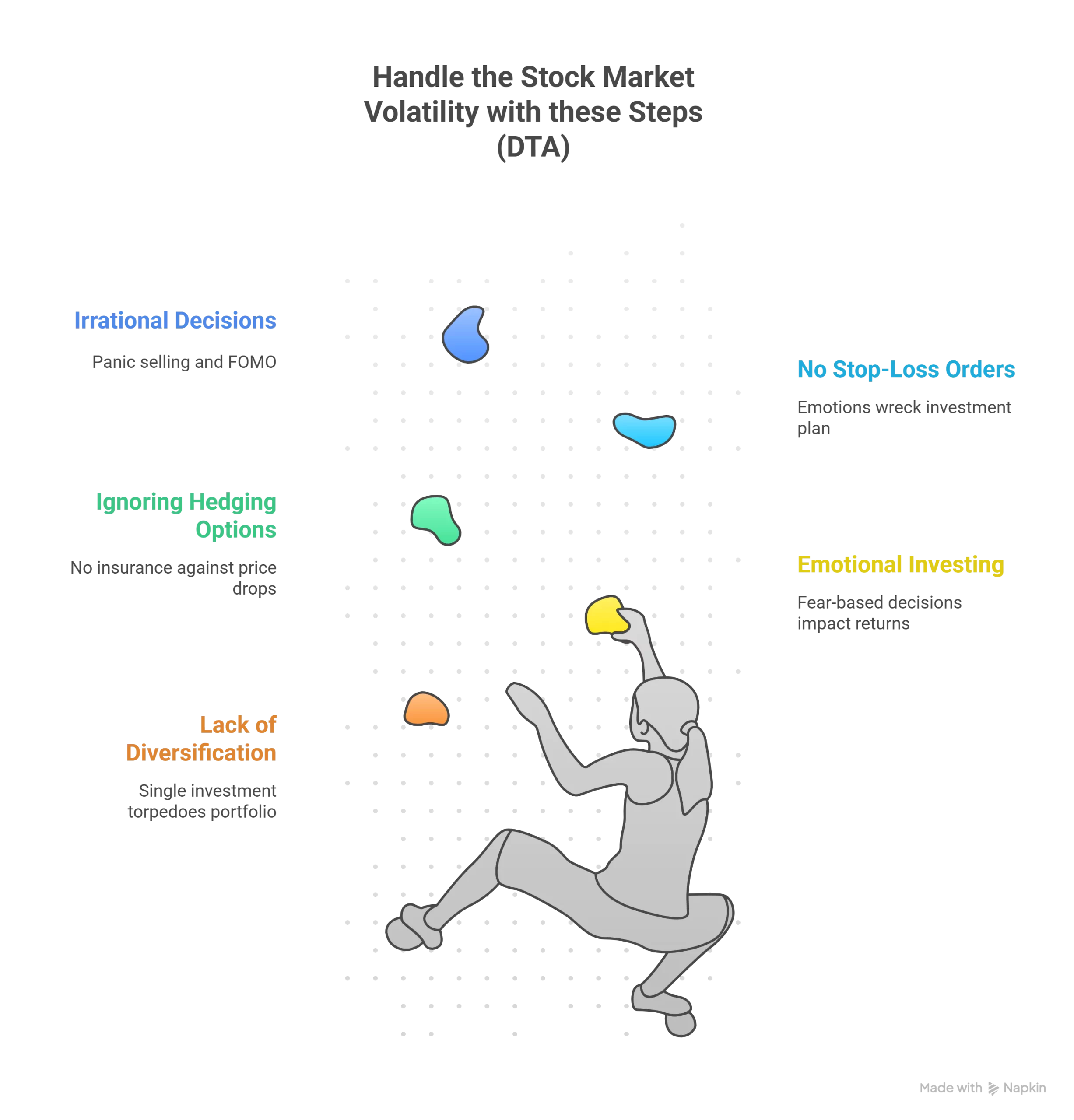
Modern markets are influenced by a cocktail of human emotion, algorithmic trading, and rapid, global information flows. This sometimes creates what user taxguy described as “programs that play fear and greed for optimal gain.” That’s why today’s volatility often looks more exaggerated than the underlying economic news might suggest. Understanding the psychological triggers and mechanical factors behind these price moves sets the foundation for all robust volatility management techniques.
Method 1: Diversification – The Bedrock of Risk Management
Diversification is a tried-and-true risk management method—like investing’s “don’t put all your eggs in one basket.” By spreading your investments across multiple asset classes, sectors, and regions, you reduce the risk of a single investment torpedoing your whole portfolio. On forums, users consistently cite this as the #1 tool for smoothing returns and sleeping better at night. As one Redditor put it, “Once I added bonds and some REITs, the gut-wrenching swings in my account dropped a lot.”
- Own a mix of stocks, bonds, real estate, and even some cash or commodities.
- Don’t let any single stock or sector dominate your holdings. Fidelity suggests keeping any single stock below 5% of your portfolio.
- Use broad-based ETFs for easy, instant diversification without overcomplicating your investment strategy.
- Consider international exposure—global markets often don’t move in lockstep.
During the 2008–2009 bear market, diversified portfolios generally fell much less than all-equity strategies, and recovered faster, according to Vanguard’s research. For easy, hands-off diversification, consider model portfolios or all-in-one funds—just make sure to periodically review them, since markets shift over time.
Benefits & Pitfalls Table
| Benefits | Common Pitfalls |
|---|---|
| Reduces risk of catastrophic loss | Smoother returns | Less stress during downturns | Over-diversification (too many holdings to track) | Ignoring correlations during crisis periods |
Method 2: Dollar-Cost Averaging for Emotional Discipline
Dollar-cost averaging (DCA) is one of my favorite “autopilot” approaches to volatility. You invest a fixed amount of money at set intervals (say, monthly), regardless of whether prices are up or down. This means you buy more shares when prices are low and fewer when they’re high, which naturally averages out your cost over time.
- Removes the urge to “time the market”—which countless forum threads agree is nearly impossible anyway.
- Protects you from putting all your money in at an inopportune peak.
- Promotes consistency and helps reduce market-watching anxiety.
On Reddit’s r/investing, user IncandescentTable lamp shared: “I started monthly DCA into S&P500 ETFs during the Covid crash and just kept at it. As things recovered, I barely noticed the volatility because I was focusing on my next contribution, not the headlines.”
DCA isn’t magic. If the market drops and stays low for a long period, you can still see paper losses. But over the long term, studies and thousands of user posts suggest that DCA helps curb regret and reduces the impact of fear-based decisions.
Method 3: Options-Based Hedging—Insuring Against Severe Price Drops
Options aren’t just for gamblers—you can use them as a smart insurance policy for your investments. Strategies such as buying protective puts, selling covered calls, or establishing a collar can help you limit downside without completely sacrificing your upside. As Schwab’s analysts note, “Options let you insure against market risk, though protection always comes at a price.”
- Protective puts: Buy the right to sell your stock at a set price, creating a floor under your portfolio value.
- Covered calls: Sell calls against your stock holdings for income, partially offsetting volatility dips.
- Collars: Combine both strategies—cap your upside, insure your downside, and sometimes pay little to nothing for the hedge.
Forum user gammaFlow recounted: “When the war news hit, my protective put on the S&P 500 saved my portfolio from a big drop, letting me stay calm and reinvest in the recovery.”
Important caveats:
- Hedging costs money—either upfront for the put, or in foregone gains with covered calls.
- Check implied volatility: options are pricier when markets are already fearful, so buy protection before storms hit.
- Options add complexity—always start small, ideally on a portion of your portfolio. Consider consulting an advisor if unsure.
Options Comparison Table
| Strategy | Best Use Case |
|---|---|
| Protective Put | When you’re worried about sharp falls, but want to keep holding long-term |
| Covered Call | When markets are flat or rising slowly; you’re willing to cap your upside for income |
| Collar | When you’re seeking a balance—limited risk and limited reward, often at little net cost |
Method 4: Setting Stop-Loss Orders—Enforcing Discipline During Chaos
One lesson I learned early: emotions can wreck an otherwise sound investment plan. Stop-loss orders serve as an automated safety net, instructing your broker to sell if a stock falls below a certain price. But it’s not just about setting any old stop—you want a method suited to your risk tolerance and the market environment.
- Percentage-based stops (e.g., sell if the price drops more than 10% below your buy point) are simple, but can trigger during normal volatility.
- Volatility-adjusted stops use the stock’s Average True Range (ATR) to set “smart” levels; this can help reduce getting stopped out on a random wiggle.
- Trailing stops lock in gains by moving up with your investment, only activating when prices drop by a preset amount from the peak.
User sorex on TradingView said, “I place my stop loss behind support or resistance zone and my takeprofit before support or resistance zone, and the cool thing about this is that when the volatility changes, the support and resistance zones also get wider or tighter so they adapt.”
Here’s where mistakes happen: moving your stop further away when things go against you, “just to give it a chance,” or skipping stops altogether out of fear. Automated, preset stops eliminate this destructive temptation. Still, use them wisely—markets sometimes gap through stops during sharp drops, so liquidity in your holdings matters.
Method 5: Staying Informed and Rational—Avoiding Knee-Jerk Decisions
Market anxiety thrives in information vacuums and echo chambers. Staying updated on economic data, company news, and global events helps keep things in perspective. More importantly, maintaining a rational, long-term view—and ignoring sensational headlines—reduces the urge to panic sell or FOMO into market tops.
- Follow credible financial news, earnings reports, and economic releases. Avoid information overload or relying on a single source.
- Apply basic technical and fundamental analysis. Tools like moving averages, RSI, and volume can highlight if a move is more noise than signal.
- Seek out evidence over emotion. As one Bogleheads member wrote, “Anxiety lies in the future related to the question of ‘What is going to happen?’ Since there is no certain answer…there are very differing interpretations.”
- Consider a trusted financial advisor, especially if you find yourself making repeated emotion-driven portfolio changes during volatility.
Situations Checklist
- Did markets just drop 5% in a day? Pause, gather facts, and review your plan before reacting.
- Media screaming “market crash”? Check if underlying fundamentals support the headlines.
- Tempted to sell everything? Remember: many of history’s best market days follow the worst ones.
Troubleshooting Your Volatility Management Approach
I’ve definitely made mistakes trying to time the bottom or abandoning my plan out of fear. When your current strategy feels off, here’s how I troubleshoot:
- Review your diversification. Am I overexposed to a single stock or sector?
- Check if I’m DCA-ing regularly, or did I stop during a market slide out of anxiety?
- Did I buy options protection after prices already dropped (when puts are expensive), or do I plan in advance?
- Am I using systematic stops and sticking to them—or moving them due to emotion?
- Am I tuning out the noise and focusing on evidence, not rumors?
Whenever my portfolio is knocked around by volatility, I step back and reread my written investment plan. If I’ve strayed from these five methods, that’s almost always the culprit.
5 Advanced, Lesser-Known Insights About Managing Volatility
- Volatility position sizing (using ATR or risk parity) has reduced maximum portfolio drawdowns by up to 25% compared to fixed-size position methods in real trading accounts, according to research by Moreira and Muir.
- Systematic rebalancing during major events (like Brexit or Covid-19) not only maintains risk but actively captures outsized gains by forcing you to “buy the dip” and “sell the rip” mechanically, even when your instincts scream otherwise.
- Options-based hedging works best when initiated ahead of a volatility spike. Implied volatility skyrockets during panic, making protection expensive—it pays to buy insurance when everyone is calm.
- Trailing stop-losses tied to technical indicators, like ATR or exponential moving averages, adapt automatically to shifting market regimes, reducing the odds of being prematurely stopped out during random price chops.
- Combining multiple methods—diversification, DCA, and volatility-adaptive stops—produces a synergistic effect, dampening both the size and frequency of drawdowns more than relying on a single tool.
Conclusion
To sum it all up: managing stock market volatility isn’t about finding a prediction crystal ball. In my experience, what works is commitment to process, discipline, and a willingness to adapt. The five methods outlined here—diversification, dollar-cost averaging, options-based hedging, systematic stop-losses, and staying informed—each cover a different part of the volatility problem. I’ve used them myself to weather everything from flash crashes to euphoric rallies, and each time, following these steps kept my nerves (and my finances) in check.
Here’s a clear recap of the step-by-step process I always come back to:
- Review my portfolio’s diversification—avoid overconcentration.
- Set up regular, automated investments (DCA) to eliminate timing stress.
- Consider hedging with options when market risks rise, but always weigh the cost.
- Establish stop-loss or trailing stop orders that make sense for each asset and stick to them—no exceptions.
- Stay updated with facts, check my emotions, and when in doubt, consult trustworthy sources or advisors.
If you’ve made it this far, I’d love to hear your thoughts and experiences with these or other volatility management methods. Have you tried any of these steps, or do you have your own strategies for navigating price swings? Drop a comment below and let’s help each other build calmer, smarter investment plans!