

The right trading institute is the one whose course matches your market (stocks, options, forex, crypto or funded trading), your current level and your budget, and which teaches risk management before strategy. No single institute is “best” for every learner.
India now has several kinds of trading education providers: classroom institutes, hybrid academies, online course platforms, free self-study libraries, exchange-linked certification bodies, and global prop-firm evaluation programmes that many Indian traders encounter online. This guide compares them category by category, from beginner to advanced.
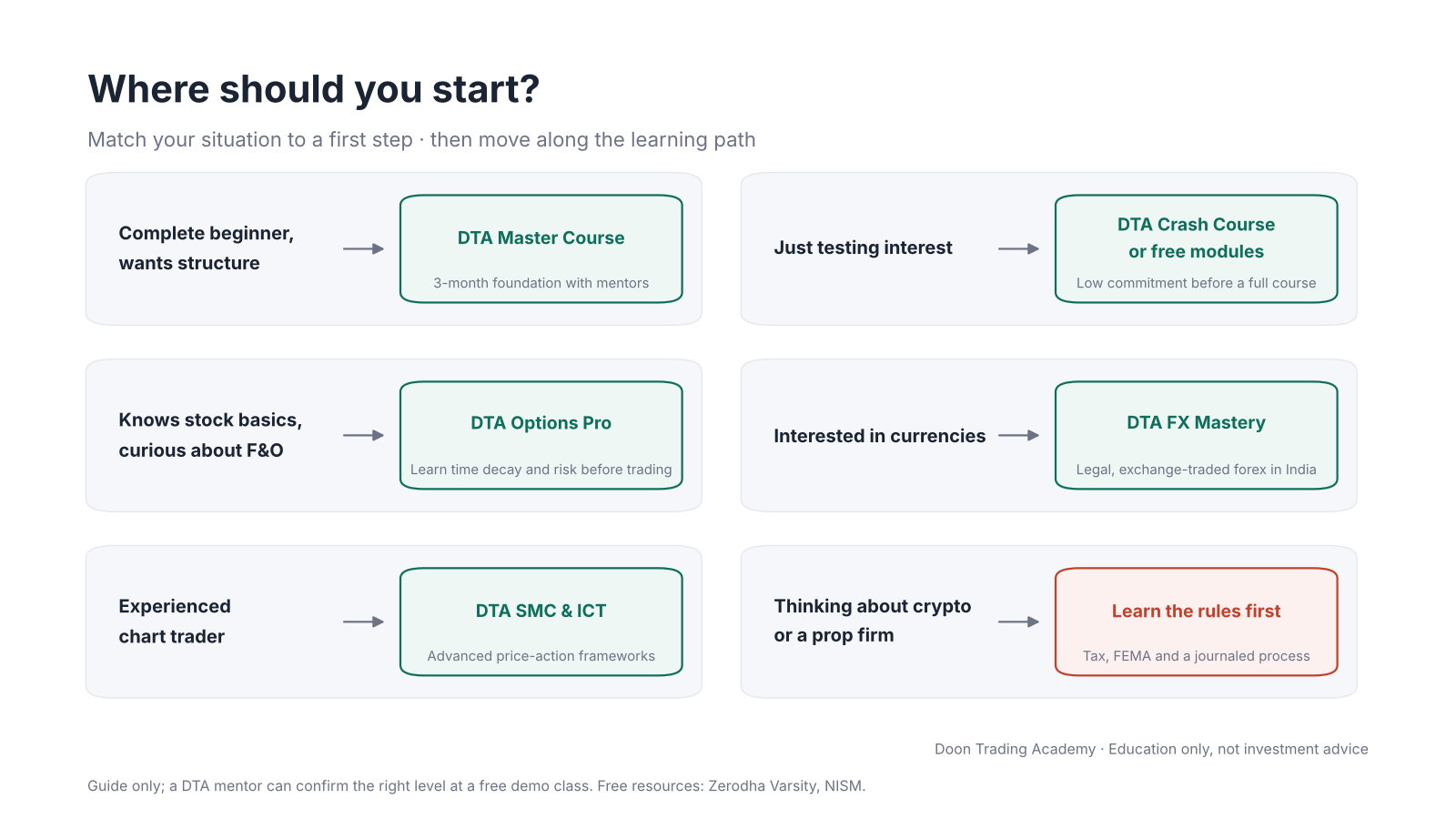
Quick answer by learner type
| If you are… | Start with | Consider next |
| A complete beginner who wants classroom structure | A full foundation course, such as the DTA Master Course | Options or price-action specialisation |
| A beginner testing interest on a small budget | Free modules (Zerodha Varsity) or a short course (Elearnmarkets Stock Trading 101, DTA Crash Course) | A structured foundation course |
| Comfortable with stock basics and curious about F&O | An options course, such as DTA Options Pro or StockDaddy’s options course | Supervised practice and journaling |
| An experienced chart trader | An SMC/ICT or advanced price-action course | Refining a written trading plan |
| Interested in currencies | A forex course that teaches India’s legal framework (exchange-traded currency derivatives) | Macro and risk modules |
| Interested in crypto | Learn the tax and FIU-IND compliance rules before any strategy | Risk management in highly volatile assets |
| Interested in prop firms | Understand the evaluation model and Indian legal questions first | A proven, journaled process before paying any challenge fee |
Disclosure: This article is published by Doon Trading Academy (DTA). It is a brand-authored comparison based on publicly available information, not an independent ranking or certification of teaching quality. DTA is listed first because this is our own publication. Details of other providers come from their public pages and should be verified directly before enrolment. Nothing here is investment advice.
Best trading institutes in India (2026): which one fits you?
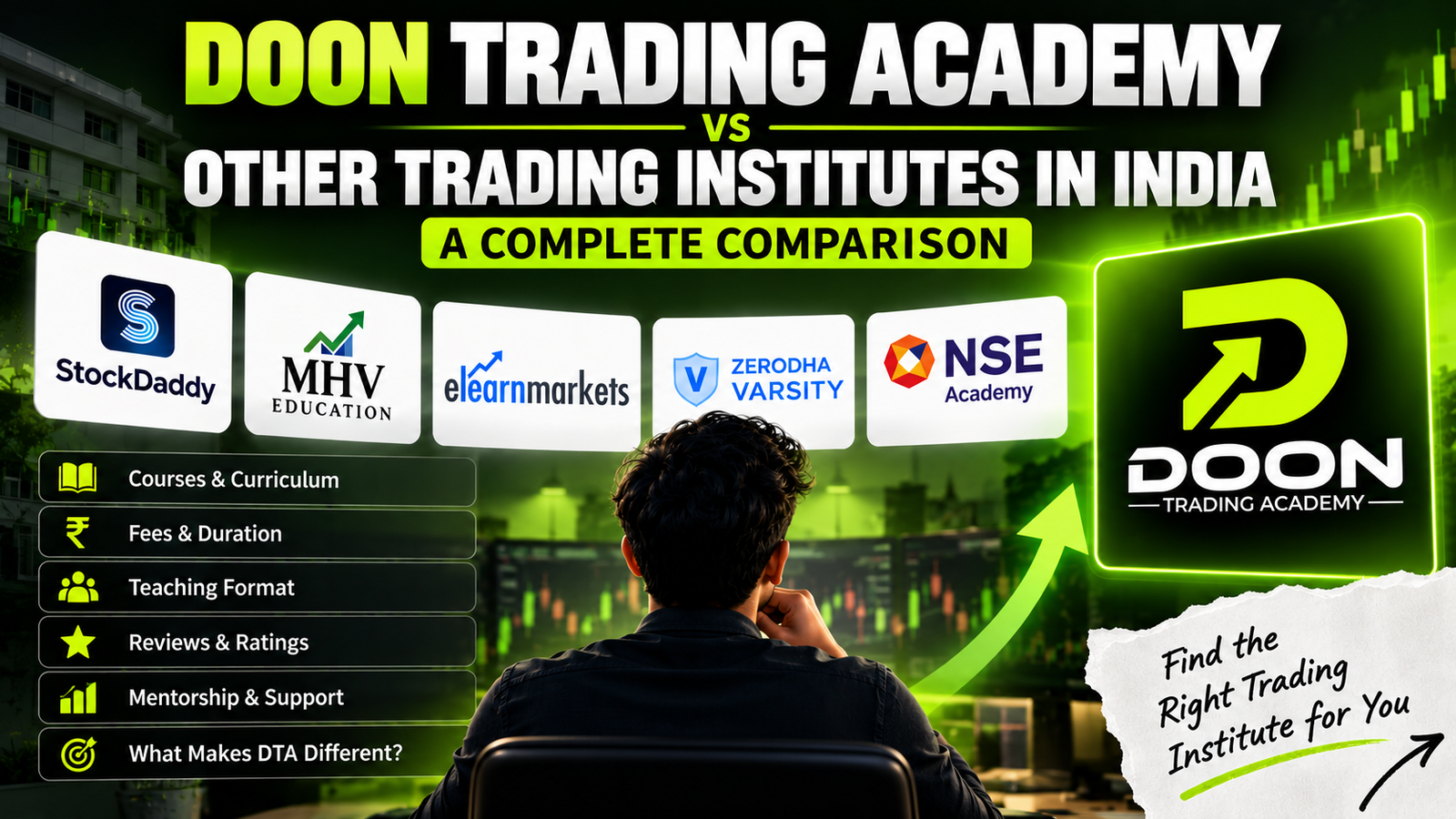
The table below lists the best-fit option for each kind of learner, based on published courses, formats and fees. It is a use-case guide, not a ranking of teaching quality.
| Institute | Best suited for | Levels covered | Markets | Format | Published fee range |
| Doon Trading Academy | A structured, mentor-led path from beginner to advanced in one institute | Introductory to advanced | Stocks, options, forex (Indian rules), SMC/ICT | Classroom in Dehradun, Chandigarh, Moradabad + online | ₹14,999 + GST to ₹41,300 incl. GST |
| StockDaddy | Hybrid learning with an app, recorded courses and centres | Beginner to intermediate | Stocks, technical analysis, options | Hybrid centres, app, recorded | ₹24,999 per listed course |
| MHV Education | A local classroom alternative in the Dehradun region | Beginner to intermediate | Stocks, technical analysis | Classroom in Dehradun and Rishikesh + online | Confirm with provider |
| Financial Nerve | A technical-analysis-focused classroom option in Dehradun | Beginner to intermediate | Stocks, technical analysis, equity F&O strategies | Classroom in Dehradun (Ballupur) | Confirm with provider |
| Elearnmarkets | Low-cost, self-paced online learning | Beginner to specialised | Stocks, price action, other topics | Online | ₹3,000 to ₹20,000 for listed courses |
| Zerodha Varsity | Free self-study before paying for a course | Beginner to intermediate | Stocks, derivatives, technical and fundamental analysis | Free, self-paced online | Free |
| NSE technical-analysis programme | A short, certified technical-analysis course | Beginner to intermediate | Technical analysis | 12-hour online interactive | Confirm on NSE page |
| NISM certifications | Regulator-linked credentials in derivatives and currency markets | Intermediate | Equity, currency and other derivatives | Exam-based | ₹1,500 to ₹3,000 per exam |
Crypto and prop firms: no institute above is listed as a best fit for crypto trading or funded-trader programmes. See Categories 4 and 5 for what to check before choosing in those areas.
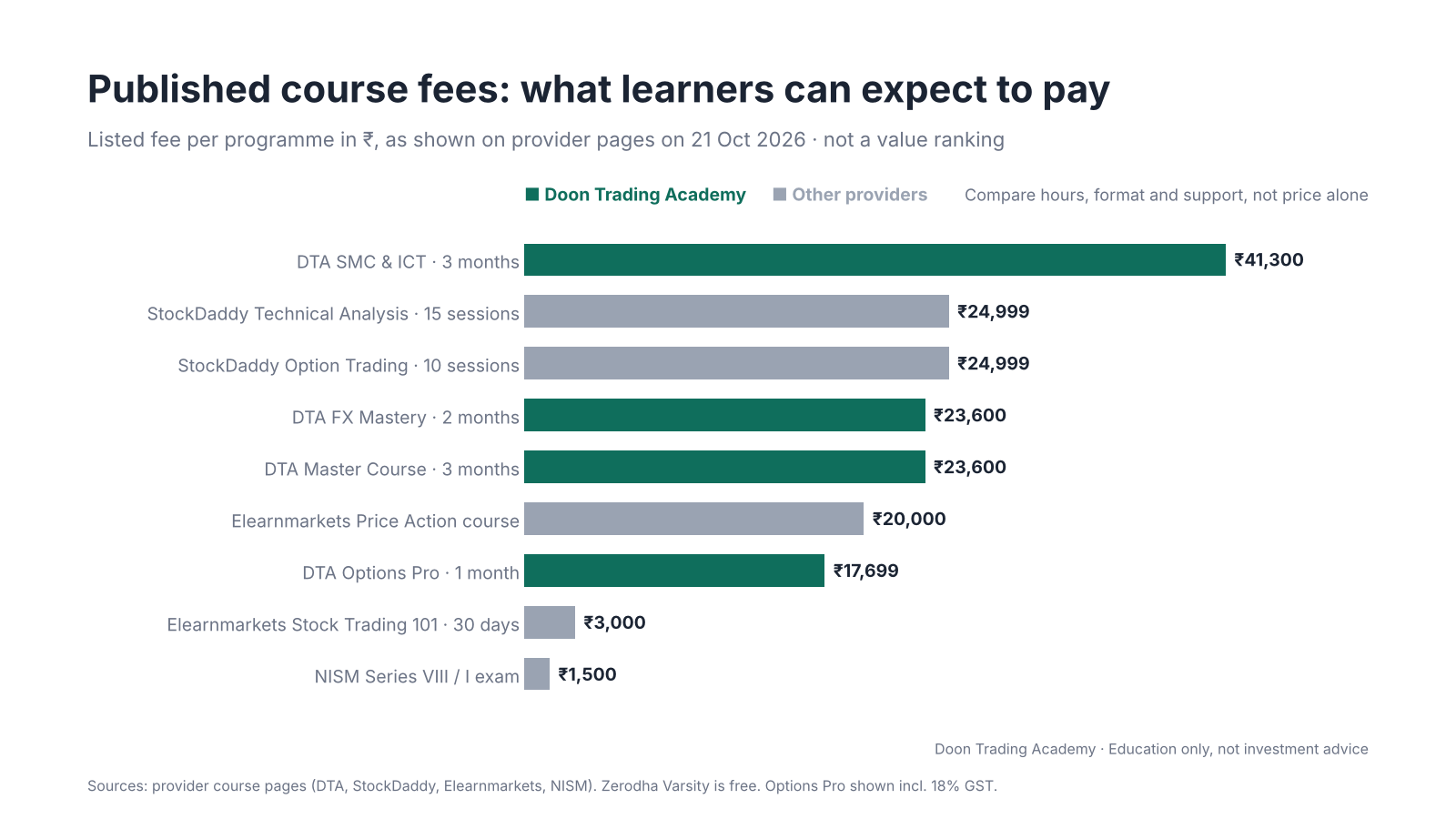
Fees and details were taken from each provider’s public pages on 21 October 2026 and may change.
Why does the choice of trading education matter?
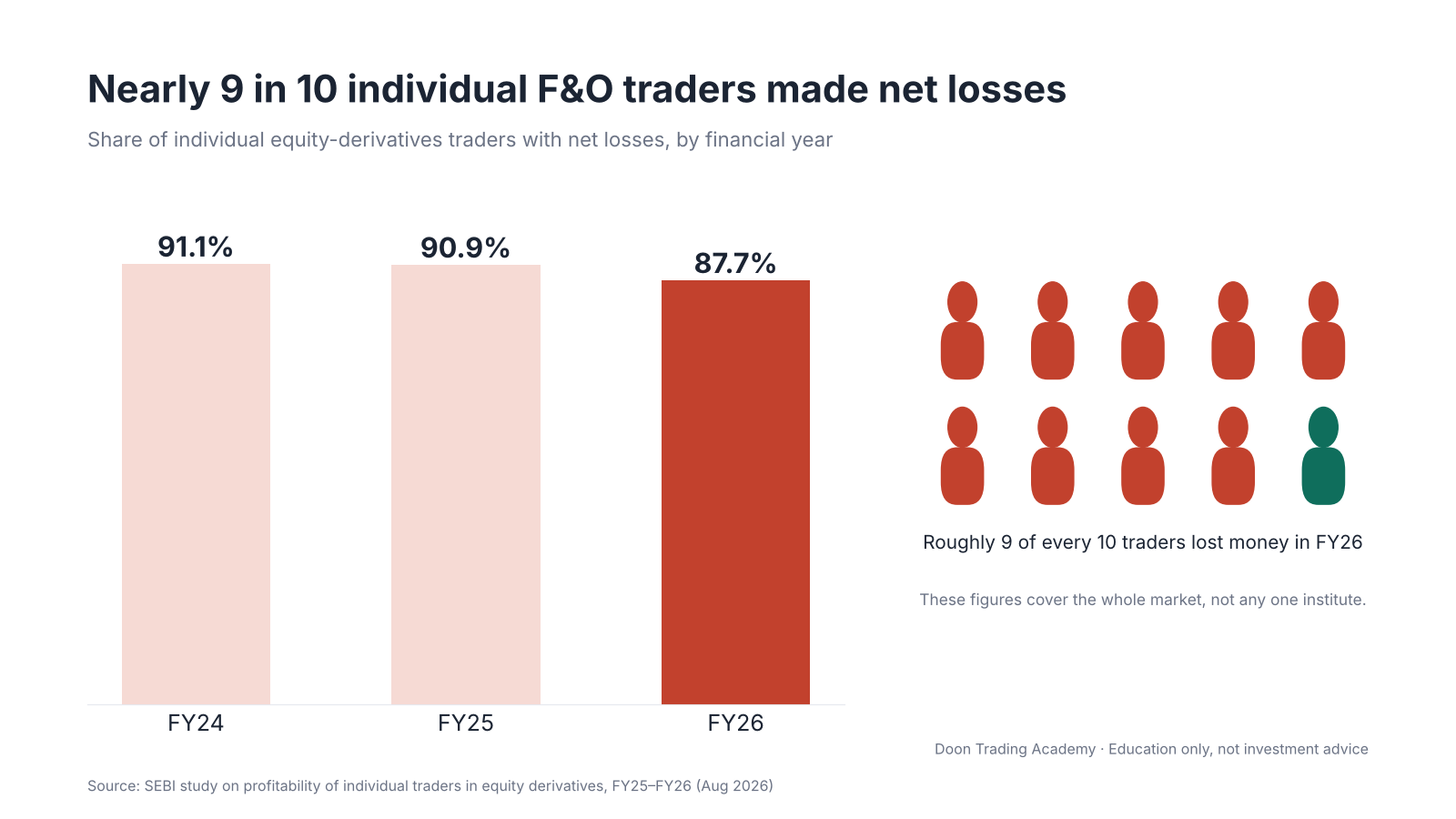
It matters because most individual derivatives traders in India lose money: SEBI’s latest study found that 87.7% of individual equity F&O traders made net losses in FY26 (April 2025 to March 2026).
Key figures from SEBI’s FY25–FY26 profitability study, as reported in August 2026:
| Measure | FY26 figure |
| Individual traders with net losses | 87.7% (down from 90.9% in FY25 and 91.1% in FY24) |
| Aggregate net losses of individual traders | ₹91,685 crore (₹1,11,788 crore in FY25) |
| Cumulative individual net losses, FY22–FY26 | about ₹3.85 lakh crore |
| Share of losses from options | about 92% |
| Transaction costs paid by individuals | about ₹25,000 crore |
| Traders under 30 years | 43% of individual traders; about 88.5% of them lost money |
Sources: SEBI study page, Business Today, Business Today on profit split, Outlook Money.
These figures describe the whole equity-derivatives market. They do not measure outcomes at DTA or at any other institute, and no course can promise to move a learner out of the loss-making group.
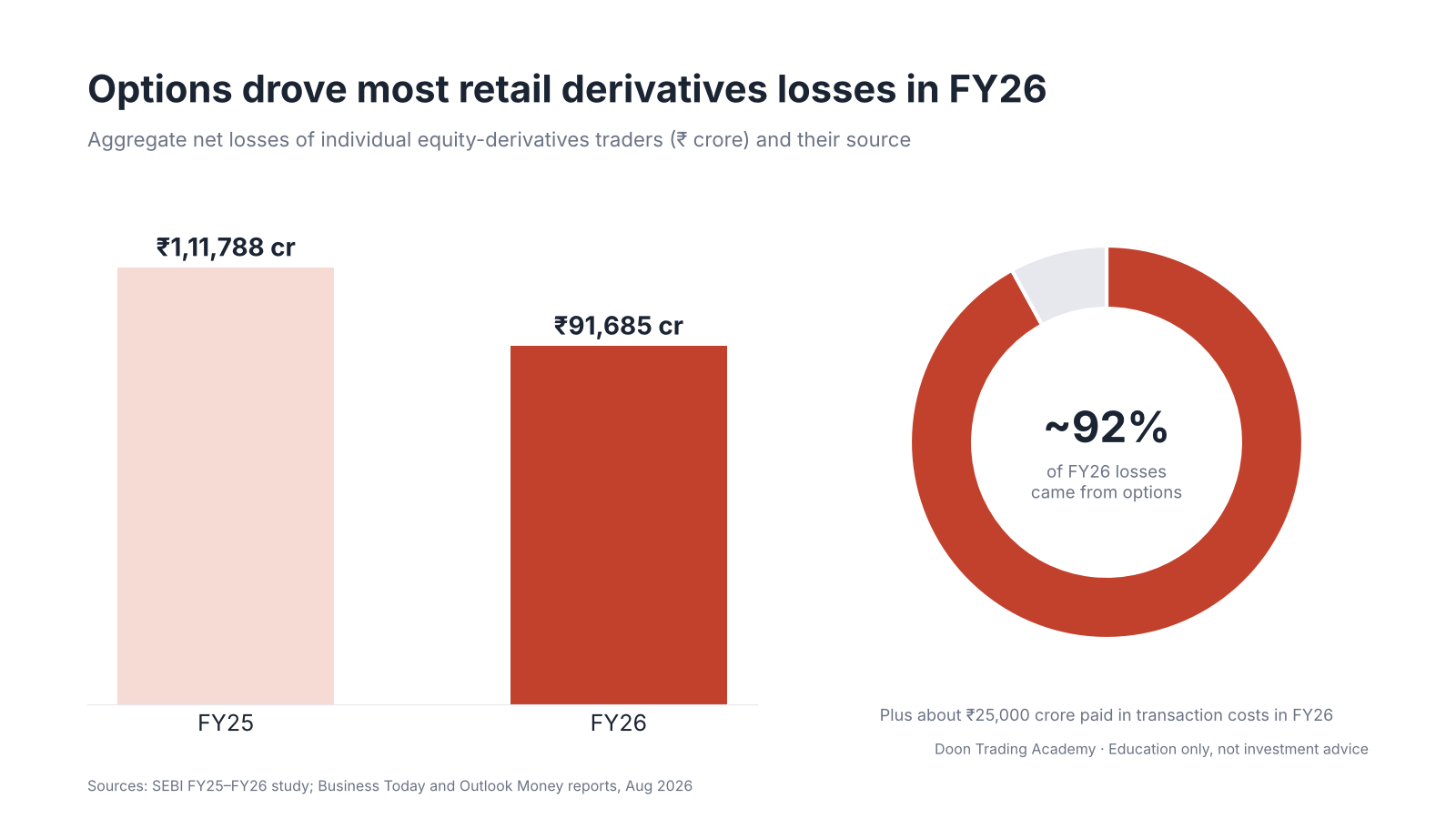
What the data does show is that knowing chart patterns is not enough. A useful course should also teach transaction costs, position sizing, drawdowns, the behaviour of options near expiry, and the real possibility of losing capital. Judge any programme on its curriculum, teaching quality, practice opportunities and honesty of claims, not on promises of profit.
What does Doon Trading Academy offer?
Doon Trading Academy (DTA) offers five sequenced programmes, from an introductory crash course to an advanced SMC/ICT course, taught in English and Hindi at classroom centres in Dehradun, Chandigarh and Moradabad and online.
DTA describes itself as an education-only institute: it is not a SEBI-registered investment adviser or research analyst and does not give tips, buy/sell calls or portfolio services. Its course catalogue arranges learning in five stages: foundations, analysis, risk management, specialisation, and practice with review.
| DTA programme | Level | Market | Published duration | Published fee |
| Crash Course | Introductory | Stocks | Short format | Confirm with DTA |
| Master Course | Beginner | Stocks | 3 months, 2-hour daily classes, 11 modules | ₹20,000 + GST (₹23,600) |
| Options Pro | Basic to advanced | Index and stock options | 1 month, 11 modules | ₹14,999 + GST (about ₹17,699) |
| FX Mastery | Beginner to advanced | Currencies, within Indian rules | 2 months, 8 modules | ₹23,600 |
| SMC & ICT Course | Advanced | Price action (forex and other markets) | 3 months, 12 modules | ₹35,000 + GST (₹41,300) |
Fees were taken from DTA’s course pages on 21 October 2026. GST-inclusive figures assume 18% GST. Confirm the current fee, batch timing, recording-access terms and refund policy before paying.
Master Course (beginner)
The Master Course is DTA’s stock market course for beginners. Its 11 modules cover market structure, trading platforms, technical and fundamental analysis, trading psychology and risk management, with recorded sessions for revision.
Options Pro (intermediate)
Options Pro covers calls and puts, the option Greeks, premium calculation and the Black-Scholes model, buying and selling strategies, spreads and hedging, open interest, implied volatility and PCR, and a closing module on risk, psychology and money management. It is meant for learners who already understand stock basics.
FX Mastery (forex)
FX Mastery covers currency pairs, pips, market sessions, macro drivers and risk management. DTA states that the course is taught within India’s RBI and SEBI framework, meaning exchange-traded currency derivatives rather than offshore platforms.
SMC & ICT Course (advanced)
The SMC & ICT course covers market structure (BOS, CHoCH), liquidity, order blocks, fair value gaps, multi-timeframe analysis and ICT entry models. DTA positions it after the foundations, because these frameworks are a vocabulary for price action, not a shortcut to profit.
What DTA says it includes in every course
- Risk management and trading psychology.
- Trade journaling and post-trade review.
- Mentor interaction in class.
- Regulatory awareness (SEBI and RBI rules).
- A free demo class before enrolment.
DTA’s own site also states 10+ years of market education and a 4.9-star Google rating across 100+ reviews. Visitors can check these figures on DTA’s Google Business profile.
How were the institutes compared?
Each provider was compared on the same seven attributes, using only information on its public pages or public review sites as of 21 October 2026.
- Learner level: beginner, intermediate or advanced.
- Market covered: equity, options, forex, crypto or funded trading.
- Format: classroom, . online, recorded, or self-paced.
- Published duration and fee.
- Risk-management coverage in the published syllabus.
- Regulatory clarity: whether the provider states that it is education-only, or holds a relevant registration.
- Public review signals, read with their sample size in mind.
No provider was rated, scored or ranked on teaching quality, because that cannot be verified from public pages. Where a detail could not be confirmed, it is marked “confirm with provider”.
Category 1: Which institutes teach stock market basics to beginners?
For beginners, the main choice is between a structured classroom or hybrid foundation course (DTA, StockDaddy, MHV Education), a short online course (Elearnmarkets) and free self-study (Zerodha Varsity).
| Provider | Beginner offering (as published) | Format | What it suits |
| Doon Trading Academy | Master Course: 3 months, 11 modules, ₹23,600 incl. GST; Crash Course for testing interest | Classroom (Dehradun, Chandigarh, Moradabad) and online | Learners who want a fixed schedule, mentor interaction and a defined path to specialisation |
| StockDaddy | Technical-analysis and options programmes, an education app and recorded courses | Hybrid: learning centres, app, mentor-led sessions | Learners who want digital resources alongside classroom or mentor contact |
| MHV Education | Stock market training described as including .-market learning and technical analysis | Classroom in Dehradun and Rishikesh, plus online | Learners in the Dehradun region comparing local classroom options |
| Financial Nerve | Basics of the Stock Market, followed by technical analysis and equity, futures and options strategies | Classroom in Dehradun | Dehradun learners who want a technical-analysis-led programme |
| Elearnmarkets | Stock Trading 101: 30 days, ₹3,000 | Online | Budget-conscious learners who prefer online study |
| Zerodha Varsity | Free modules on markets, technical analysis, fundamentals and more | Self-paced online | Independent learners who want to study before paying for anything |
Sources: DTA, StockDaddy, MHV Education, Elearnmarkets, Zerodha Varsity.
Financial Nerve details come from its Dehradun Business Directory listing (last updated September 2024), which describes a Dehradun classroom institute led by mentor Anubhav Kandpal, stated there to hold an MBA and CMT Level 3 with over a decade of market experience. Its listing describes a progression from stock market basics to technical analysis (stock selection, entries and exits, position sizing and stop losses) and equity, futures and options strategies. Fees and current batch details are not published there, so confirm them directly with the institute.
How should a beginner compare these options?
Compare like with like. A free library, a 30-day online course and a three-month classroom programme serve different needs, so price alone does not show value.
Ask every provider for the same details: the full syllabus, total teaching hours, . versus recorded classes, how doubts are answered, how long recordings stay available, extra charges, and the written refund policy.
Where does DTA fit for beginners?
DTA suits beginners who learn best with scheduled classes, face-to-face mentoring and a clear sequence from basics to specialisation. Learners who prefer full flexibility, or who first want to test their interest at no cost, may start with free resources and move to a structured course later.
Category 2: Which institutes teach intermediate and advanced trading?
Intermediate and advanced learners usually choose between options courses, technical-analysis or price-action courses, and specialised frameworks such as Smart Money Concepts (SMC) and ICT.
| Provider and programme | Focus | Published duration | Published fee |
| DTA Options Pro | Option Greeks, pricing, buying and selling, spreads, hedging, OI/IV/PCR, risk | 1 month, 11 modules | ₹14,999 + GST |
| DTA SMC & ICT Course | Market structure, liquidity, order blocks, fair value gaps, ICT models | 3 months, 12 modules | ₹41,300 incl. GST |
| StockDaddy Option Trading Course | Options trading | 10 sessions | ₹24,999 |
| StockDaddy Professional Technical Analysis | Technical analysis | 15 sessions | ₹24,999 |
| Elearnmarkets Price Action and Strategies on Equity and Commodities | Price action | As listed on its course page | ₹20,000 |
| NSE certificate programme in technical analysis | Technical analysis with certification | 12 hours, online interactive | Confirm on NSE page |
Sources: DTA Options Pro, DTA SMC & ICT, StockDaddy, Elearnmarkets, NSE.
Why should options education come after the basics?
Options add time decay, volatility and leverage to price risk, which is why SEBI found that options drove about 92% of individual F&O losses in FY26. A learner should be able to explain theta decay, position sizing and maximum loss for a strategy before trading real options.
Is an SMC or ICT course right for you?
An SMC or ICT course suits traders who already understand basic market structure, support and resistance, and risk per trade. These frameworks describe liquidity and institutional price behaviour; they do not remove risk, and they are best evaluated with a journal and a defined process.
DTA publishes a dedicated 12-module SMC & ICT syllabus with its fee. Learners comparing advanced courses should ask any provider how setups are tested, how losing trades are reviewed, and how the course stays within SEBI’s education-only rules.
Category 3: How should you choose a forex trading course in India?
Choose a forex course that teaches how Indian residents can trade currencies legally: exchange-traded currency derivatives through SEBI-registered brokers on recognised Indian exchanges, not leveraged forex on offshore apps.
Is forex trading legal in India?
Yes, within limits. Indian residents can trade permitted currency futures and options, such as INR pairs and permitted cross-currency pairs, on recognised Indian exchanges. Trading forex on electronic trading platforms not authorised by the RBI, or remitting money abroad for margin trading, can attract action under FEMA.
The RBI maintains an Alert List of entities that are neither authorised to deal in forex under FEMA nor authorised to run forex electronic trading platforms (ETPs). After its November 2025 update the list held 95 names, and the RBI states that it is not exhaustive, so absence from the list does not mean a platform is authorised. The list also covers websites that promote unauthorised platforms, including through “training” or “advisory” services.
Sources: RBI press release, November 2025, Outlook Money, Moneylife.
What should a good forex course teach?
| Topic | Why it matters |
| Legal market access in India | Avoids FEMA exposure from offshore platforms |
| INR pairs and permitted crosses on Indian exchanges | These are the instruments residents can trade |
| Macro drivers: interest rates, RBI policy, crude oil, trade flows | Currencies move on economics, not only on charts |
| Contract specifications, margin and expiry | Exchange-traded currency derivatives behave differently from spot forex |
| Risk management and position sizing | Leverage magnifies both gains and losses |
| No broker referrals to unauthorised platforms | Promoting such platforms is a regulatory red flag |
How does DTA’s FX Mastery compare?
DTA’s FX Mastery is a two-month, eight-module course priced at ₹23,600 that, according to DTA, is taught within India’s RBI and SEBI framework. Before choosing any forex course, from DTA or elsewhere, ask the provider to show which instruments and venues the course assumes, and confirm that it does not route students to platforms on the RBI Alert List.
NISM’s Series I Currency Derivatives certification is another structured, low-cost way to learn the exchange-traded currency market (see Category 6).
Category 4: What should you know before taking a crypto trading course in India?
Before any crypto strategy course, learn India’s crypto rules: a flat 30% tax on gains, 1% TDS on transfers, no loss set-off, and trading only through exchanges registered with FIU-IND.
What are India’s crypto (VDA) rules in 2026?
| Rule | What it means for a learner |
| 30% tax on VDA gains (plus 4% cess), Section 115BBH | Only the cost of acquisition is deductible |
| No loss set-off | Crypto losses cannot be set off against other income or other VDA gains |
| 1% TDS under Section 194S | Deducted on transfers above the annual threshold, which reduces capital available for frequent trading |
| FIU-IND registration under PMLA | 49 VDA service providers were registered as reporting entities as of March 2025 |
| Budget 2026 reporting penalties | New penalties for crypto transaction-reporting lapses from 1 April 2026; tax rates unchanged |
| No comprehensive crypto law yet | Crypto is not regulated like securities, so investor protections are limited |
Sources: KoinX, India crypto tax statistics, Decrypt on Budget 2026.
What kinds of crypto education are available?
Crypto education in India comes in four broad forms: free learning hubs run by exchanges, global online course marketplaces, short workshops by trading institutes, and blockchain or technology programmes at universities. Many focus on blockchain technology rather than trading, so check the syllabus before paying.
A useful crypto course should cover:
- Indian tax, TDS and reporting obligations.
- How to check FIU-IND registration of an exchange.
- Wallet security and common crypto scams.
- Volatility, liquidity and leverage risk, especially in crypto derivatives.
- Applying general price-action and risk-management skills to a market that trades 24/7.
Does DTA teach crypto?
DTA does not currently publish a dedicated crypto trading course. Its Master Course and SMC & ICT programmes teach price action, market structure and risk management, which are general skills; learners who want crypto-specific content should look for a course that covers the Indian tax and compliance points above.
Crypto advertising in India is also subject to ASCI’s guidelines for virtual digital assets, which require prominent risk disclaimers. Treat any course that promises crypto profits, or skips the tax and risk topics, with caution.
Category 5: What should Indian learners know about prop firms and funded-trader programmes?
Prop-firm “funded trader” programmes are paid evaluations, not trading courses: you pay a fee, trade under strict drawdown and profit-target rules, and if you pass you may receive a share of profits from an account the firm controls.
How does a typical funded-trader programme work?
- Evaluation fee: usually a one-time payment that scales with the notional account size.
- Challenge phase: one or two rounds, often on a simulated account, with a profit target, a daily loss limit and a maximum drawdown.
- Funded stage: traders who pass trade the firm’s account (often still simulated in early stages) under the same rules.
- Profit split: the trader receives an agreed percentage of profits; breaking a rule usually ends the account.
What types of prop programmes do Indian traders come across?
| Type | Markets | Key questions for Indian residents |
| Global forex/CFD prop programmes | Forex, CFDs, indices, commodities | Is the trading venue authorised in India? How does the RBI Alert List and FEMA position apply? How is the fee paid and how are payouts received? |
| Global futures prop programmes | Exchange-traded futures (often US markets) | Trading hours (US sessions run late in the Indian evening), payout route, tax treatment |
| Indian-market funded programmes | Nifty, Bank Nifty, Sensex options and futures | Is real capital or a simulation used? Who is the broker? What charges apply to the trader? |
Are prop firms legal for Indian residents?
The position is not settled for every model, and this article does not give legal advice. Prop firms are generally not regulated by SEBI, and the RBI’s FEMA framework does not permit remittances for margin trading or leveraged forex on unauthorised platforms. Payouts received are taxable income in India. Anyone considering a forex or CFD-based programme should take advice from a chartered accountant or lawyer before paying any fee.
How does trading education relate to prop challenges?
Passing an evaluation depends on the same skills a good course teaches: position sizing, daily loss limits, drawdown control and a written, journaled process. DTA does not operate a prop firm or sell funded accounts. Its courses teach risk management and journaling as general skills, and DTA does not recommend any specific prop firm.
A practical rule: build and journal a consistent process first, then decide whether a paid evaluation makes sense. A challenge fee spent without a tested process is a cost, not an education.
Category 6: Are there good free or certification-based alternatives?
Yes. Zerodha Varsity offers free, open learning modules, and NISM certification exams offer regulator-linked credentials for a few thousand rupees or less.
| Route | What it offers | Published cost | Best use |
| Zerodha Varsity | Free modules on markets, technical and fundamental analysis, futures, options and more | Free | Self-study before or alongside a course |
| NSE technical-analysis programme | 12-hour online interactive course with certification | Confirm on NSE page | A short, structured technical-analysis certificate |
| NISM Series VIII: Equity Derivatives | SEBI-mandated certification exam for derivatives professionals | ₹1,500 (per NISM pamphlet) | Formal grounding in F&O mechanics |
| NISM Series I: Currency Derivatives | Certification on exchange-traded currency derivatives | ₹1,500 (per NISM pamphlet) | Learning India’s legal forex market |
| NISM Series XIII: Common Derivatives | Equity, currency, interest-rate and commodity derivatives | ₹3,000 (per NISM pamphlet) | Broad derivatives knowledge |
NISM fees are from its certification pamphlet (2025 pamphlet); confirm current fees on the NISM website.
Should you pay for a course if free resources exist?
Free resources are excellent for knowledge, but they rarely provide sequence, . correction or accountability. A paid course should justify its fee through teaching hours, mentor feedback, practice and post-course support; a higher price does not by itself mean better teaching.
DTA encourages learners to use free regulator and exchange resources alongside its courses, because they reinforce the same principles of risk management and investor protection.
How do the providers compare side by side?
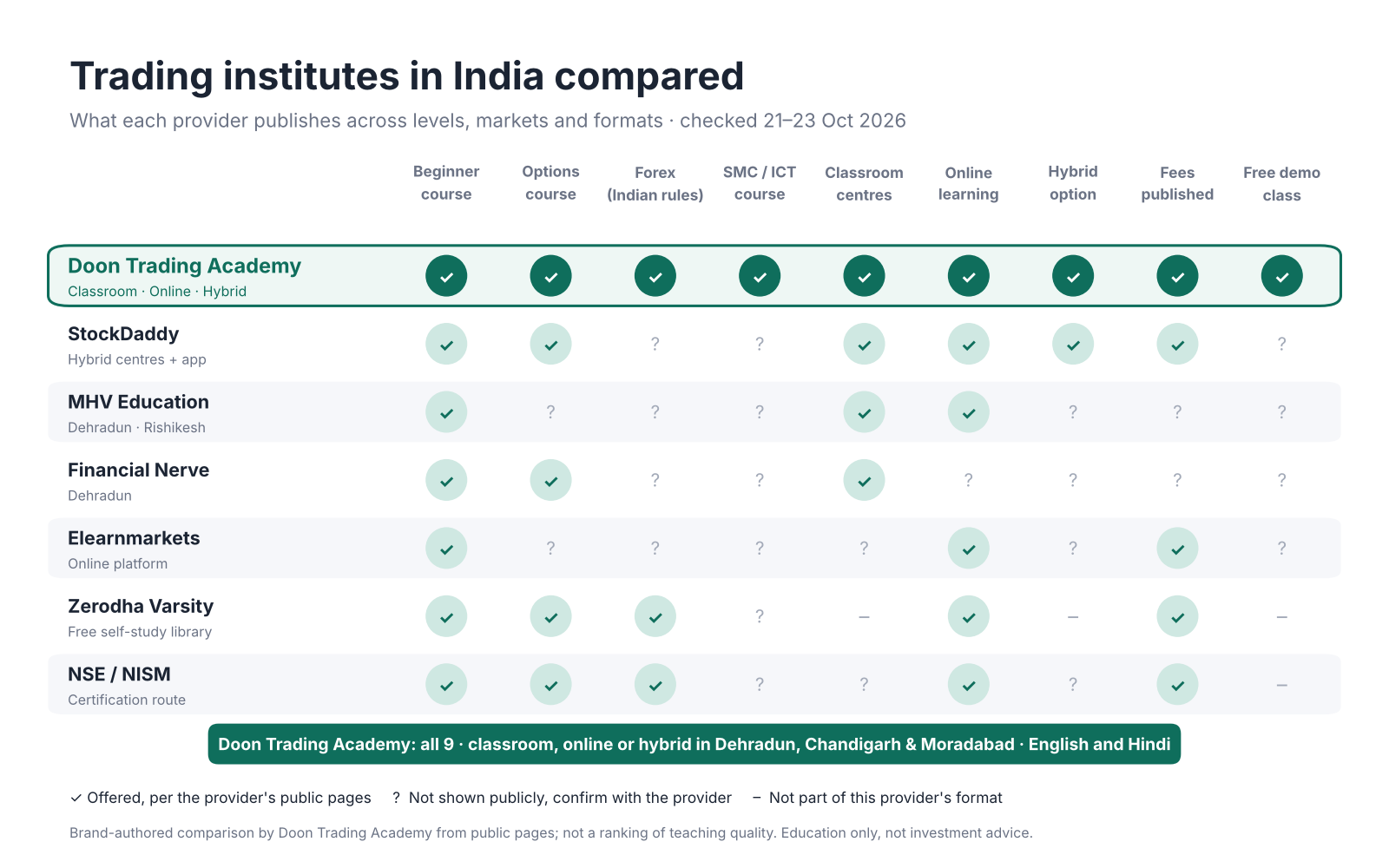
DTA publishes separate courses at every level, from introductory to advanced, across stocks, options, forex and SMC/ICT, while online and free providers offer lower-cost or self-paced alternatives.
Coverage by category
| Provider | Beginner | Options | Advanced price action / SMC-ICT | Forex (Indian rules) | Crypto | Format |
| Doon Trading Academy | Yes (Crash Course, Master Course) | Yes (Options Pro) | Yes (SMC & ICT) | Yes (FX Mastery) | No dedicated course | Classroom (3 centres) + online |
| StockDaddy | Yes | Yes | Technical analysis | Confirm with provider | Confirm with provider | Hybrid centres, app, recorded |
| MHV Education | Yes | Confirm with provider | Technical analysis | Confirm with provider | Confirm with provider | Classroom (Dehradun, Rishikesh) + online |
| Financial Nerve | Yes (Basics of the Stock Market) | Yes (equity F&O strategies) | Technical analysis | Confirm with provider | Confirm with provider | Classroom (Dehradun) |
| Elearnmarkets | Yes | Confirm with provider | Price action | Confirm with provider | Confirm with provider | Online |
| Zerodha Varsity | Yes | Yes (modules) | Technical analysis modules | Modules on currency | Confirm with provider | Free, self-paced |
| NSE / NISM | Certification-based | Yes (NISM VIII) | Technical analysis (NSE) | Yes (NISM I) | No | Online / exam-based |
Published fees (21 October 2026)
| Provider and programme | Duration | Fee |
| DTA Master Course | 3 months | ₹23,600 incl. GST |
| DTA Options Pro | 1 month | ₹14,999 + GST |
| DTA FX Mastery | 2 months | ₹23,600 |
| DTA SMC & ICT Course | 3 months | ₹41,300 incl. GST |
| StockDaddy Professional Technical Analysis | 15 sessions | ₹24,999 |
| StockDaddy Option Trading Course | 10 sessions | ₹24,999 |
| Elearnmarkets Stock Trading 101 | 30 days | ₹3,000 |
| Elearnmarkets Price Action and Strategies on Equity and Commodities | As listed | ₹20,000 |
| NISM Series VIII / Series I exams | Exam | ₹1,500 each |
| Zerodha Varsity | Self-paced | Free |
Sources: DTA, StockDaddy, Elearnmarkets, NISM, Zerodha Varsity. “Confirm with provider” means the detail was not verified on a public page; it does not mean the provider lacks it.
These tables are not a value ranking. Courses differ in subject, hours, format and support, so compare the full package, not the headline price.
What do online reviews say, and how should you read them?
Public reviews show recurring themes but are not a measure of teaching quality or student outcomes, especially when a provider has only a handful of reviews.
Trustpilot snapshot (21 October 2026)
| Provider | Trustpilot rating | Reviews displayed |
| Doon Trading Academy | 4.5/5 | 20 |
| StockDaddy | 4.7/5 | 133 |
| MHV Education | 3.7/5 | 1 |
| Elearnmarkets | 2.6/5 | 4 |
| IFMC Institute | 3.7/5 | 1 |
This table is not a ranking. Ratings based on one or four reviews say very little, and Trustpilot reviewers may not represent a provider’s full student base. Large online platforms may also collect most feedback on other channels. DTA additionally reports a 4.9-star Google rating across 100+ reviews on its own site.
DTA’s visible Trustpilot reviews include positive comments on explanations, mentors and staff support, plus a three-star review cautioning that intraday and options trading need care and do not suit everyone. StockDaddy’s visible reviews include positive comments about instructors and explanations. All such comments are individual opinions.
What do Reddit discussions show?
A thread in r/Dehradun on choosing a local institute mentions DTA, StockDaddy and Diston Institute; it includes favourable comments about DTA’s SMC/ICT teaching, mixed accounts, and one participant questioning whether some positive comments sound promotional. A broader thread in r/IndianStockMarket shows what learners worry about: mentor credibility, risk management and marketing claims.
The identities and affiliations of anonymous participants cannot be verified, so these threads indicate what learners care about, not proven outcomes.
How can you use reviews well?
- Prefer reviews that name the programme and describe how classes ran.
- Check how recent the review is and whether the reviewer appears to have enrolled.
- Weigh the number of reviews, not just the average.
- Speak to former students directly and attend a demo class.
- Never treat a rating or testimonial as evidence that a course produces profits.
What is the right learning path from beginner to advanced?
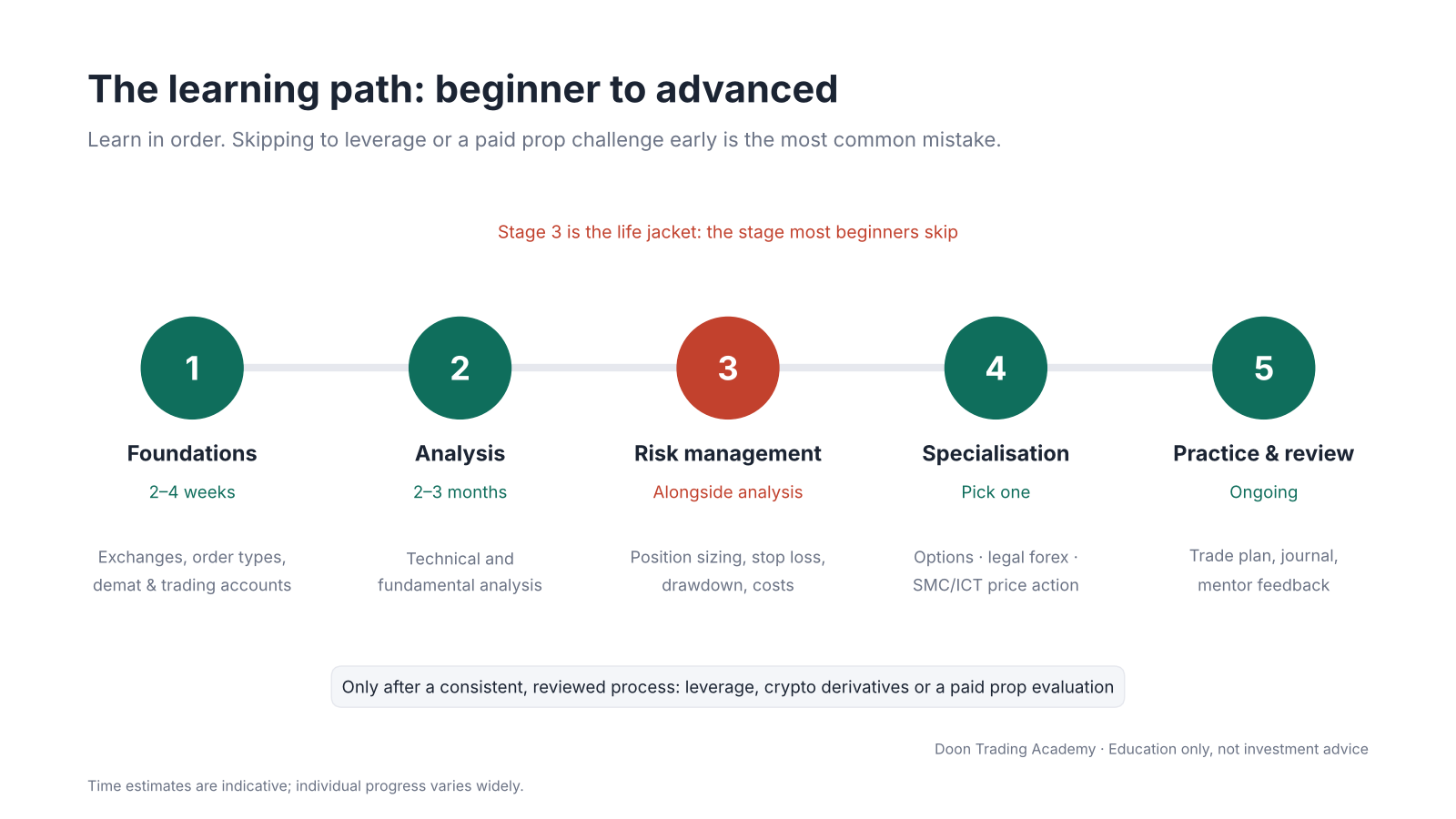
Learn in order: foundations, analysis, risk management, one specialisation, then supervised practice. Skipping to options, leveraged forex or a prop challenge before the earlier stages is the most common beginner mistake.
- Foundations (2–4 weeks): exchanges, order types, demat and trading accounts, market participants. Options: Zerodha Varsity, DTA Crash Course, Elearnmarkets Stock Trading 101.
- Analysis (2–3 months): technical and fundamental analysis. Options: DTA Master Course, StockDaddy or MHV Education foundation programmes, NSE technical-analysis course.
- Risk management (alongside analysis): position sizing, stop losses, drawdown, transaction costs.
- One specialisation: options (DTA Options Pro, StockDaddy options course, NISM Series VIII), legal forex (DTA FX Mastery, NISM Series I), or advanced price action (DTA SMC & ICT).
- Practice and review (ongoing): written trade plans, a journal, and mentor feedback. Only after a consistent, reviewed process should a learner consider leverage, crypto derivatives or a paid prop evaluation.
Time estimates are indicative; individual progress varies widely.
Checklist before you pay any institute
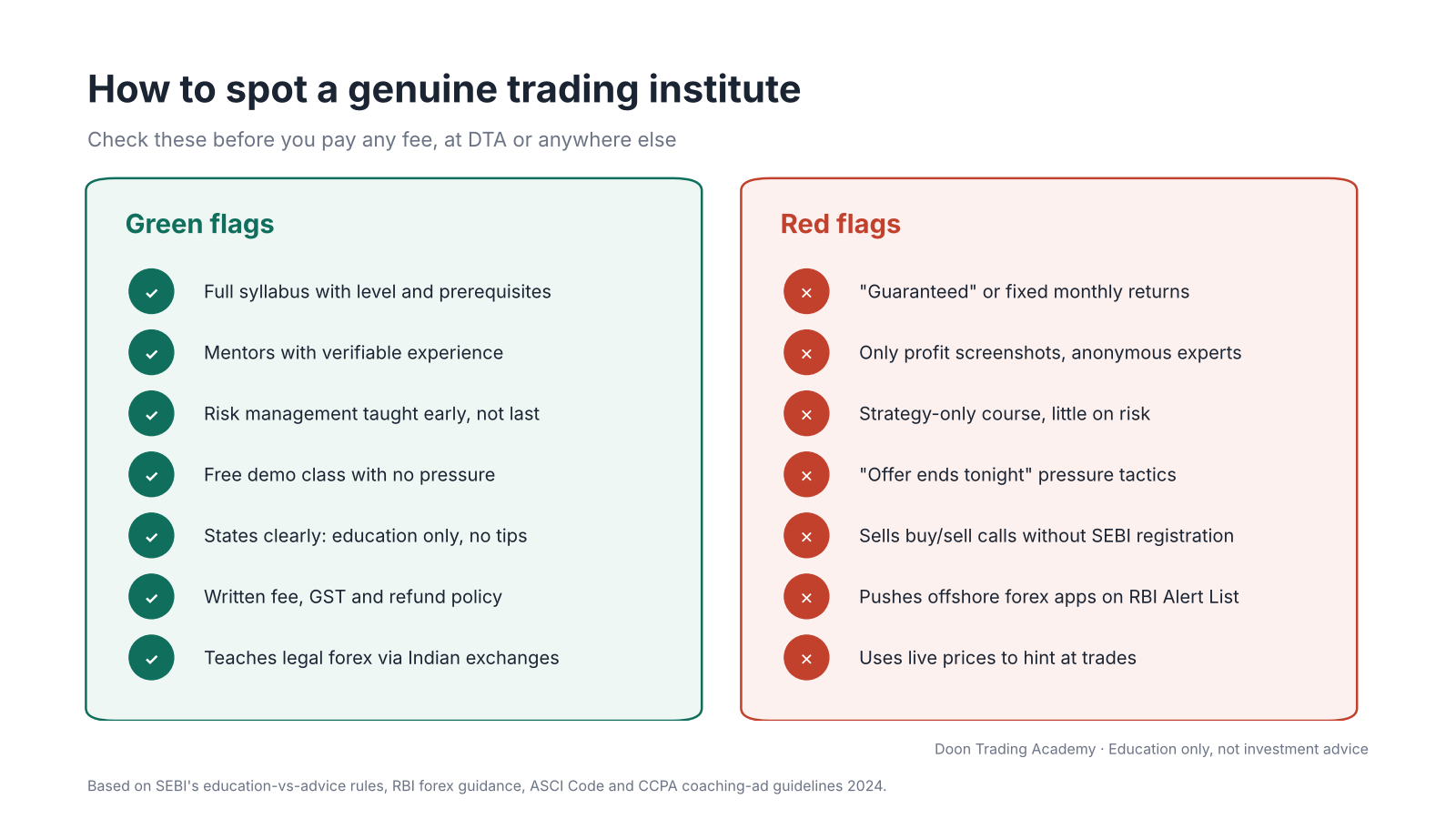
- Curriculum: Is the full syllabus published, with level and prerequisites?
- Format: Live, recorded, classroom or online, and does it fit your schedule?
- Faculty: Who teaches, and can their experience or credentials be verified?
- Risk management: Are position sizing, drawdowns, costs and the risk of loss taught early?
- Interaction: How are doubts answered, and is there feedback on practice work?
- Fees: What is the total payable, including GST and any extras?
- Access: How long are recordings and materials available, and is that in writing?
- Refunds: Is there a written refund and cancellation policy?
- Regulatory clarity: Does the provider state it is education-only, or show a valid SEBI registration if it gives advice?
- No guarantees: Does it avoid promises of profits, fixed returns or “secret strategies”?
- Forex and crypto: Does it avoid steering students to platforms on the RBI Alert List or unregistered crypto exchanges?
Which Indian rules apply to trading education?
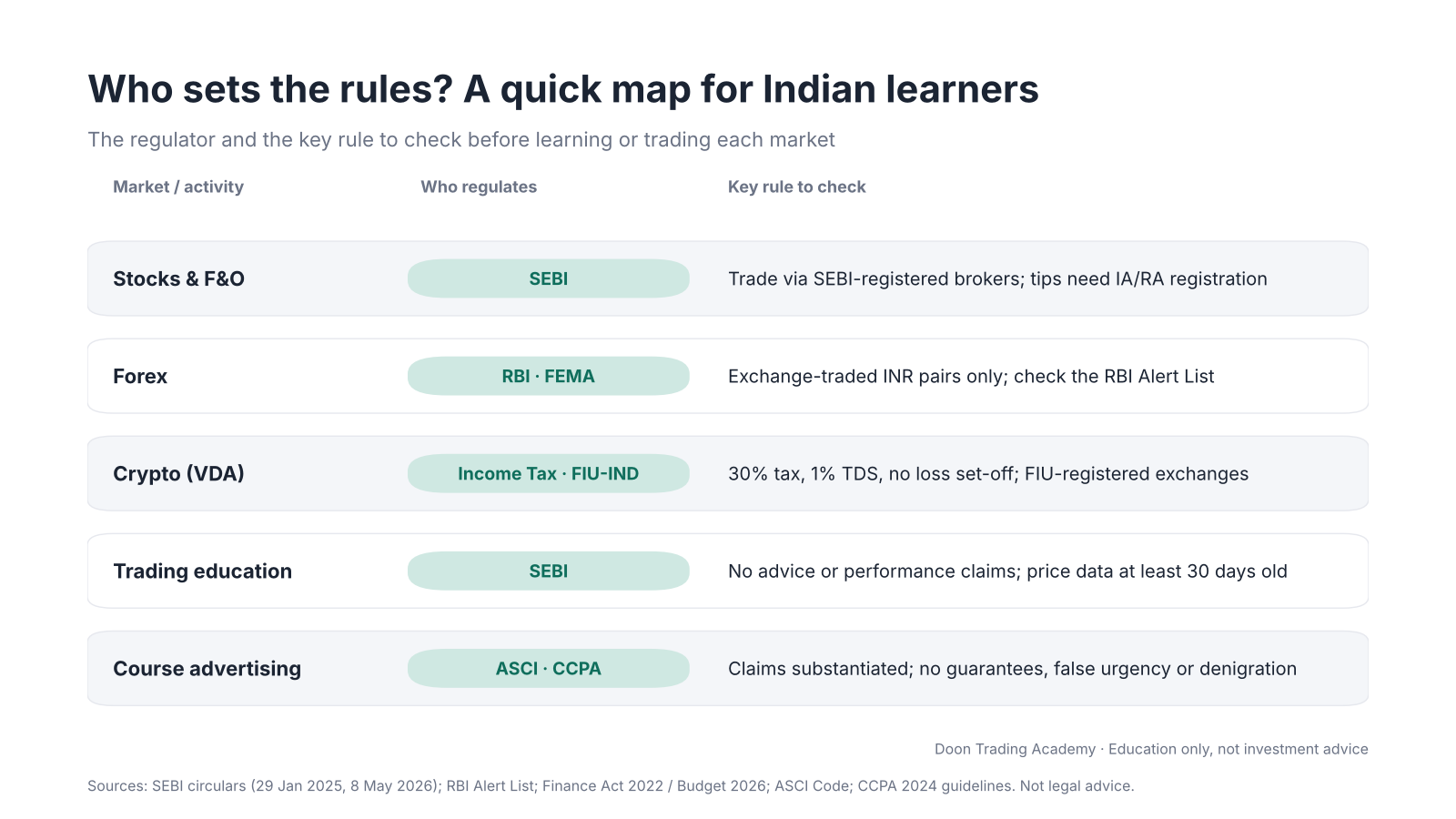
Trading education is legal in India, but educators must stay on the education side of SEBI’s line between teaching and investment advice, follow RBI rules on forex, and advertise truthfully under ASCI and CCPA guidance.
| Regulator / rule | What it requires | Why learners should care |
| SEBI circular, 29 January 2025 | Unregistered persons engaged in education must not give investment advice, make performance claims or indirectly recommend securities | A course that sells tips or “calls” without SEBI IA/RA registration is a red flag |
| SEBI circular, 8 May 2026 (effective 1 July 2026) | Education may use market price data only with a 30-day lag; names or code names of securities must not be used with recent data to indicate future prices (replaces the earlier three-month rule) | “Live market” sessions that suggest current trades may cross into advice |
| SEBI public caution | Verify the registration of anyone offering investment advice or research | Check SEBI’s intermediary database before acting on recommendations |
| RBI / FEMA and ETP Directions | Forex only through authorised persons and authorised ETPs; Alert List of unauthorised platforms | Offshore leveraged forex can expose residents to FEMA action |
| Income Tax Act and FIU-IND (PMLA) | 30% VDA tax, 1% TDS, exchange registration | Crypto courses should teach compliance first |
| ASCI Code | Claims must be truthful and substantiated; comparisons must be fair and must not denigrate competitors | Applies to every institute’s ads, including comparison pages like this one |
| CCPA Guidelines for Prevention of Misleading Advertisement in Coaching Sector, 2024 | No false claims about success, results or guarantees; no false urgency | Protects learners from inflated marketing |
Sources: Outlook Money on SEBI’s 30-day rule, SEBI January 2025 circular, SEBI caution, RBI Alert List update, ASCI Code, CCPA coaching guidelines.
DTA states on its website that it is an education-only institute, not a SEBI-registered investment adviser or research analyst, and that it does not provide tips, buy/sell recommendations, portfolio management or brokerage services.
Frequently asked questions
Which is the best trading institute in India? There is no single best institute for everyone. The right one matches your market, level, budget and learning style, publishes its syllabus and fees, teaches risk management early, and makes no profit promises.
Is Doon Trading Academy good for beginners? DTA’s Master Course is designed for beginners: three months of two-hour daily classes across 11 modules, in English and Hindi, for ₹23,600 including GST. Attend the free demo class to judge whether the teaching style suits you.
Where are DTA’s classroom centres? DTA lists centres in Dehradun, Chandigarh and Moradabad, plus online classes.
How much does a stock market course cost in India? Published fees range from free (Zerodha Varsity) and ₹3,000 (Elearnmarkets Stock Trading 101) to about ₹24,000–₹41,000 for multi-week classroom or mentor-led programmes. Compare hours, format and support, not just price.
Which is better: online or offline trading classes? Offline classes suit learners who need fixed schedules and face-to-face mentoring; online classes suit self-disciplined learners and working professionals. DTA offers both.
Is forex trading legal in India? Yes, through SEBI-registered brokers on recognised Indian exchanges in permitted currency pairs. Leveraged forex on unauthorised offshore platforms is not permitted under FEMA; check the RBI Alert List.
Is crypto trading legal in India? Crypto is not banned, but gains are taxed at 30%, 1% TDS applies on transfers, losses cannot be set off, and exchanges must register with FIU-IND. There is no comprehensive crypto law yet.
Can Indians join prop firms? Many Indians take part in funded-trader programmes, but the legal position depends on the model, especially for forex and CFDs. Prop firms are generally not SEBI-regulated, and payouts are taxable. Take professional advice before paying an evaluation fee.
Can a trading course guarantee profits? No. No legitimate course can guarantee profits; SEBI data shows 87.7% of individual F&O traders made net losses in FY26.
Does DTA give stock tips or trading calls? No. DTA states that it is an education provider and not a SEBI-registered investment adviser or research analyst.
Are NISM certifications useful for traders? They give a structured, regulator-linked grounding in topics such as equity and currency derivatives at low cost (₹1,500 per exam for Series VIII and Series I per NISM’s pamphlet). They test knowledge, not trading skill.
How long does it take to learn trading? Basics take a few weeks to a few months; consistent, disciplined trading usually takes a year or more of practice and review.
Final verdict: should you choose Doon Trading Academy?
Choose DTA if you want a classroom or online programme with a published path from beginner to advanced, covering stocks, options, legal forex and SMC/ICT, taught in English and Hindi with a free demo first.
Other providers serve other needs well. StockDaddy offers hybrid centres and digital resources; MHV Education offers classroom training in Dehradun and Rishikesh; Financial Nerve offers technical-analysis-led classroom training in Dehradun; Elearnmarkets offers lower-cost online courses; Zerodha Varsity is free; NSE and NISM provide certification routes. Crypto learners should prioritise tax and compliance teaching, and anyone drawn to prop firms should build a tested process and take legal advice first.
Whatever you choose, compare the syllabus, teaching hours, faculty, support and full fee, attend a demo, and remember that education improves decision-making; it does not guarantee profits.
Book a free DTA demo class in Dehradun, Chandigarh, Moradabad or online.
Sources
- Doon Trading Academy, course catalogue, Master Course, Options Pro, FX Mastery, SMC & ICT
- StockDaddy courses
- MHV Education
- Elearnmarkets courses
- Zerodha Varsity
- NSE technical-analysis programme
- NISM certifications
- SEBI FY25–FY26 F&O profitability study
- Business Today on the SEBI study
- Outlook Money on SEBI’s 30-day price-data rule
- RBI Alert List update
- KoinX crypto tax statistics and Decrypt on Budget 2026
- ASCI Code and CCPA coaching guidelines, 2024
- Trustpilot pages for DTA, StockDaddy, MHV Education, Elearnmarkets, IFMC Institute
Research date: 21 October 2026. Fees, ratings and programme details change; verify with each provider. This comparison is for educational purposes only and is not investment, tax or legal advice.