

The Indian financial markets offer a wide range of career paths — from active roles on the trading floor to research, risk management, compliance, technology and client-facing wealth advisory. This article maps the main options, the skills and qualifications employers expect, practical steps to break in, and how to choose a path that fits your strengths.
- Quick Summary
- Major roles include trader, research analyst, portfolio manager, risk manager, operations, compliance, and quant/technical developer.
- Combine domain knowledge (fundamental/technical) with practical skills (Excel, coding, risk rules) and certifications to improve hireability.
- Short courses and structured training close the gap faster than unguided self-study for most beginners.
- Beyond the obvious: developing discipline, a measurable trading process, and mastering one niche (e.g., derivatives pricing or algo strategies) accelerates progress.
Who should read this
This guide is for students, fresh graduates, professionals seeking a career switch, and investors in India who want a clear map of roles, skills, training options, and realistic next steps in Indian financial markets.
What are the primary career categories?
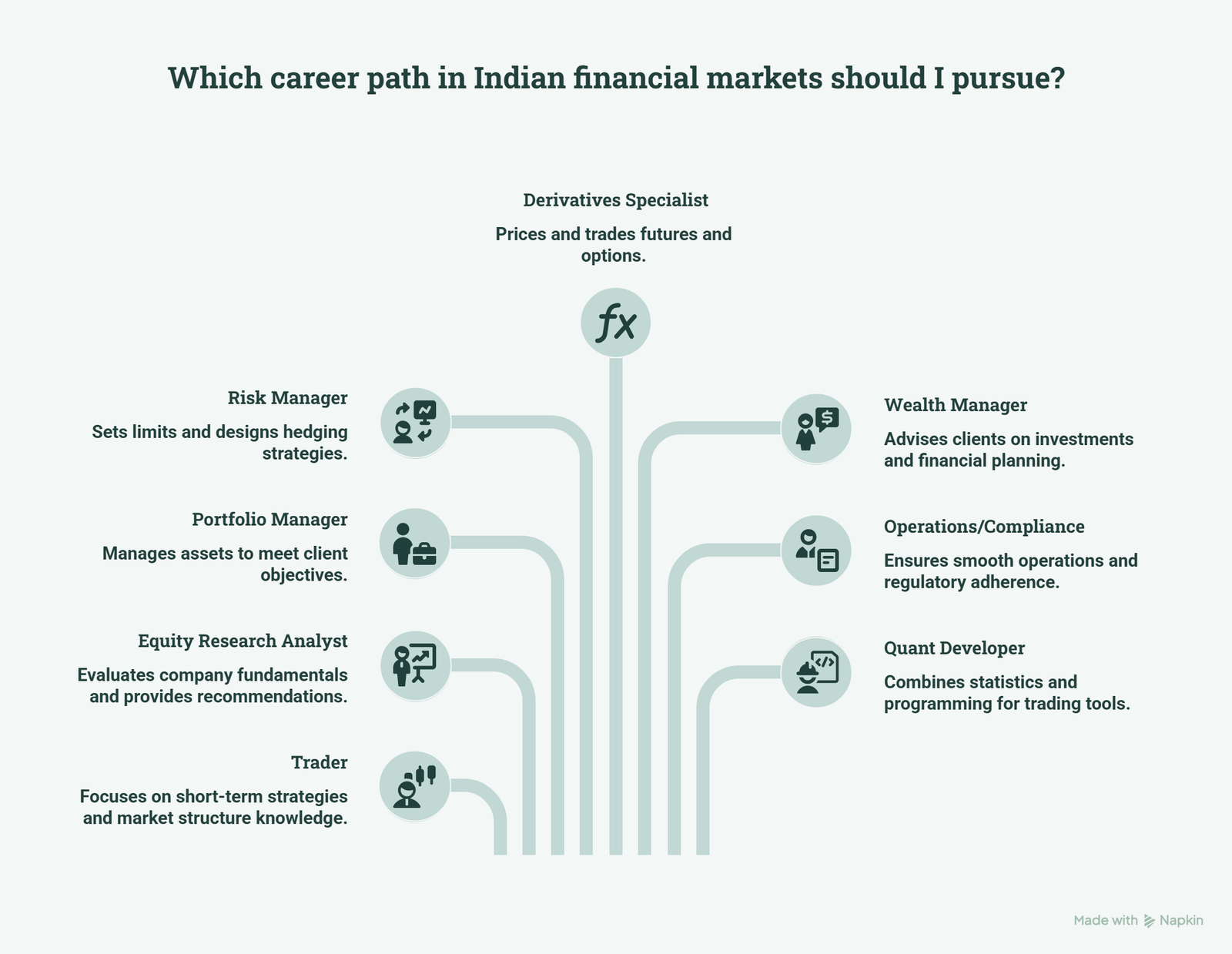
Answer: Roles cluster into front-office (trading, research, sales), middle-office (risk, portfolio management), back-office (operations, settlements), and technology/compliance functions. Each has different day-to-day work, career progression, and skill sets.
Explanation: Front-office roles interact directly with markets or clients. Middle-office translates strategy into controlled execution. Back-office ensures smooth operations. Tech and compliance enable scale and regulatory adherence.
Major career paths (overview)
1. Trader (Proprietary / Institutional / Retail)
Traders execute short-term or intraday strategies for proprietary firms, brokerages, or asset managers. They rely on market structure knowledge, order types, risk rules, and technical patterns.
To learn core trading concepts and practical techniques, begin with foundational material about what the stock market is and then study how exchanges operate in India using how the stock market works. For technical setups and indicators used by traders, the technical analysis framework is essential.
2. Equity Research Analyst
Research analysts evaluate company fundamentals, build financial models, and recommend buy/sell/hold. Common employers include brokerages, institutional asset managers, and investment banks.
Skills: financial statement analysis, valuation (DCF, comparables), sector knowledge, and communication. Core study areas include fundamental analysis and financial statement reading.
3. Portfolio Manager / Fund Manager
Portfolio managers design and manage a mix of assets to meet client objectives. They combine macro views, stock selection, risk budgeting, and client reporting.
4. Risk Manager / Quantitative Risk Analyst
Risk professionals set limits, design hedging strategies, and monitor exposures. They use position sizing rules, scenario analysis, and derivatives to control losses. Practical risk rules for traders and managers are covered in position sizing and risk-management guides.
5. Derivatives / Options Specialist
Derivatives specialists price and trade futures, options, and structured products. Knowledge of option pricing, greeks, and execution strategies is important; start with basic derivatives material such as futures and options explained for Indian markets and option pricing basics.
6. Wealth Manager / Relationship Manager / Financial Advisor
Client-facing roles that advise retail and HNI clients on portfolio construction, mutual funds, and tax-efficient investments. Strong communication, regulatory knowledge, and trust-building are crucial.
7. Operations, Compliance, and Back-Office
These roles ensure settlements, compliance with SEBI rules, reconciliation, and reporting. They are stable career options offering domain exposure and pathways into front-office roles over time.
8. Quant / Algo Developer / Fintech Engineer
Quantitative roles combine statistics, programming, and market microstructure. Employers include prop desks, hedge funds and fintech firms building trading platforms and execution tools. Coding skills (Python, SQL) and experience with historical data are central.
Trading vs Investing — quick comparison
How trading differs from investing
| Trading | Investing |
|---|---|
| Shorter time horizon (minutes to months) | Longer time horizon (years) |
| Requires active position management and technical setups | Relies on fundamentals and portfolio allocation |
| Higher frequency of trades and transaction costs | Lower turnover and focus on compounding |
Education, certifications and practical training
Degrees that help: B.Com, BBA, Economics, Engineering, and MBAs with finance. Professional credentials: CFA (useful for research and portfolio roles), CA (helpful for corporate finance), and NISM/NCFM certifications (relevant for compliance and distribution).
Short, focused courses accelerate readiness. When choosing training, evaluate curriculum fit, practical casework, .-market practice, and post-course support. See a practical checklist when choosing courses: stock market course selection and the broader complete guide to choosing a stock market institute.
Skills and tools employers expect
- Domain knowledge: fundamental analysis, valuations or technical analysis depending on the role.
- Practical market skills: order types, margin rules, and exchange mechanics — learn how markets operate in India via how the stock market works.
- Risk control: position sizing, stop-loss rules, and portfolio risk measurement — see guidelines on risk-management and position sizing.
- Software: Excel, Bloomberg/Refinitiv basics for institutional roles, Python/R for quant roles, and familiarity with trading platforms.
- Soft skills: communication, discipline, and decision-making under uncertainty; trading psychology training can be decisive.
How to start (step-by-step)
- Choose a target role (trader, analyst, operations, quant).
- Build foundational knowledge: read market mechanics and core concepts (stock market basics).
- Complete a practical course or guided training aligned with the role — compare options using the course-selection checklist.
- Practice with simulated accounts or small real capital while documenting every trade or model (logging is essential).
- Network: attend industry events, internships, and apply for analyst/trainee roles.
- Continuously refine skills: specialize in a niche (options strategies, sector research, algo execution) rather than chasing breadth early on.
Common questions
Do I need a finance degree to work in markets?
Direct answer: No — many successful professionals come from engineering, mathematics, or commerce backgrounds. Employers look for demonstrable skills and a track record (internships, projects, trading logs, or coding portfolios).
Is self-learning enough, or should I join a course?
Direct answer: Self-learning can work for disciplined individuals, but structured training shortens the learning curve and provides practical frameworks. See the trade-offs in self-learning versus professional training.
Which market segment pays best in India?
Answer: Compensation varies widely by role, firm size, and experience. Sales and senior portfolio managers at large asset managers, senior quant/tech leads, and successful prop traders on profit-sharing models typically have higher upside. Entry-level roles often start modestly but can grow with performance and specialization.
Day-in-the-life snapshots (short)
- Trader: pre-market market scan, executing strategies, monitoring positions, and reviewing setups post-close.
- Research analyst: company calls, financial model updates, report writing, and idea presentations.
- Risk manager: reviewing exposures, stress tests, limit breaches, and reporting to senior management.
- Operations: settlement reconciliations, trade confirmations, and exception handling.
Five beyond-common-sense insights
- Measure process, not just P&L: Track trade or research process metrics (win-rate, average loss, model accuracy) to improve repeatability. This reduces emotional decision-making.
- Focus on one market microstructure: Specializing in a segment like equity options or intraday cash trading makes it easier to become indispensable than trying to be competent across everything. For derivatives specifically, review futures and options explained to choose a specialization.
- Train psychology actively: Skill drills in risk-limited simulated environments accelerate emotional control. Resources on building trading psychology are practical for early-career traders (trading psychology).
- Short structured projects beat long vague study: Complete small, measurable projects (a valuation model, an algo backtest, or a documented 30-trade experiment) rather than indefinite reading. This portfolio demonstrates capability to recruiters.
- Understand the limits of technical analysis: Technical methods are tools, not guarantees. Combine them with risk rules and confirmation techniques — the limitations are explored in the technical analysis resources to avoid overreliance (technical analysis framework).
Practical resources and topics to study next
- Market mechanics and order types to understand execution advantages.
- Financial statement analysis and valuation techniques for research roles.
- Option pricing and hedging for derivatives roles — use primer material on option pricing.
- Risk frameworks and position sizing rules: risk management guides.
- Technical indicators and chart patterns for short-term trading: see the technical indicators and patterns guides.
How to choose the right path for you
- Assess strengths: numerical and coding strength suits quant roles; communication and client skills favor sales/wealth management; pattern recognition and discipline suit trading.
- Test with short projects: build a model, trade a small account, or write an industry note to validate interest and aptitude.
- Seek mentorship or internships to confirm fit before committing to a long credential like CFA or MBA.
Conclusion
Career paths in Indian financial markets are diverse and rewarding for people who combine domain knowledge with practical skills, disciplined process, and a willingness to specialise. Actionable next steps: pick one target role, close skill gaps with a focused course or project, document measurable results, and network into internships or entry-level roles. If you’re deciding between self-study and structured training, compare your learning discipline, time horizon, and need for hands-on practice.
If you found this useful, please share your career goals or questions in the comments — readers often benefit from specific examples and I encourage you to ask for role-specific guidance.