

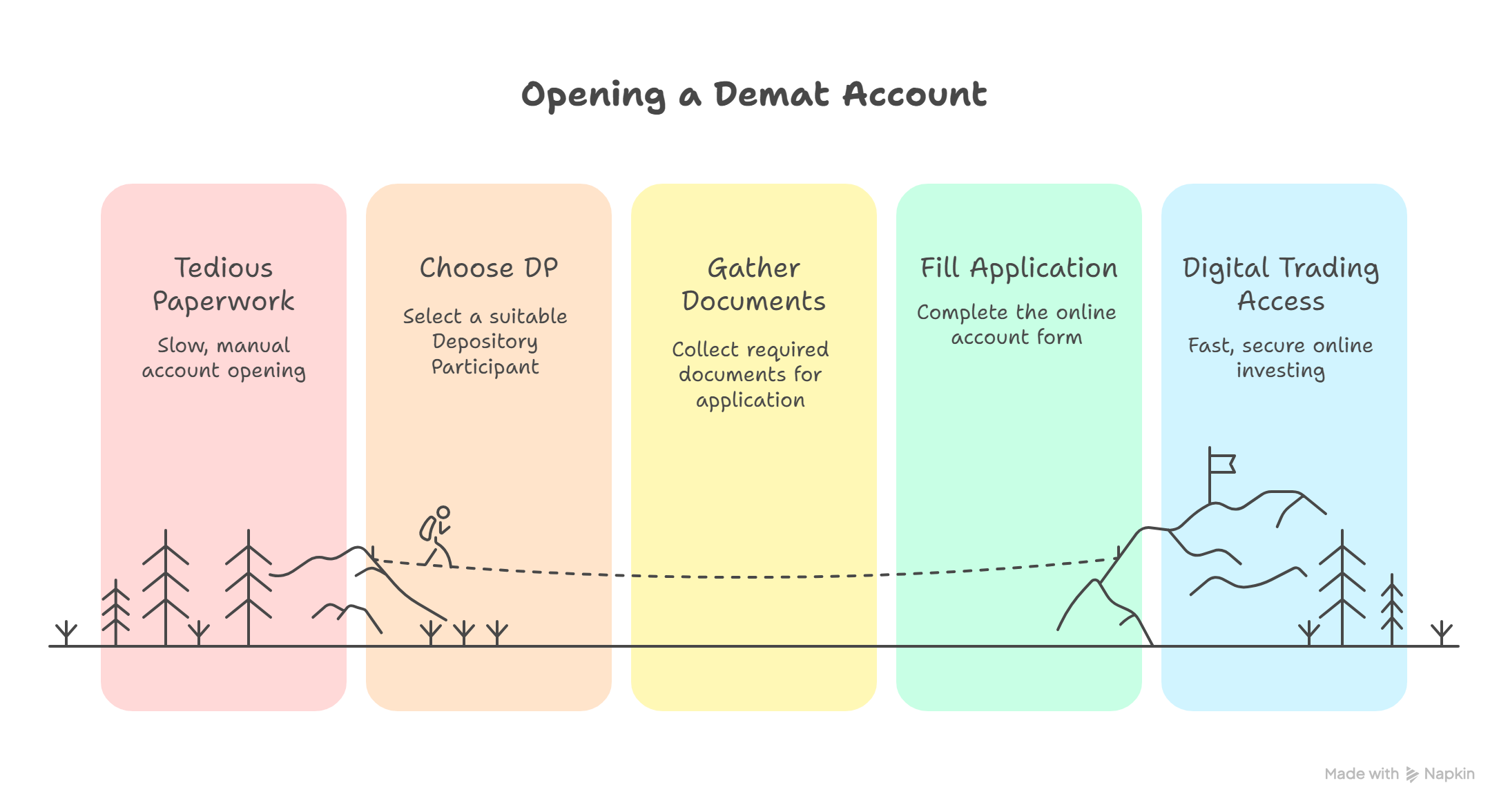
Opening a demat account is the gateway to participating in India’s flourishing digital trading ecosystem. Over the past decade, I’ve seen firsthand how the process has shifted from tedious paperwork and lengthy waits to a rapid, digital-first experience. Below I’ll guide you through everything you need to know: demat account essentials, the seamless five-step process, tips from my own and users’ experiences, and advanced insights so you don’t just open an account—you open the right account for you.
Quick Summary
- A demat account holds your securities electronically and is essential for digital trading in India.
- The opening process is now digitized and just five steps: choose a Depository Participant (DP), gather documents, fill the application, complete KYC, and sign the agreement/e-sign.
- Key requirements include PAN, Aadhaar, bank details, and up-to-date KYC information.
- Comparing DPs and understanding fees, tech platforms, and customer service is crucial before opening an account.
- Account activation typically takes a few hours to a couple of days when done online.
Introduction to Demat Accounts and Digital Trading
When I opened my first demat account, I was amazed at how much easier it was compared to the stories I’d heard from friends who started investing a decade earlier. Today, dematerialization (“demat”) means you hold shares and other securities in digital form, making them easier to buy, sell, transfer, and monitor. This not only makes trading faster and safer but is now required by SEBI for most transactions, ensuring the Indian securities market keeps pace with rapid digitalization.
Demat accounts are managed by depositories like NSDL or CDSL, but you interact with these through intermediaries known as Depository Participants (DPs)—these are banks, brokers, and financial fintechs. The sharp rise in digital traders, with over 15 crore demat accounts as of 2024, proves how the process has simplified and how confidence in online trading has soared.
Understanding Dematerialization and Its Importance
Dematerialization means converting physical share certificates or securities into electronic records, eliminating risks of loss, theft, or damage, and streamlining settlements. For me, the biggest relief is not having to worry about misplaced certificates or T+2 settlement delays. Everyone from new investors to seasoned traders now enjoys faster market access, instant portfolio updates, and the ability to transact from anywhere via their phone or computer. Open a demat account and you empower yourself with this convenience and security.
Step 1: Research and Choose a Depository Participant (DP)
Think of your DP as your portal to the stock market—a partner that holds your securities securely and enables trading. DPs include traditional banks (HDFC, ICICI), full-service brokers, and discount brokers (Zerodha, Angel One, Upstox). The right DP can make trading smooth, cost-effective, and secure; the wrong one can lead to headaches.
Here’s a quick comparison:
| DP Type | Key Features |
|---|---|
| Full-Service (e.g., HDFC, Kotak Securities) | Comprehensive research/advisory, higher fees, branch support |
| Discount Brokers (e.g., Zerodha, Angel One) | Low/flat fees, tech-driven, self-service, fewer offline branches |
Factors to consider: reputation (look for a SEBI-registered DP with a clean track record), ease of use (intuitive mobile/desktop platforms), customer service response time, fee transparency, and technology (reliable apps and trading tools). Many Redditors, like u/digitalinvestor2023, recommend “choosing a DP that offers smooth mobile KYC and responsive support, especially if you’re new—don’t fall for just zero-brokerage ads.”
For a hands-on comparison, check the Zerodha online account page or the Angel One demat account opening for their respective features and offers.
Step 2: Gather Necessary Documents
Nothing stalls the process like missing paperwork. Be sure to collect and have digital scans or clear mobile photos of these:
- PAN card (mandatory for all investors).
- Aadhaar card (enables instant e-KYC and address proof).
- Recent bank statement or canceled cheque (to verify bank linkage, essential for settlements and dividends).
- Passport-sized photo and a clear signature on plain white paper.
If you’re an NRI, you’ll also need proof of overseas address, passport, and visa. For minors or joint accounts, there are extra steps—full details are always clearly listed during the online application. Ensure documents are current and details match across all IDs—“Mismatch between signature on PAN and uploaded photo delayed my activation by a week,” shared u/simplemarkets in a popular forum thread. Take a few extra seconds to double-check before uploading, and you’ll avoid these common delays.
Step 3: Fill Out the Account Opening Form
You can access the DP’s application form online (via web or app). Filling it out is straightforward, but accuracy matters—your name, date of birth, and address must exactly match your official documents. Options typically include:
- Filling and submitting the form online with e-signature (the fastest method)
- Downloading, printing, and submitting at a local branch (if you prefer in-person or have complex cases like NRIs/corporate accounts)
Online forms often auto-fetch details from your Aadhaar or DigiLocker, minimizing manual entry. If you submit physically, make sure all fields are legible and no section is left incomplete.
Digital submission trumps paper in terms of speed and convenience. However, in rare cases (like corporate accounts), branch visits may still be required. For most users, e-sign and upload processes are hassle-free—just ensure strong internet during uploads.
Step 4: Complete the Know Your Customer (KYC) Process
This is a regulatory must. KYC involves verifying your identity, address, and (sometimes) income details. Most DPs allow seamless e-KYC using your Aadhaar—an OTP sent to your linked mobile number completes identity checks instantly.
For further compliance, you may also undergo “Video KYC,” where you record a short clip showing your face and original PAN card—usually guided step-by-step by the app. According to Choice Broking, their advanced e-KYC and video verification enable account activation within four hours if details are correct.
KYC updates aren’t one-time; you’ll periodically be asked to confirm or refresh details to comply with SEBI norms—so do respond when prompted to avoid future account freezes.
Step 5: Sign the Agreement and Initiate the Account
Once all documents are uploaded and KYC is complete, you will electronically sign the DP agreement—legally binding you and confirming understanding of the rights, charges, and obligations. Always read the agreement, even if tedious. It covers terms for demat operations, dispute handling, and fees. I make it a point to scan at least the main points, especially regarding charges and liability—the fine print matters.
Account activation is now quick: after e-signing, your unique Demat account number, client ID, and trading credentials are sent via email/SMS. You can usually start exploring the trading dashboard almost immediately after online activation—sometimes there’s a brief waiting period (up to 48 hours) for full trading privileges. Customer support is available via chat or phone if you’re stuck anywhere in the process; in my experience, a quick WhatsApp query often resolves any technical snags.
Understanding Types of Demat Accounts
It’s worth clarifying that not all demat accounts are the same. The main types include:
- Regular Demat Account: For resident Indians trading in equity or debt
- Repatriable/Non-Repatriable NRI Accounts: For Non-Resident Indians, subject to RBI approvals
- Corporate Demat Accounts: For firms and businesses, requiring more documentation
Most individual retail investors choose the regular account, but if you have specific requirements (NRI status, minor accounts, etc.), review your DP’s dedicated process and document needs.
Five Advanced Insights About Opening a Demat Account
- Most accounts are activated within hours: Due to automation and e-KYC, leading brokers now activate accounts in 4 to 24 hours, versus days in the past.
- Aadhaar-based e-KYC is required for instant opening: If your mobile is not linked to Aadhaar, you’ll fall back to manual KYC—which can take a week or more.
- UPI-based penny drop verification is safer and faster than cheque scans: Platforms like Zerodha and Angel One use a ₹1 transfer to verify your bank instead of requiring scanned cheques, reducing errors and fraud risks.
- Automated document validation detects mismatches instantly: AI checks scan your uploaded photos, signatures, and IDs for consistency. This is why even small differences can lead to account delays or rejections.
- Annual Maintenance Charges (AMC) vary widely—and aren’t always advertised up-front: While “zero account opening” deals attract users, hidden fees can add up. Read the complete fee schedule to avoid nasty surprises.
Common Mistakes to Avoid When Opening a Demat Account
From my experience and that of dozens of forum users, here are the pitfalls you can sidestep:
- Uploading blurry or mismatched document scans: Always preview before submitting. If your signature isn’t identical everywhere, upload a clearer one.
- Choosing a DP for just one feature (like zero brokerage) and ignoring ongoing fees or customer service: Consider support, platform reliability, and reviews as well.
- Assuming demat and trading accounts are the same: They’re often bundled but serve different purposes. Ensure both are activated if you want to buy/sell.
- Ignoring nomination forms: SEBI now requires nomination—do it up front to protect your family’s interests.
- Delaying KYC updates: Neglecting periodic KYC requests, even post-activation, can freeze your account.
On r/IndiaInvestments, u/marathimarket aptly wrote: “Wish someone told me earlier about AMC—‘zero account open’ lured me but after 3 months the charges slowly crept in!”
Costs, Charges, and Fee Comparison
| Fee Type | Common Range / Example |
|---|---|
| Account Opening Fee | ₹0–₹500 (many DPs waive this to attract new users) |
| Annual Maintenance (AMC) | ₹0 (promotional) to ₹600/year; Angel One gives 1st year free, then ₹20/month* |
| Brokerage Charges | Zero to flat ₹20/trade for de.ry/intraday (discount brokers) |
| Other Service Charges | Pledge, dematerialization, statement printing (may apply as per usage) |
*Check your DP’s latest fee schedule for updated and detailed charges.
Security and Regulatory Safeguards
Modern digital DPs deploy high-level encryption, 2FA (two-factor authentication), AI fraud checks, and compliance audits, making the process safe. Zerodha and Angel One both underscore no account can be opened without SEBI-mandated KYC and regular document checks, and your securities are held with NSDL/CDSL—offering regulatory protection no matter which broker you pick.
Frequently Asked Questions
- Do I need both a demat and trading account? Yes, for stock trading you need both—the demat account holds your securities; the trading account executes buy/sell orders.
- Is online demat account opening safe? With Aadhaar e-KYC, secure servers, and encryption, modern DPs ensure account opening and operation are very safe when you use official platforms.
- Can I open multiple demat accounts? Yes, you can have more than one account with different DPs—just use the same PAN for individual holdings.
- What causes delays in account opening? Most delays are due to document or signature mismatches, or incomplete KYC. Double-check all uploads for accuracy.
- How do I transfer shares from an old demat account? Submit a De.ry Instruction Slip (DIS) to your DP or use the online transfer option if supported.
Glossary
- Demat Account: Electronic account to hold, transfer, and manage investment securities.
- Depository Participant (DP): Intermediary (bank/broker) authorized to open/manage demat accounts.
- KYC (Know Your Customer): Regulatory process to verify identity and address of investors.
- NSDL/CDSL: National and Central depositories safeguarding your digital securities.
- AMC (Annual Maintenance Charges): Yearly fee for maintaining the demat account.
- PAN: Permanent Account Number, India’s primary financial identity document.
Conclusion
Looking back, when I first stepped into digital trading, the demat account opening process was stressful and slow—waiting days for verification, hunting down documents, and worrying about missing signatures. Now, with tech-driven platforms and robust KYC, the whole experience is rapid and user-centric. Let me recap the actionable, step-by-step process:
- Start by choosing the right Depository Participant—consider reputation, tech, and fee transparency.
- Gather all essential documents—PAN, Aadhaar, bank proof, and ensure details match across forms.
- Accurately fill out the online account opening application—let technology auto-fill when possible.
- Complete e-KYC and, if prompted, video verification for instantaneous regulatory checks.
- E-sign the agreement and get your demat and trading credentials—ready for your trading journey within hours in most cases.
From holding shares securely to buying and selling them from anywhere, a demat account is your ticket to safe, efficient, and fully online investing. My advice? Take a few minutes to compare DPs and read the fine print—you’ll thank yourself later. If you’ve navigated the process before, or if you have questions on specific brokers or tricky scenarios, drop your thoughts in the comments! Let’s build smarter, safer investor journeys together.