


Understanding the mechanics of the stock market is essential not just for traders but for anyone aiming to invest wisely for the long term. As an investor myself, I learned very quickly that simply buying and selling shares isn’t enough—how you execute each trade can profoundly impact your results. That’s where mastering different order types comes in. Knowing how you enter or exit a position is as crucial as deciding which stock to buy or sell. In this article, I’ll break down the eight primary stock market order types, share real-world insights, and help you pinpoint which approach works best for your strategy.
Quick Summary
- Market orders offer quick execution, ideal for liquid stocks but risk slippage in volatile markets.
- Limit orders give price control but may go unfilled if the price isn’t reached.
- Stop and stop-limit orders automate risk management but can surprise you during fast moves.
- Trailing stops dynamically protect gains yet may trigger on market noise.
- Market-on-close and limit-on-close orders prioritize end-of-day pricing tactics.
- Day and Good ‘Til Canceled (GTC) orders control order duration and corresponding risks.
- Advanced order types (iceberg, FOK, TWAP, etc.) serve professional execution and are gaining traction with retail traders.
- Choosing the right order type is key to balancing speed, price, and execution certainty across changing market conditions.
1. Market Orders
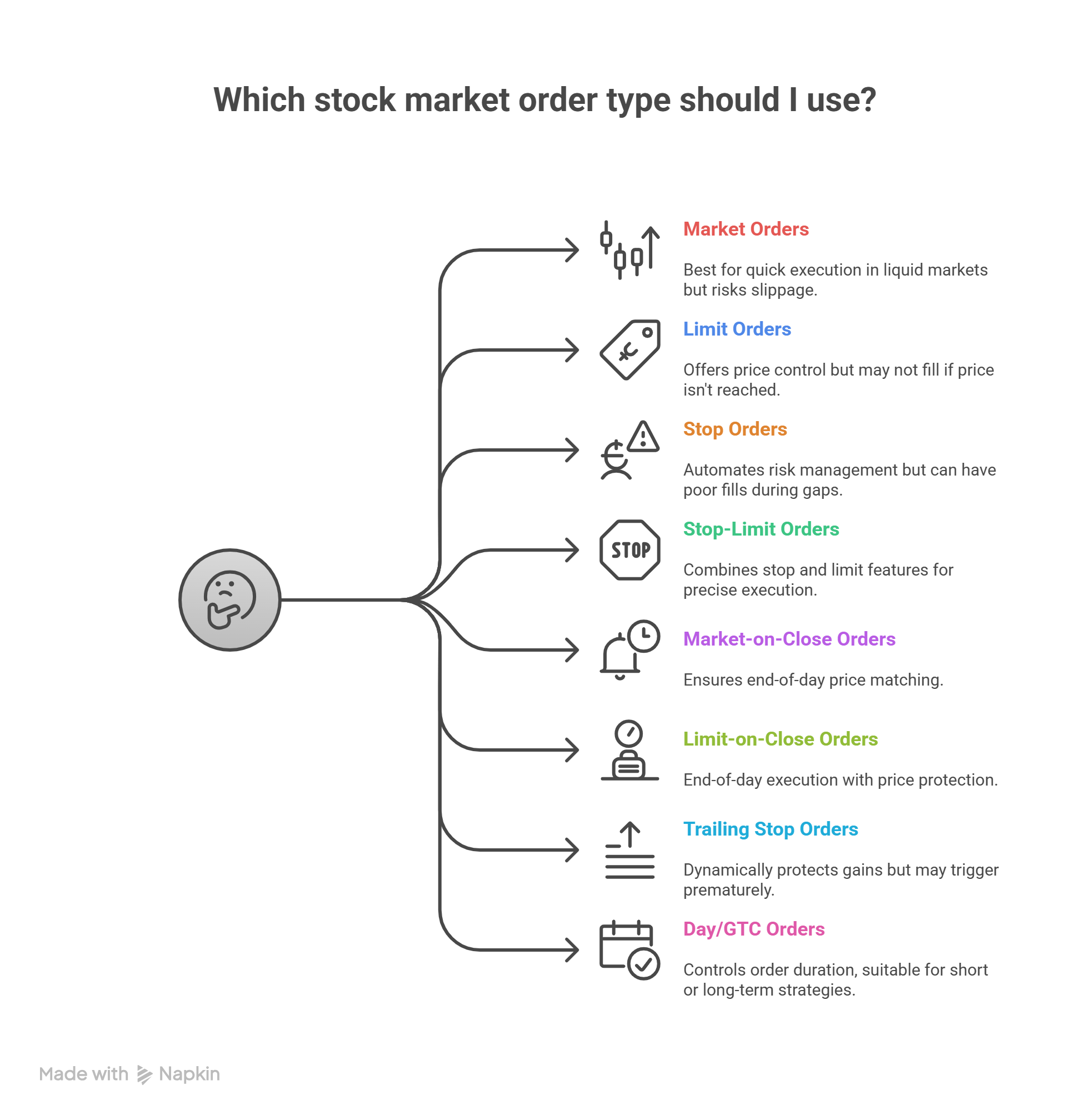
Market orders are the most basic way to buy or sell a stock. You tell your broker you want to buy or sell immediately at the best price currently available. This is often used when your top priority is a quick transaction, not pinpointing a particular price.
Educational sources highlight that most retail traders use market orders when trading highly liquid stocks or ETFs because execution is nearly instantaneous, especially during normal hours. Dr. Jim Dahle, writing on White Coat Investor, says: “For extremely liquid ETFs like VTI, VXUS, and ITOT, market orders work just fine, even in turbulent times, since spreads are so tight.”
Pros: Fastest order type; high probability of fill in liquid markets.
Cons: You might pay more (or sell for less) than you expected in fast-moving or illiquid markets.
- Use market orders when: You’re trading major stocks or ETFs, need quick entry/exit, and tight spreads are available.
- Avoid them: During earnings releases or big news events, as slippage can be severe.
2. Limit Orders
Limit orders let you set the maximum price you’re willing to pay (when buying) or the minimum price you’ll accept (when selling). The trade happens only if the market reaches your specified limit. These orders are vital for anyone who values price control over instant execution.
On the Bogleheads forum, user Ron Scott describes setting “limit orders well below the current market to catch opportunistic dips”—a practice that’s helped him accumulate positions during sudden market downturns without constantly monitoring prices.
Pros: Complete control over the entry/exit price; no surprises from fast-moving quotes.
Cons: The order may not fill at all if the market never reaches your limit—patience (or luck) is required.
- Ideal for: Illiquid stocks, volatile conditions, or when you’re willing to miss a trade if a price isn’t met.
3. Stop Orders (Stop-Loss Orders)
A stop order (often called a stop-loss) automatically turns into a market order if a stock crosses a preset price. Typically, it’s used to limit downside risk or enter trades on breakout moves.
Educational guides emphasize that stop orders “trigger a sale or purchase once the stop price is hit—but your actual fill price may differ if the market gaps past your stop.” In my experience, stop orders work best for liquid assets, but I’ve learned (sometimes the hard way) that catastrophic earnings moves or flash crashes can lead to ugly execution prices.
Pros: Automatic, emotion-free risk management; useful for protecting profits.
Cons: Prone to poor fills when gaps happen—”stop triggered at $40 but filled at $38″ is a real possibility.
- Ideal scenario: To cap potential loss without watching the market constantly.
4. Stop-Limit Orders
A stop-limit order combines the features of stop and limit orders. When your stop price is reached, a limit order is submitted rather than a market order. This way, you’re protected against disastrous fills—at the cost of possibly missing your exit.
As explained on Schwab’s educational site, “A stop-limit order will only execute within the price band you specify,” but if the market moves too quickly, it may not fill at all. Advanced traders use this when adverse slippage is unacceptable—yet accept that incomplete fills are the risk.
Pros: More precise execution than a plain stop order.
Cons: Increased chance the order won’t execute if prices move sharply past the limit.
- Best used when: You want to exit a trade on certain conditions, but only within strict price boundaries.
5. Market-on-Close Orders (MOC)
A market-on-close (MOC) order instructs your broker to execute a market trade right at (or just before) the closing bell—guaranteeing participation in the end-of-day price action.
According to professional trading discussions, this is popular with index fund managers who need closing prices to track benchmarks precisely. “MOC orders help reduce tracking error against closing benchmarks in S&P 500 funds,” one pro trader commented on a forum.
Pros: Ensures end-of-day price matching.
Cons: Potential for slippage or unexpected fills if the last-minute market is volatile.
- Ideal for: Portfolio managers or anyone who must match closing prices precisely (e.g., index/ETF traders).
6. Limit-on-Close Orders (LOC)
Limit-on-close (LOC) orders are similar to MOC, but here you designate the limit price. The order only fills at or better than your price, right at market close.
These orders are useful when you want end-of-day execution but will not accept a fill worse than your target. A brokerage educator noted, “LOC orders protect against last-minute price spikes that can sneak into MOC executions.”
Pros: End-of-day execution with price protection.
Cons: The order may not fill if the price isn’t reached, missing out on closing action.
- Best for: Traders managing overnight risk who need closing prices, but dislike surprise fills.
7. Trailing Stop Orders
A trailing stop order is a dynamic version of the classic stop order. The stop price automatically adjusts upward (for a buy or long position) or downward (for a short/ sell) as the market moves in your favor—locking in gains while letting profits run.
Charles Schwab’s guides illustrate trailing stops as a way to “let your winners run higher, but with an automatic exit if the move reverses.” In volatile periods, I’ve used trailing stops to ride upward trends, but I’ve also been stopped out by temporary price hiccups—so choosing the right trailing distance is key.
Pros: Flexible profit protection; reduces need to constantly monitor trades.
Cons: In choppy markets, stops may trigger prematurely and remove you from positions too early.
- Best for: Trend-followers aiming to maximize returns and minimize regret over missed reversals.
8. Day Orders and Good ‘Til Canceled Orders (GTC)
Day orders are only active during the current trading session—if unfilled, they expire at the market close. Good ‘Til Canceled (GTC) orders stay active until filled or manually canceled, often for up to 30–90 days before most brokerages automatically remove them.
Day orders are perfect for day traders who don’t want overnight exposure. A Bogleheads forum user shared: “My GTC limit orders for USMV sit well below the market… Sometimes it takes months for a flash crash to trigger a fill, but I’m glad I left them open because I’ve caught some spectacular entries.”
| Order Type | Best Use |
|---|---|
| Day Order | Short-term tactical trades; avoiding overnight risk |
| GTC Order | Long-term entries/exits away from current market; requires patience |
Pros: Fits your desired trade duration.
Cons: GTC orders can become “stale” and trigger unexpectedly if the market moves due to unrelated events; day orders may require daily re-entry.
- Choose Day orders: When you want no overnight exposure.
- Choose GTC orders: For set-and-forget long-term entries.
Advanced Insights: Beyond-Common-Sense Realities
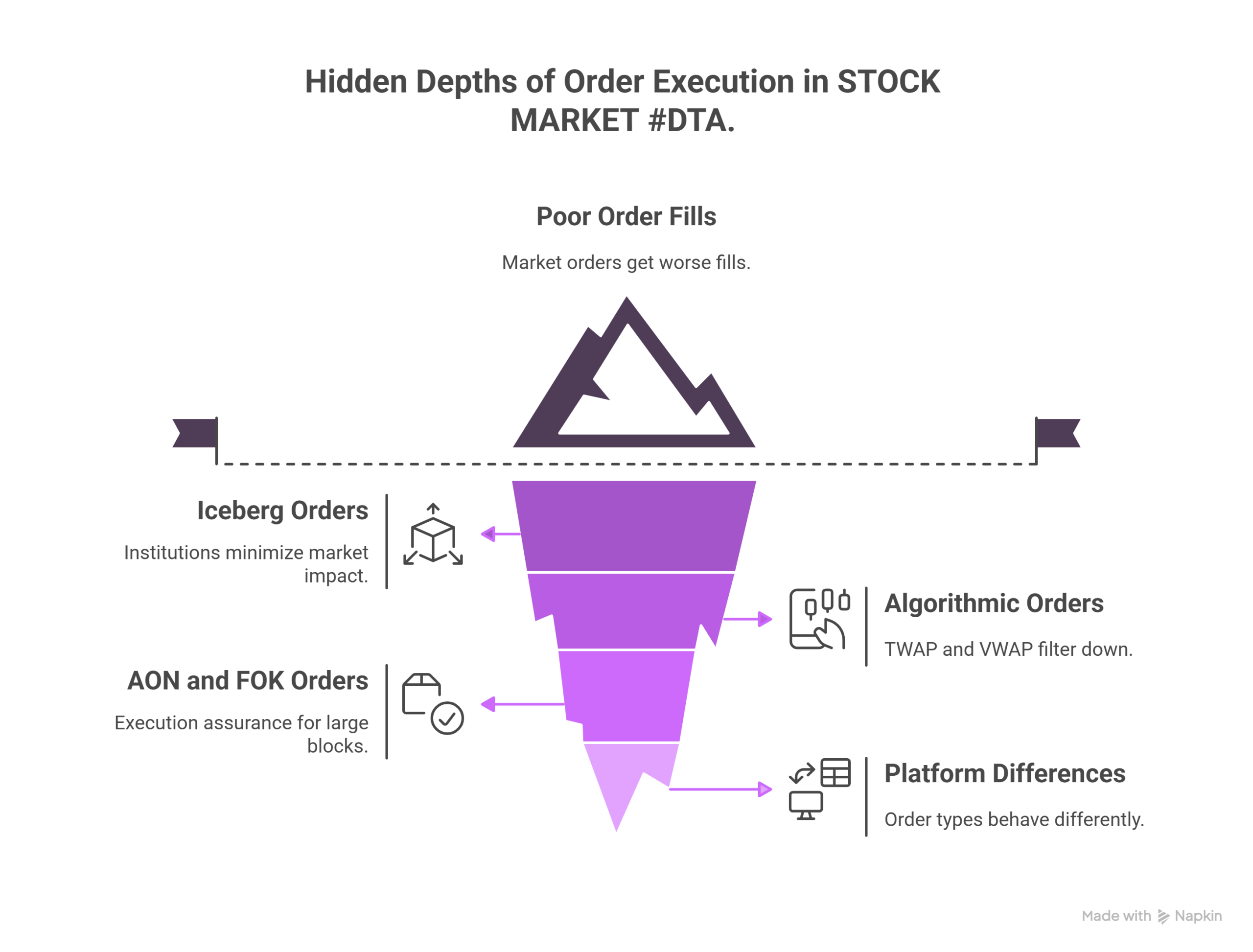
- Market orders can yield dramatically worse fills in low-liquidity securities or after-hours trading—sometimes several percent away—an issue widely reported both by retail traders and professionals.
- Iceberg orders (where only part of a large order is visible on the book) are increasingly used by institutions to minimize market impact; retail traders often “see” these in action but may not realize it.
- Algorithmic order types like TWAP (time-weighted average price) and VWAP (volume-weighted average price) are now filtering down from institutional desks to advanced retail brokerage platforms.
- All-or-none (AON) and fill-or-kill (FOK) orders provide execution assurance for large blocks; these are crucial for traders who must avoid partial execution (e.g., in arbitrage or large ETF hedging) but are rarely offered by all platforms.
- Order types may behave differently on different broker platforms. For example, on Alpaca, one Reddit user (@deadpixeltrader) reported “limit sell legs getting stuck in Held status for bracket orders,” showing that platform glitches can affect even the best-laid execution plans.
Conclusion

From navigating my first market order to learning the pain points of stops during a flash crash, I’ve found that mastering stock market order types is far more valuable than I once realized. In our journey above, I walked you through market, limit, stop, stop-limit, trailing stop, MOC, LOC, GTC, and day orders—each with unique strengths and weaknesses, real-world user experiences, and common pitfalls. Here’s the step-by-step process I always recommend:
- First, clarify your trading or investing goal and urgency—does price, certainty, or timing matter most?
- Next, pick an order type that matches your priority—market for speed, limit for price, stops for risk, and GTC/LOC for extended exposure or closing prices.
- If you’re moving large volumes, consider advanced types (iceberg, FOK, VWAP) but check your platform’s capabilities first.
- Always test new order types with small positions and check for broker-specific quirks—don’t assume universal behavior.
- Finally, monitor your execution results and adapt as you gain experience. Even the pros refine their approach constantly.
Have questions about a specific order type, or a story about a trade that didn’t go as planned? Leave a comment below—I’d love to hear your experience and learn together.
Additional Resources
- White Coat Investor: Stock Orders – A Primer
- Bogleheads Forum: Tactical Use of Limit and GTC Orders
- Schwab Learning Center: Stock Order Types Explained
- Investopedia: Trading Basics
- For personal guidance, consult your broker’s educational resources or reach out to a licensed financial advisor.