



Understanding margin, leverage and SPAN is essential for anyone trading futures and options (F&O) on Indian exchanges. These three concepts determine how much capital you must put up, how large a position you can take, and how exchanges measure portfolio risk. This article explains what each term means, how margins are computed in India, how leverage works in practice, and practical rules to manage margin-related risk.
- Quick Summary
- SPAN (Standard Portfolio Analysis of Risk) is the exchange’s scenario-based engine: it calculates the worst-case loss across many market scenarios and is the core component of F&O margin in India.
- Exchanges add an exposure margin (or additional margin) on top of SPAN to cover gap risk — the total margin you must deposit equals SPAN + exposure + any broker/exchange add-ons.
- Leverage equals the notional value of the contract divided by the margin required; higher margin reduces leverage and vice versa — but effective risk depends on worst-case loss, not just headline leverage.
- Hedging and spreads reduce SPAN requirements because SPAN measures portfolio-level risk; selling naked options attracts much higher margins than buying options.
- Always keep margin buffer: margins can change with volatility and open interest, and exchanges or brokers can increase requirements with short notice.
What is margin in Indian F&O?
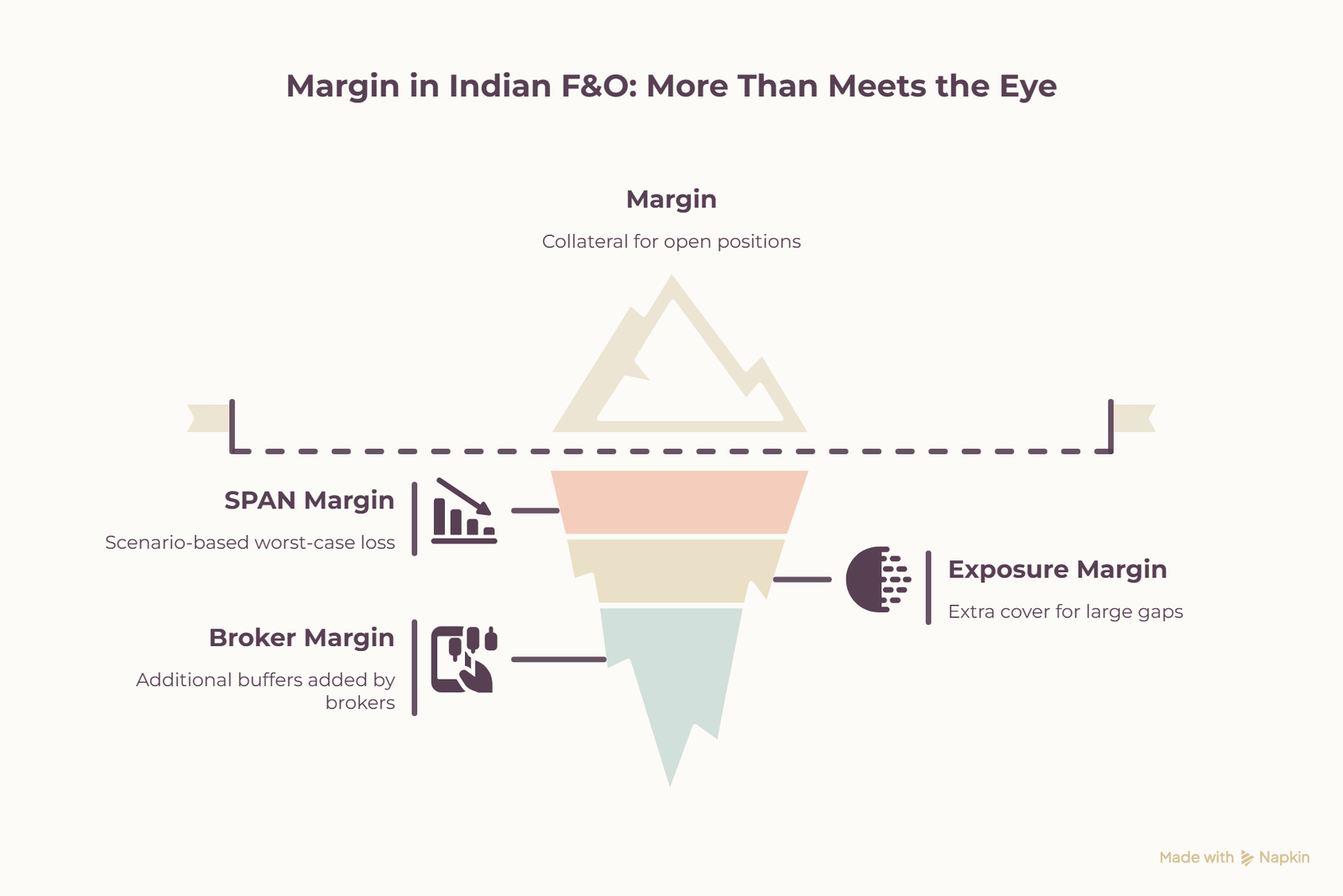
Answer: Margin is collateral required by the exchange/broker to cover potential losses on open derivatives positions.
Explanation: Margin is not a fee or purchase price — it is a security deposit held to cover possible adverse moves. For F&O in India, margin is collected to protect the clearinghouse and market participants. The exchange calculates margins using a portfolio-level risk model (SPAN) and then adds exposure or additional margins to cover tail risks. Brokers collect and hold these margins in client accounts.
Common margin components
- SPAN margin — scenario-based worst-case loss computed on the portfolio.
- Exposure margin — extra cover for large gaps or residual risk not captured by SPAN.
- Additional/broker margins — some brokers add their own buffers (depending on client profile or intraday product type).
What is SPAN and how does it work?
Answer: SPAN (Standard Portfolio Analysis of Risk) is a system that simulates multiple price and volatility scenarios to estimate the maximum potential loss of a portfolio over a defined time horizon.
Explanation: SPAN runs hundreds of hypothetical market scenarios (different price moves, volatility shifts) against each position in the portfolio and identifies the worst outcome. Because it evaluates the whole portfolio, SPAN rewards offsetting positions — for example, long and short positions in correlated strikes or expiries reduce net portfolio risk and therefore lower the SPAN requirement.
How is exposure margin different from SPAN?
Answer: Exposure margin is an extra buffer separately applied to cover gap risk and extreme events that SPAN might not fully capture.
Explanation: While SPAN focuses on defined scenarios, exchanges add exposure margin to protect against sudden, large price moves between market sessions or during extreme volatility. The total exchange margin payable is typically SPAN + exposure.
How is leverage calculated in F&O?
Answer: Leverage = Notional value of the position ÷ Margin required.
Explanation: The notional value is the market value of the contract (contract size × price). For example, a futures contract’s notional = lot size × index/stock price. If the notional value is large and margin is relatively small, headline leverage will be high. However, headline leverage can be misleading — effective leverage should consider worst-case portfolio loss and margin add-ons.
Simple leverage example (variables only)
- Notional value = LotSize × Price
- Margin required = SPAN + Exposure + Additional
- Leverage = Notional value / Margin required
Using variables avoids specific margin rates (which change by contract and volatility). When you plug actual numbers from your broker/exchange into those formulas you get the operational leverage for that position.
How margin works for buyers vs sellers of options
Answer: Buyers of options typically pay only the premium (no margin), whereas sellers/writers of options must post margin because their potential loss can be large.
Explanation: When you buy an option you pay the premium and have limited downside (premium paid). When you sell a naked option you expose yourself to potentially unlimited (calls) or large (puts) losses. Exchanges therefore require margin for sellers — often computed with SPAN plus a larger exposure margin — to ensure the seller can cover adverse moves. Hedged option strategies (spreads) typically require lower margins because offsetting positions reduce portfolio risk under SPAN.
Practical rules to manage margin and leverage risk
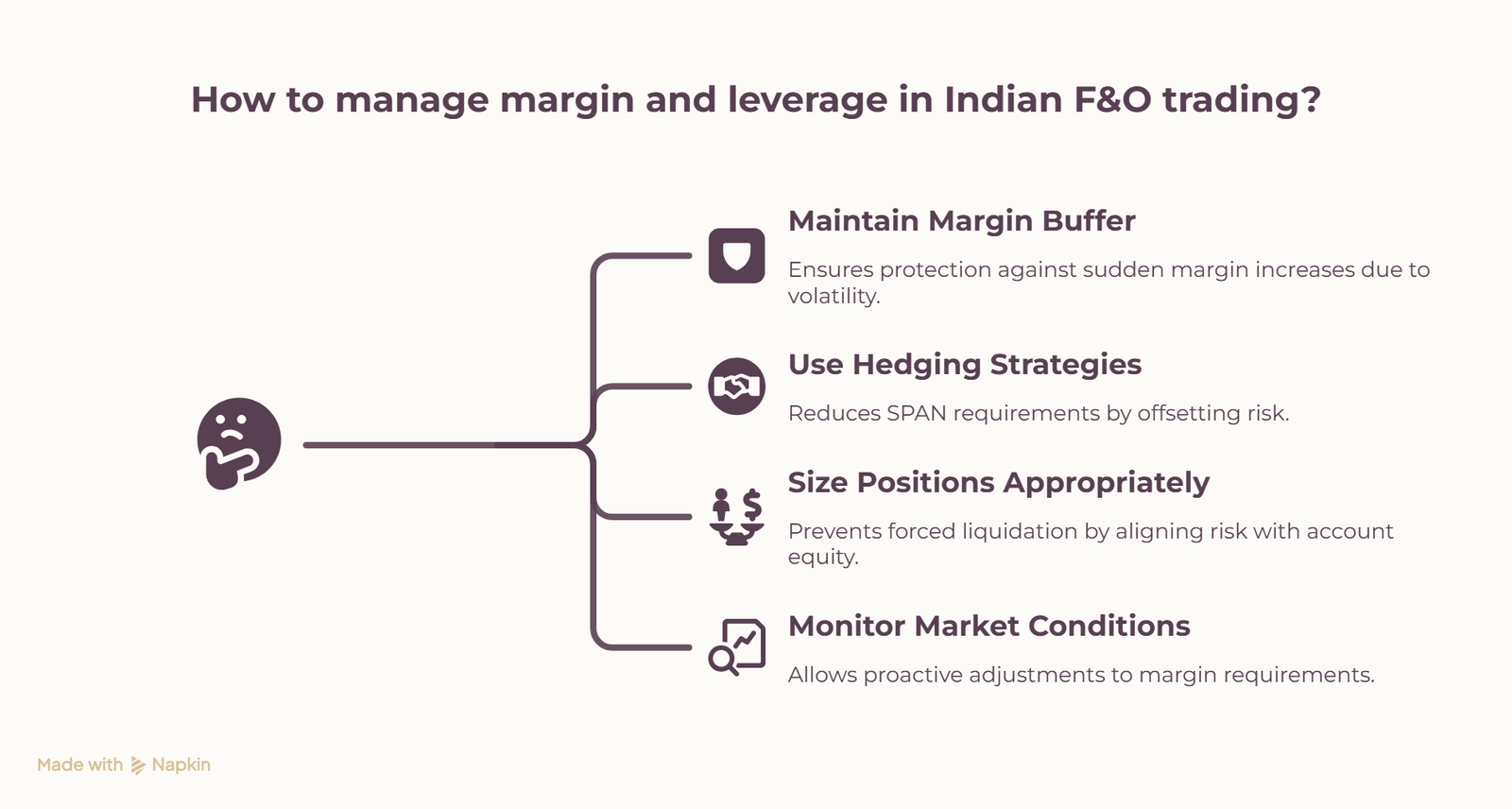
- Always maintain a buffer above the margin required. Real-time volatility or exchange announcements can increase margins quickly.
- Use spreads and hedges to reduce SPAN-based requirements — offsetting positions lower portfolio risk and therefore margin.
- Size positions using risk-based rules (not just available margin or desired leverage).
- Monitor open interest and volatility; rising open interest and volatility often push exposures and margins higher.
- Keep separate capital for margin to avoid forced liquidation during short-term drawdowns.
Position-sizing reminder
Apply position-sizing rules that tie risk to account equity and worst-case loss, not only to margin. For practical guidance on position sizing rules and limits, see detailed methods such as the 2% rule and broader risk-management frameworks.
Understanding position sizing using the 2% rule helps convert margin and leverage into safe trade sizes, while formal risk rules explain how to limit capital at risk per trade.
Two-column comparison: Margin vs Leverage
Quick comparison table
| Margin | Leverage |
| Collateral required to hold a derivatives position (calculated by SPAN + exposure). | Ratio showing how large a position you control relative to your margin (Notional ÷ Margin). |
Examples of margin-reducing strategies
- Use intramonth spreads to offset directional exposure — SPAN treats offsetting strikes/expiries favorably.
- Prefer defined-risk strategies (buying options or debit spreads) when you want limited downside with known premium cost.
- Move from naked positions to hedged pairs to reduce exposure margin and broker add-ons.
How to check margins and who sets them
Exchanges (for example the National Stock Exchange) set the SPAN grids and exposure rules — brokers display the margin required in your trading terminal. Always verify the exchange-specified SPAN and exposure numbers for each contract and the broker-specific additional margins or intraday products they offer.
For a clear primer on F&O instruments, contract specifications and basic mechanics, review introductory materials designed for Indian markets.
See an accessible overview of futures and options mechanics here: futures and options explained for Indian markets.
Common questions (Direct answer + brief explanation)
Will margin requirements change during market hours?
Direct answer: Yes — exchanges or brokers can change intraday margin requirements in response to extreme volatility.
Explanation: Sudden spikes in volatility or major announcements can prompt exchanges/brokers to raise margins. This is why a cash buffer beyond the displayed margin is important.
Does SPAN reward hedging?
Direct answer: Yes.
Explanation: Because SPAN evaluates the portfolio across scenarios, hedged positions that offset risk reduce worst-case losses and therefore lower SPAN requirements.
Where can I learn more about option pricing and why selling options needs higher margins?
Direct answer: Option pricing explains premium components and why sellers carry higher risk.
Explanation: Option premiums include intrinsic value and time value; sellers face the obligation side of the contract and hence exchanges require margin. For a focused explanation of those pricing components, see materials on option pricing.
Further reading on the mechanics of option pricing and time value is available here: option pricing: intrinsic and time value.
Beyond-common-sense insights (practical technical points)
- SPAN benefits disciplined hedging: structured multi-leg hedges produce non-linear margin benefits under SPAN because the engine measures net portfolio exposure rather than per-leg worst-case losses.
- Headline leverage understates tail risk: two positions with the same notional/margin ratio can have very different worst-case losses depending on optionality and skew — always check potential worst-case scenarios, not only leverage.
- Margin efficiency varies across products: single-stock options often require higher exposure margins than index options because single stocks can gap more severely on corporate news.
- Exchange margin increases usually lag volatility spikes initially but can be raised quickly — proactive buffers prevent forced exits during margin calls.
- Using defined-risk spreads reduces capital tied up without sacrificing strategic exposure — you can control directional exposure with lower SPAN charges versus naked positions.
How to reduce the risk of margin calls
- Keep a separate cash buffer equal to a realistic multiple of current margin (for example, the margin for your largest position).
- Prefer hedged strategies when using high leverage instruments.
- Monitor volatility indicators and open interest; reduce size ahead of known announcements.
- Implement strict stop-loss and position-sizing rules, and follow formal risk-management frameworks.
For structured rules on managing position risk and setting practical limits, review the academy’s guidance on risk-management techniques and position sizing.
Explore formal risk-management rules here: risk management rules for position sizing.
Conclusion
Margin, SPAN and leverage form the backbone of safe F&O trading in India. SPAN provides a portfolio-level measure of potential loss, exposure margins cover gap risk, and together they determine how much capital you must commit. Effective traders treat margin requirements as a risk control signal — use hedges and disciplined position sizing to reduce required capital, maintain a margin buffer, and measure leverage by worst-case loss rather than headline ratios. If you have questions about specific contract margins or how to size a position for your account, ask below or share your scenario and we’ll help clarify.