



Retail traders in futures and options (F&O) markets often enter with high hopes but frequently end up losing money. The F&O segment magnifies both gains and losses because of leverage, contract mechanics, time decay (for options), and daily margining (mark-to-market). Understanding the structural, behavioural, and technical reasons behind these losses is critical for any trader who wants to survive and eventually succeed.
- Quick Summary
- Most retail F&O losses stem from misuse of leverage, poor risk management, and weak trading processes.
- Common gaps include limited knowledge of option pricing, failure to manage daily margin and time decay, and emotional mistakes like revenge trading.
- Practical fixes: strict position sizing, defined trade plans, journaling, and education on F&O mechanics and option Greeks.
- Less obvious insight: matching strategy to capital (not the other way around) prevents many blowups.
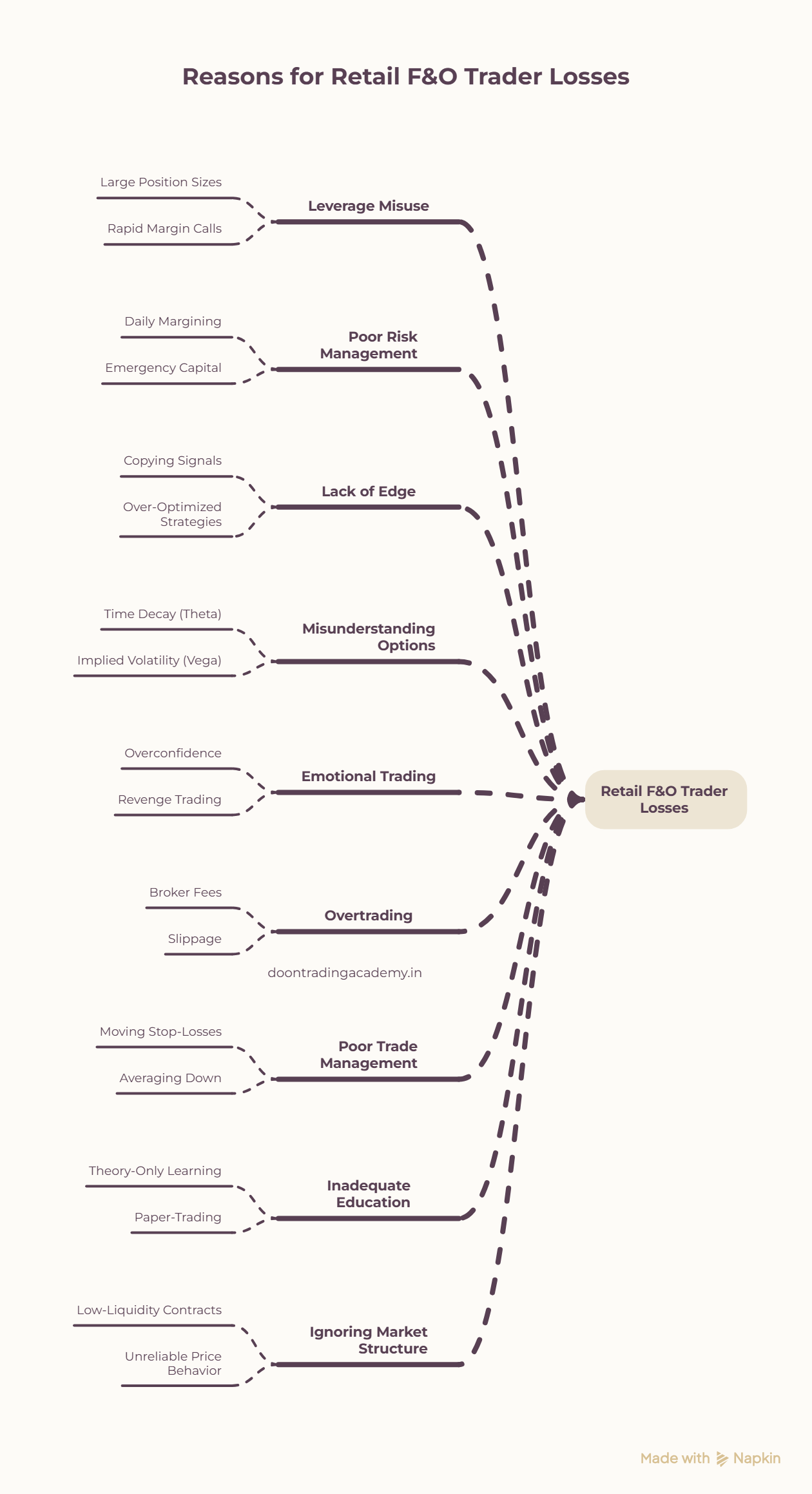
Primary reasons retail F&O traders lose money
1. Leverage without proper position sizing
F&O products provide leverage. Leverage increases potential returns but also magnifies losses and the speed at which margin calls can occur. Many retail traders use large position sizes relative to their capital because they see the leverage as a way to amplify small accounts — and this frequently ends badly.
Understanding proper position sizing and the concept of risk per trade is essential. See practical rules for position sizing such as the 2% rule to limit ruin risk and keep drawdowns manageable.
Position sizing using the 2% rule helps traders cap the damage from any single loss.
2. Poor risk management and margin misunderstanding
Retail traders often underestimate the daily cash flow impact of F&O margining (mark-to-market), initial and variation margin requirements, and the possibility of sudden intraday margin spikes. Failing to plan for margin can force premature exits or position liquidations.
Explicit risk rules—stop-loss placement, monitoring margin utilization, and reserving emergency capital—are not optional in F&O trading.
Learning formal risk-management rules for position sizing and margin planning reduces the chance of catastrophic account failure.
Risk management rules for position sizing explain practical steps traders should implement.
3. Lack of a repeatable edge and poor strategy selection
Having an “edge” means a positive expected value over many trades. Many retail traders copy signals they don’t understand, use over-optimized historical strategies, or attempt complex option strategies without grasping the underlying probabilities.
Without a defined edge, random wins can create a false sense of competence; losses eventually reveal the lack of a robust plan.
4. Misunderstanding options mechanics and Greeks
Options add another layer of complexity: time decay (theta), implied volatility (vega), and delta/gamma dynamics change a position’s risk profile every day. Retail traders sometimes treat options like stocks and fail to manage time decay or volatility risk.
A clear grounding in how option pricing works and how Greeks influence positions is essential before trading multi-leg strategies.
Foundational F&O concepts and option pricing basics are good starting points for understanding these dynamics.
5. Emotional trading: fear, greed, and revenge trades
Trading exposes emotions. Wins can breed overconfidence; losses can trigger revenge trading or refusal to accept a stop-loss. This cyclical emotional behaviour destroys returns even when the underlying strategy is sound.
Techniques to manage fear and greed — pre-trade checklists, fixed position size, and rules for scaling in/out — help convert good strategy into consistent results.
Techniques to manage fear and greed in trading teach practical exercises traders can adopt.
6. Overtrading and transaction costs
Frequent trading increases broker fees, slippage, and the chance of entering low-quality setups. Retail traders often underestimate the impact of transaction costs and slippage in fast-moving F&O instruments, which erodes edge.
7. Poor trade management and lack of discipline
Failing to follow an exit plan, moving stop-losses to get “hope” to work, or averaging down without a plan are common triggers for outsized losses. Disciplined trade management (defined entry, stop, target, and trade size) is the antidote.
8. Inadequate education and confusing theory with practice
Theory-only learning without guided practice, backtesting pitfalls, or failure to paper-trade new strategies leads to premature . trading with real money and real consequences.
Practical training that bridges theory to the . market and a curriculum that covers both mechanics and psychology reduces common mistakes.
Bridging trading theory and practice highlights why hands-on learning matters.
9. Ignoring market structure, liquidity and timing
Trading without reference to market structure (trends, ranges, support/resistance) or in low-liquidity contracts increases the risk of poor fills and unreliable price behavior.
Understanding how price moves and how to read support and resistance improves decision quality.
Learning support and resistance identification and market structure basics helps traders choose higher-probability trades.
Question-driven sections (friendly)

Why does leverage cause small mistakes to become account-ending events?
Direct answer: Because leverage amplifies both gains and losses and can trigger rapid margin calls, converting routine drawdowns into forced liquidations.
Explanation: With leverage, a small adverse move becomes a large percentage loss on your capital. Margin systems require daily settlement in F&O markets; if the account lacks the cash to cover variation margin, brokers can square positions, often at worst prices for the trader.
Can disciplined position sizing prevent account blowups?
Direct answer: Yes — disciplined position sizing dramatically reduces the probability of catastrophic loss and preserves the ability to recover after drawdowns.
Explanation: Position sizing limits the amount risked per trade (e.g., a fixed percentage of capital). This prevents one or a few losses from depleting trading capital beyond recovery, enabling the trader to continue and compound a proven edge.
See more on position sizing and the 2% rule and other risk management rules.
How much does psychology matter compared to technical skill?
Direct answer: Psychology often matters as much as — and sometimes more than — technical skill because consistent execution of a strategy is required to realize the statistical edge.
Explanation: A well-designed system provides an edge only if the trader can follow the system through losing streaks and discipline tests. Techniques for building trading psychology, journaling, and routine reviews are practical tools to improve execution.
Resources on building trading psychology and emotional techniques are helpful starting points: build master trading psychology and manage fear and greed.
Table: Typical behaviours — retail traders vs disciplined traders
Behavior comparison
| Retail trader tendency | Disciplined trader practice |
|---|---|
| Uses maximum possible leverage | Limits leverage and sizes positions to risk budget |
| No written trade plan; trades by impulse | Trades only according to a documented plan with exit rules |
| Neglects margin and option time decay | Plans for margin flows and manages option Greeks |
| Blames the market after losses | Reviews trades, updates rules, and journals performance |
Five beyond-common-sense insights
- Match strategy to capital: Choosing strategies with required margin and potential drawdowns that fit the trader’s capital base prevents repeated forced scale-ups and blowouts.
- Time-decay as a silent cost: For options sellers and buyers, theta works continuously; calibrating holding periods to expected theta erosion can turn a theoretically profitable idea into a practical loser if time decay is ignored.
- Daily margin seasonality: Margin requirements can rise around expiries and macro events; planning for higher margins during these windows prevents surprise liquidations.
- Execution risk is an edge killer: Even a small systematic slippage on entry/exit transforms a marginal edge into a losing strategy; prioritize testing execution under . conditions (or simulated slippage) before committing significant capital.
- Survivorship bias in strategy testing: Backtests that ignore delisted or illiquid contracts overstate past performance; include realistic liquidity and rollover assumptions when validating F&O systems.
Actionable checklist: What to change this week
- Define your risk-per-trade (e.g., a fixed percentage of capital) and enforce it for all positions.
- Create a one-page trade plan: entry, stop, target, and rationale for every F&O position.
- Paper-trade new option strategies for a set period while tracking time decay and margin behavior.
- Start a trade journal and review weekly to spot recurring behavioural errors.
- Study option pricing and Greeks until you can explain how theta and vega will affect your position daily.
Useful further reading (internal guides)
Understanding the product and your own behaviour is essential: foundational reading on F&O mechanics and psychology will accelerate learning.
Futures and options explained for Indian markets covers contract basics and margin mechanics.
Option pricing and time value explains theta, intrinsic value, and implied volatility in plain language.
Strengthen trade execution and discipline with guides on position sizing rules and general risk management.
To address emotional pitfalls, see resources on managing fear and greed and how to build master trading psychology.
Finally, avoid common errors listed in mistakes to avoid in the stock market and study traits that distinguish consistent traders in traits of successful traders.
Conclusion
Why most retail F&O traders lose money is not a mystery — it is the predictable result of leverage misuse, weak risk management, emotional decision-making, and incomplete understanding of F&O mechanics. The path to improvement is concrete: reduce position size, implement robust risk rules, learn option pricing and margin behavior, and build the habits that ensure consistent execution.
Take the actionable checklist above and begin making incremental changes. Over time, disciplined execution and education convert a risky hobby into a repeatable trading process.
If you have specific situations or questions about your F&O approach, share them in the comments — describing your strategy, capital, and risk rules will help others give practical suggestions.