


Options give traders flexible ways to express views on direction, volatility, and time decay. Each strategy combines long and short calls or puts to create a specific payoff shape with defined trade-offs: potential profit, potential loss, probability of success, capital required, and sensitivity to volatility and time. This article explains common option strategies, their real-world risk profiles, when traders use them, and practical controls to manage risk.
- Quick Summary
- Covered calls and protective puts convert option exposure into conservative, income-oriented or hedged stock positions.
- Vertical spreads (bull call, bear put) limit both profit and loss — useful when direction is expected but risk must be capped.
- Ironic condors and credit spreads aim for time decay profitability but carry tail risk if volatility spikes; position sizing matters most.
- Straddles/strangles profit from large moves or volatility increases but can lose to time decay if the move doesn’t occur.
- Understand option pricing (intrinsic vs time value, implied volatility) and use position-sizing and risk rules to limit capital at risk.
Primary concepts you must understand first
What is an option (short answer)?
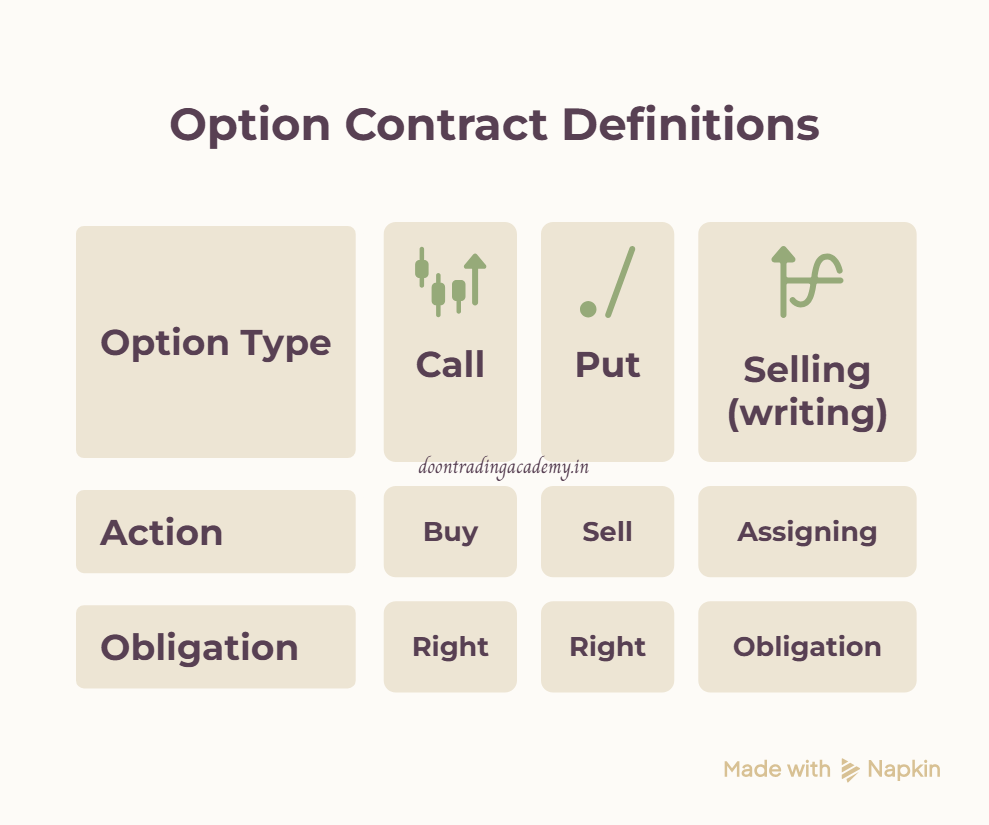
An option is a contract that gives the buyer the right, but not the obligation, to buy (call) or sell (put) an underlying asset at a specified strike before or at expiration. Selling (writing) an option creates an obligation if assigned.
Why implied volatility and time value matter
Option premiums consist of intrinsic value and time value. Implied volatility (IV) drives time value: higher IV → higher premiums. Traders choosing a strategy must match the expected move and volatility environment — strategies that sell premium want lower future IV, while buyers want higher realized volatility. For a practical primer, review option pricing and time value.
Basic directional and risk terms
- Long = you paid premium (limited loss = premium paid).
- Short = you received premium (potentially large loss if naked).
- Max profit / max loss = the known ceiling or floor of a strategy’s outcomes.
- Assignment risk = short American-style options can be exercised early.
- Greeks (delta, theta, vega) indicate sensitivity to price, time decay, and volatility.
Common option strategies and their risk profiles
Long call
Setup: Buy a call option.
Risk profile: Limited downside (premium paid); unlimited upside as underlying rises. Profitable when the underlying rises above strike + premium before expiration. Time decay (theta) and decreasing IV hurt long calls; vega is positive.
Long put
Setup: Buy a put option.
Risk profile: Limited loss (premium); large upside potential if underlying falls sharply (profit capped by zero underlying price). Useful as speculative bearish or protective hedge.
Covered call
Setup: Own underlying stock and sell a call against it.
Risk profile: Generates income and lowers cost basis; upside is capped to strike + premium; downside remains stock exposure minus premium received. Good for moderately bullish-to-neutral views. Beware of assignment if the stock rallies above strike.
Protective put
Setup: Own underlying stock and buy a put.
Risk profile: Acts like insurance: downside is limited to strike minus premium; upside remains unlimited. Costly in high-IV environments but effective during uncertain markets.
Bull call spread (vertical spread)
Setup: Buy a call at a lower strike and sell a call at a higher strike (same expiry).
Risk profile: Limited loss (net premium); limited profit (difference between strikes less net premium). Requires less capital than stock; vega impact reduced relative to a long call because sold call offsets some premium. Use when moderately bullish.
Bear put spread (vertical spread)
Setup: Buy a put at a higher strike and sell a put at a lower strike.
Risk profile: Limited loss and limited profit similar to bull call spread but for bearish view. Cheaper than long put with reduced vega exposure.
Iron condor
Setup: Sell an out-of-the-money (OTM) call spread and an OTM put spread (four legs).
Risk profile: Limited profit (net premium received); limited but significant loss if underlying moves beyond the wings. Profitable in low volatility range-bound markets because time decay works in seller’s favor. Risk increases sharply if implied or realized volatility spikes; manage size and width of spreads accordingly.
Long straddle / long strangle
Setup Straddle: Buy a call and put at the same strike. Strangle: buy OTM call and OTM put (different strikes).
Risk profile: Limited loss equal to total premiums paid; large profit potential if underlying makes a big move in either direction. Loses value to time decay if move doesn’t happen. Best used when expecting a large move or volatility increase.
Calendar (time) spread
Setup: Sell a near-term option and buy a longer-term option at the same strike.
Risk profile: Profit from time decay and stable price near strike; can lose if price moves strongly or volatility structure changes. Sensitivity to changes in term structure of IV can be complex — use after understanding option-pricing mechanics.
Short naked options (calls or puts)
Setup: Sell calls or puts without owning offsetting positions.
Risk profile: Short naked calls have unlimited theoretical loss; short naked puts have large downside exposure (if underlying collapses) and margin requirements. Only experienced traders with appropriate capital should consider; otherwise, prefer defined-risk alternatives like credit spreads.
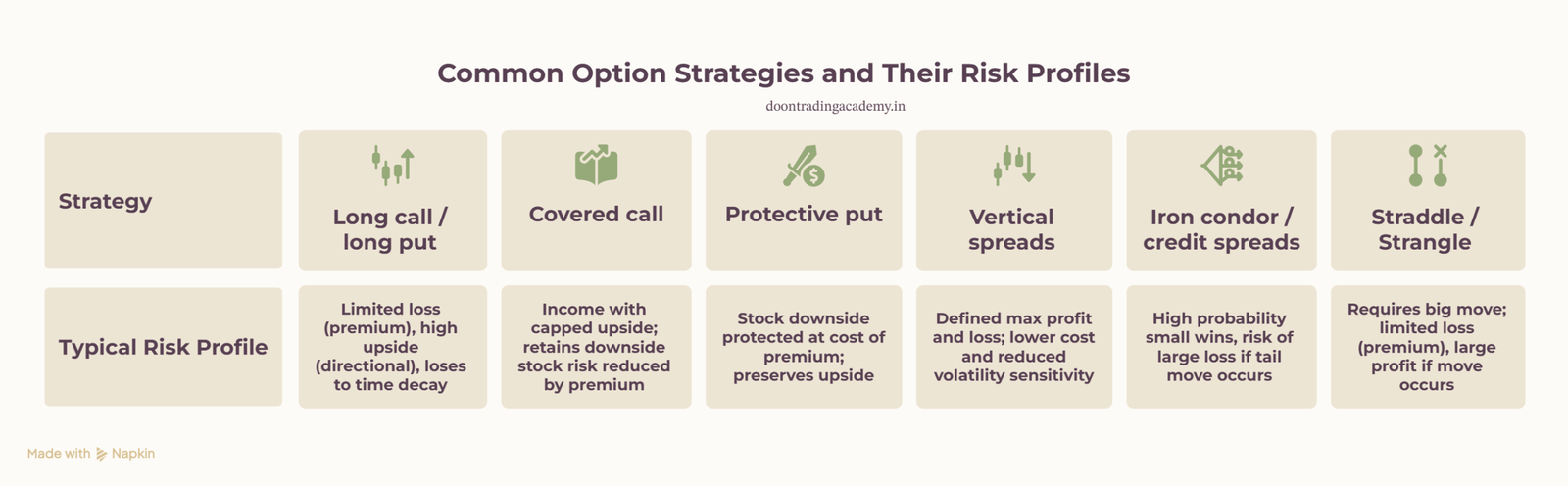
Two-column comparison: strategy vs typical risk profile
| Strategy | Typical Risk Profile |
|---|---|
| Long call / long put | Limited loss (premium), high upside (directional), loses to time decay |
| Covered call | Income with capped upside; retains downside stock risk reduced by premium |
| Protective put | Stock downside protected at cost of premium; preserves upside |
| Vertical spreads | Defined max profit and loss; lower cost and reduced volatility sensitivity |
| Iron condor / credit spreads | High probability small wins, risk of large loss if tail move occurs |
| Straddle / Strangle | Requires big move; limited loss (premium), large profit if move occurs |
How to choose a strategy (practical steps)
- Define objective: income, hedge, directional speculation, or volatility play.
- Assess market context: Is implied volatility high or low relative to historical norms? Buying options in low-IV environments and selling in high-IV markets is usually more favorable.
- Match risk to capital: Decide how much of your account you will risk on a single option position and the maximum loss you can accept.
- Use position sizing and rules: Apply formal sizing rules such as the 2% guideline and broader position-sizing techniques to limit catastrophic outcomes — see guidance on position sizing and the 2% rule and general risk management rules for position sizing.
- Plan exit rules: Know where you will close for profit, close for loss, or adjust if volatility or price moves unexpectedly.
Common pitfalls and how to avoid them
- Ignoring implied volatility — buying options in high-IV markets is often costly; sellers face risk of volatility spikes.
- Overleveraging — small premium can feel cheap but leverage magnifies losses; cap position sizes.
- Neglecting assignment risk — short options can be exercised early, especially puts around dividends or deep ITM calls.
- Emotional trading — allow rules to govern adjustments. For techniques to handle emotional bias, see techniques to manage fear and greed in trading.
Frequently asked questions
Which option strategy has limited loss?
Direct answer: Any long-only position (long call or long put) has limited loss equal to the premium paid; many spreads also have limited loss.
Explanation: Buying options caps your downside to the premium. Vertical spreads (buy one, sell one) also cap losses while reducing upfront cost compared with a naked long option.
Which strategies carry unlimited risk?
Direct answer: Short naked calls have theoretically unlimited risk; short naked puts have very large downside risk.
Explanation: Selling an uncovered call exposes the seller to unlimited losses if the underlying keeps rising. Most retail traders avoid naked short strategies or offset the risk with defined-risk spreads.
How does implied volatility affect strategy choice?
Direct answer: High IV favors premium-selling strategies; low IV favors buying volatility (long straddles/strangles or long calls/puts).
Explanation: When IV is high, options are expensive (high time value), so sellers collect larger premiums but must be wary of larger realized moves. When IV is low, buying options is cheaper and requires a smaller move to reach breakeven.
Are option strategies suitable for beginners?
Direct answer: Some are (covered calls, protective puts, simple vertical spreads), but complex multi-leg strategies require education and experience.
Explanation: Start with covered calls or buying single options to learn pricing and Greeks before attempting spreads or multi-leg trades that require active management and an understanding of margin and assignment rules.
Five advanced, beyond-common-sense insights
- Not all credit spreads are the same: two credit spreads with identical premium can have very different tail risks depending on width and distance from current price — always quantify max loss and probability of breach rather than relying on premium size alone.
- Gamma risk around earnings: selling premium into earnings can be profitable for time decay, but gamma (rapid changes in delta) can create sudden large losses; consider widening wings or avoiding short positions just before binary events.
- Net vega positioning matters across portfolio: holding multiple positions that are net long or net short vega can amplify losses if volatility moves against you; view vega exposure at portfolio level, not per trade.
- Use synthetic positions to adjust risk: a combination of options can replicate stock exposure with different margin and risk dynamics (synthetic long/short using calls and puts) and can be used to adjust cost basis or tax timing in some jurisdictions.
- Liquidity and execution cost are real risks: tight bid-ask spreads and sufficient open interest are crucial — a theoretically attractive strategy can become unprofitable due to slippage and execution, especially for complex multi-leg trades.
Conclusion
Understanding the payoff, Greeks, and capital requirements for each strategy is essential to matching a trade to your market view and risk tolerance. Conservative traders often prefer covered calls, protective puts, and defined-risk spreads; traders seeking volatility exposure choose straddles/strangles or long options. In every case, apply position-sizing rules, define exits in advance, and manage portfolio-level exposures.
If you want to learn the fundamentals of options in the Indian markets, start with the basics of futures and options explained for Indian markets and study how option pricing works in detail via the option pricing and time value guide. For practical defensive measures, follow established risk management rules for position sizing and consider the 2% rule for position sizing when sizing option exposures.
Questions, experiences, or specific scenarios you’d like analyzed? Share a comment below — discussing real examples helps clarify which strategies fit different goals.