


I treat position sizing as the practical backbone of my trading plan because Risk Management Protects Trading Capital — not as a slogan but as an everyday rule. Position sizing determines how much of my account is at risk on each trade, how long I can survive drawdowns, and whether objective edges actually compound into lasting gains.
In this article I walk through five essential rules I use for position sizing, show common sizing methods and comparisons, and offer troubleshooting tips from my own experience so you can apply these rules to stocks, futures, FX, or crypto.
Quick summary
- Size positions by risk (dollars at risk), not by contract count or percentage of equity alone.
- Cap per-trade risk (e.g., 0.5–2% of capital) to limit drawdown and preserve optionality.
- Use volatility-adjusted sizing (ATR or volatility ratio) to equalize risk across instruments.
- Combine fixed fractional rules with tail-risk controls and periodic rebalancing.
- Track realized drawdown, win rate, and expectancy; adjust sizing rules when metrics materially change.
Why position sizing matters
Position sizing translates an edge into real-world outcomes. Two traders can have the same edge but radically different equity curves solely because of sizing and risk control choices.

Size determines exposure to single-event risk, the speed of drawdown, and how many consecutive losses you can endure before being forced to deviate from your plan. Proper sizing preserves capital so your edge has time to work.
5 Essential Rules for Position Sizing
1. Define risk per trade as a dollar amount or percentage
Decide before trading how much you’re willing to lose on a single trade. I use a band: 0.5% for conservative setups, up to 1.5–2% for higher conviction trades, depending on my portfolio leverage and volatility.
Calculate position size = (risk per trade in dollars) ÷ (distance from entry to stop-loss in dollars). That keeps losses predictable and repeatable across different instruments.
2. Use volatility-adjusted sizing
Equalizing risk requires accounting for volatility. I use ATR (Average True Range) or a volatility multiple to scale position size so that a quiet stock and a choppy one consume similar risk when both are stopped out.
For example, I convert my dollar risk into the number of shares by dividing by (ATR × volatility multiple) rather than price alone. This prevents oversized positions in thin, volatile markets.
3. Limit concentration and set portfolio risk caps
No matter how strong a trade looks, I limit how many correlated positions I hold. A single-event market shock can wipe out multiple positions if they are tightly correlated.
- Set a maximum percent of portfolio risk to any single sector or theme.
- Use a hard cap on aggregate open-loss potential (for example, maximum open risk = 6–10% of capital).
4. Blend sizing methods: fixed fractional + risk budgeting
I prefer a hybrid approach: a fixed fractional core rule (e.g., 1% risk per trade) combined with risk budgeting across the portfolio. Fixed fractional provides consistency; budgeting ensures we don’t overexpose to a single factor.
Rebalance monthly and reset the fixed fraction following large portfolio gains or losses to avoid overcompounding stakes during streaks.
5. Monitor metrics and adapt — expectancy, drawdown, and volatility
Position sizing is dynamic. I monitor three key metrics: historical expectancy, current win rate, and realized drawdown. When expectancy or volatility shifts meaningfully, I reduce size until the edge is revalidated.
Keep a simple scoreboard: average win, average loss, win rate, and max drawdown. If drawdown exceeds your threshold, step down sizing by a predefined multiplier (for example, reduce risk per trade by 25%).
Comparison of common sizing methods
| Fixed fractional | Risk expressed as a fixed percentage of capital per trade; simple and effective for consistent risk control. |
| Kelly criterion (fractionalized) | Offers mathematically optimal growth but is sensitive to estimation error; most traders use a fractional Kelly (e.g., half-Kelly) to reduce volatility. |
| Volatility scaling (ATR-based) | Sizes positions based on instrument volatility, equalizing expected move exposure across instruments with different volatilities. |
Advanced insights — five beyond-common-sense facts
- Edge decay and position size interaction: When your edge decays (lower expectancy), the optimal position size falls faster than linearly. Small drops in expectancy can justify disproportionately large reductions in size to preserve long-term growth.
- Serial correlation in returns affects drawdown duration: Positive return autocorrelation increases the risk of long drawdown streaks, so sizing should be tighter in strategies with clustered losses.
- Skew and kurtosis matter: Strategies with fat tails require smaller nominal risk per trade even if average metrics look attractive, because extreme losses drive ruin probability more than average loss size.
- Execution friction compounds with size: Slippage and market impact grow with position size; realistic sizing should include an execution cost buffer, especially for less liquid instruments.
- Adaptive sizing outperforms static rules in regime changes: Systems that reduce size when volatility or correlation increases typically preserve capital better and recover faster after drawdowns.
Real-world trader perspectives
On forums, I often see practical wisdom echoing the same themes. One Reddit comment captured the discipline nicely:
- “u/quant_trader: ‘I stopped counting contracts and started counting dollars at risk. My worst drawdown fell by half and my psychological stress decreased.'”
Troubleshooting common sizing problems
I frequently encounter three recurring issues, and here’s how I address them from experience.
Problem: Unexpectedly large losses despite rules
When a stop is jumped or slippage spikes, I first check execution quality and whether I underestimated volatility. I keep a buffer in my sizing calculations to account for slippage and widen stops only when the setup justifies it.
If repeated stop-hunts occur, I reduce size and review whether my stop placement is too tight relative to market noise.

Problem: Drawdown longer than modeled
Drawdowns often last longer than historical simulations. When that happens, I step down position size, review correlation across positions, and refresh my edge estimates. I have a rule: if drawdown exceeds my model by 50%, I cut risk per trade by 25% until metrics recover.
Problem: Overconfidence after a winning streak
After a streak I watch for creeping position inflation. I use automated checks: the system alerts me if a new trade would exceed the pre-set percentage risk or if aggregate open risk crosses the portfolio cap. That mechanical guard keeps emotion out of sizing decisions.
Practical implementation checklist
- Set a clear per-trade risk percent and convert it to dollar risk.
- Calculate stop-loss distance and derive position size using dollar risk.
- Adjust size for volatility (ATR) to equalize risk across instruments.
- Enforce portfolio-level risk caps and concentration limits.
- Monitor metrics weekly and adjust sizing rules after significant regime shifts.
Conclusion
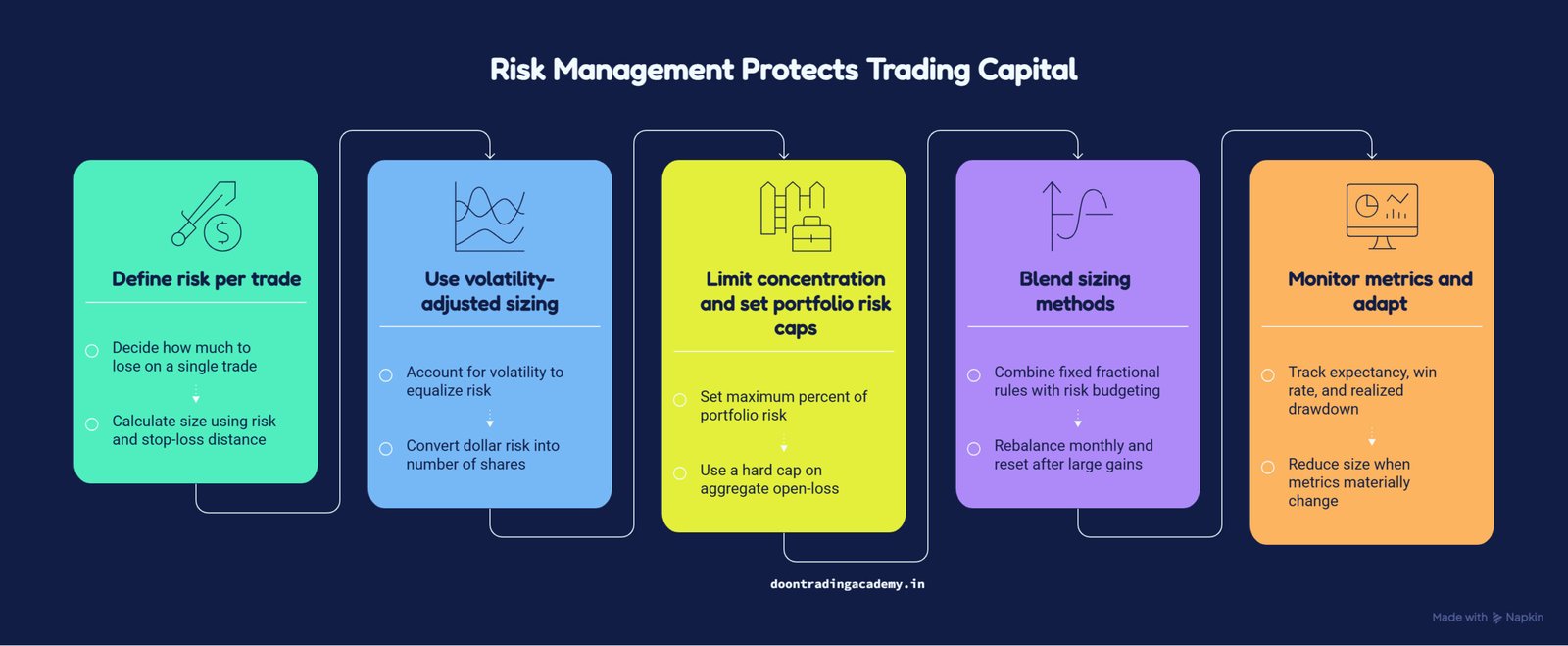
I view position sizing as the operational expression of the principle that Risk Management Protects Trading Capital. By sizing positions based on dollar risk, adjusting for volatility, capping portfolio exposure, blending sizing methods, and monitoring key performance metrics, I preserve capital and give my edge room to compound. That is it from our side.
Step-by-step recap: decide your per-trade risk, compute position size from stop distance, scale for volatility, enforce portfolio caps, and adjust sizing when expectancy or volatility changes. Following these steps has made my outcomes more consistent and my drawdowns more manageable.
If you’ve tried these rules, share what worked or where you struggled in the comments — I read them and often incorporate reader insights into my own rulebook.
For a ready-to-use worksheet, see the position sizing worksheet to calculate trade size and portfolio risk automatically.