


I know how corrosive fear and greed can be when I trade—both can turn a sound plan into impulsive mistakes. Over years of practice and study, I developed a set of repeatable methods that keep my decision-making calm and disciplined. This article lays out six proven techniques that I use to manage emotion, backed by practical steps you can apply immediately.
- Quick summary
- Recognize emotional triggers and separate them from your trading rules.
- Use pre-defined rules: position sizing, stop-loss, and trade checklists.
- Leverage routine and automation to remove impulse decisions.
- Train your mindset with journaling, reflection, and exposure to losses.
- Apply recovery and troubleshooting steps when emotions derail a session.
Emotional Control While Trading — 6 Proven Techniques
1. Pre-trade checklist and strict trade plan
A written trade plan forces objectivity. My checklist includes entry criteria, stop-loss level, profit target, position size, and the maximum allowed trades for the session.

Before each trade I run through the checklist aloud. If any item is missing or feels forced, I skip the setup. This prevents revenge trading and entry driven by noise.
2. Position sizing and predefined risk limits
Position sizing is the single most powerful tool to limit emotional reactivity. Knowing that a single loss represents a fixed percentage of my capital keeps fear and greed proportionate.
I set daily and per-trade risk limits in advance and never exceed them. For convenience and discipline, I automate size calculations when possible—see my risk management guide for templates and formulas.
3. Automated orders and stop-loss discipline
Placing orders and stop-losses immediately after entry removes the temptation to move stops to “give a trade more room.” Automation enforces the plan even when anxiety spikes.
Use limit and stop orders rather than market orders when your strategy allows it. This reduces slippage and the emotional urge to chase fills.
4. Routine, time-boxing, and session rules
Structure reduces emotional variability. I trade only during predefined time windows, follow a morning ritual, and take scheduled breaks to avoid fatigue-driven mistakes.
Time-boxing also includes a rule to stop trading after a set number of consecutive losses or a drawdown threshold. That cooling-off period prevents tilt and loss-chasing.
5. Journaling, reflection, and small-exposure practice
A concise trade journal capturing rationale, emotion level, and outcome turns feelings into data. I rate each trade on a simple emotional scale and review weekly to spot patterns.
Simulations or small-size exposure to new strategies let you learn without high emotional cost. This exposure therapy reduces fear responses over time.
6. Cognitive techniques: labeling emotions and reframing loss
Labeling emotions aloud—”I’m feeling anxious because this trade is against me”—interrupts automatic escalation. Reframing loss as feedback (“this tells me my edge didn’t apply here”) reduces threat-response intensity.
Combine labeling with breathing or a short walk to down-regulate the sympathetic response before making any management decision.
Practical Workflows and Tools
Checklist workflow
1) Pre-session checklist: market conditions, correlations, news calendar, allowable instruments.
2) Pre-trade checklist: entry reason, stop, target, position size, emotional check.
Automation and tools
Use calculators and platform order templates to enforce size and stop discipline. Many platforms support OCO (one-cancels-the-other) orders; use them for automatic take-profit/stop-loss pairing.
Consider a simple plugin or spreadsheet that alerts you when daily risk or maximum trades are reached. That external constraint preserves discipline when emotions spike.
Advanced Insights: Five Beyond-Common-Sense Facts
- Emotional arousal reduces working memory capacity—after large intraday moves traders often ignore checklist steps. Building micro-routines that take under 30 seconds circumvents this cognitive overload.
- Small, frequent exposure to controlled losses (micro-position-size experiments) accelerates desensitization to loss aversion more effectively than infrequent large exposures.
- Physiological markers—heart rate or short breathing checks—predict near-term impulsive decisions; a 60-second breathing reset statistically reduces error-prone actions in lab studies of decision making.
- Combining external constraints (automated stops) with internal strategies (labeling) produces more durable behavior change than either method alone because they target both system 1 impulses and system 2 planning.
- Keeping a “fear budget”—allocating a tolerable number of emotionally charged trades per week—helps normalize volatility of feelings and prevents compounding psychological debt across sessions.
Comparison: Mechanical vs Psychological Controls
| Mechanical Controls | Psychological Controls |
|---|---|
| Position sizing, stop-loss, OCO orders | Labeling emotions, journaling, cognitive reframes |
| Automated alerts and execution rules | Time-boxing, session limits, pre-trade rituals |
| Backtested entry and exit algorithms | Exposure therapy, loss desensitization, mindset training |
Troubleshooting: When Emotions Break Your Rules
I still hit sessions where fear or greed overrides my rules. Below are problems I encountered and the steps I use to recover quickly.
Problem: I keep moving my stops or adding to losers
- Immediate fix: Stop trading for the session. Record the sequence in your journal while it’s fresh.
- Root correction: Revisit position-sizing rules and automate stop placement. Add a hard rule: no manual stop adjustments within X minutes of entry.
- Practice: Simulate trades with enforced stops until you can follow the rule without override.
Problem: After a large win, I overtrade out of greed
- Immediate fix: Close the platform, walk away for a fixed cooldown period (e.g., 60 minutes).
- Root correction: Set a profit-capture rule—when daily profit target is reached, stop trading.
- Practice: Use a “winner’s checklist” to verify trade quality instead of trading from emotion.
Problem: I feel paralyzed by fear after consecutive losses
- Immediate fix: Reduce position sizes to micro-level for the next session to rebuild confidence safely.
- Root correction: Implement a loss-cap rule that triggers a cooldown day after hitting a drawdown threshold.
- Practice: Review the trade log with a focus on process, not outcome. I find that separating skill errors from random noise restores perspective.
Common Forum Observations and Community Tips
Many traders on community forums emphasize simple routines rather than complex psychology techniques. A recurring theme is that consistency—consistent size, consistent plan—beats trying to outsmart emotions in the moment.
If you want peer accountability, consider joining a trade group or a mentorship where you can share journals and process reviews. That external feedback loop shortens learning cycles.
Conclusion
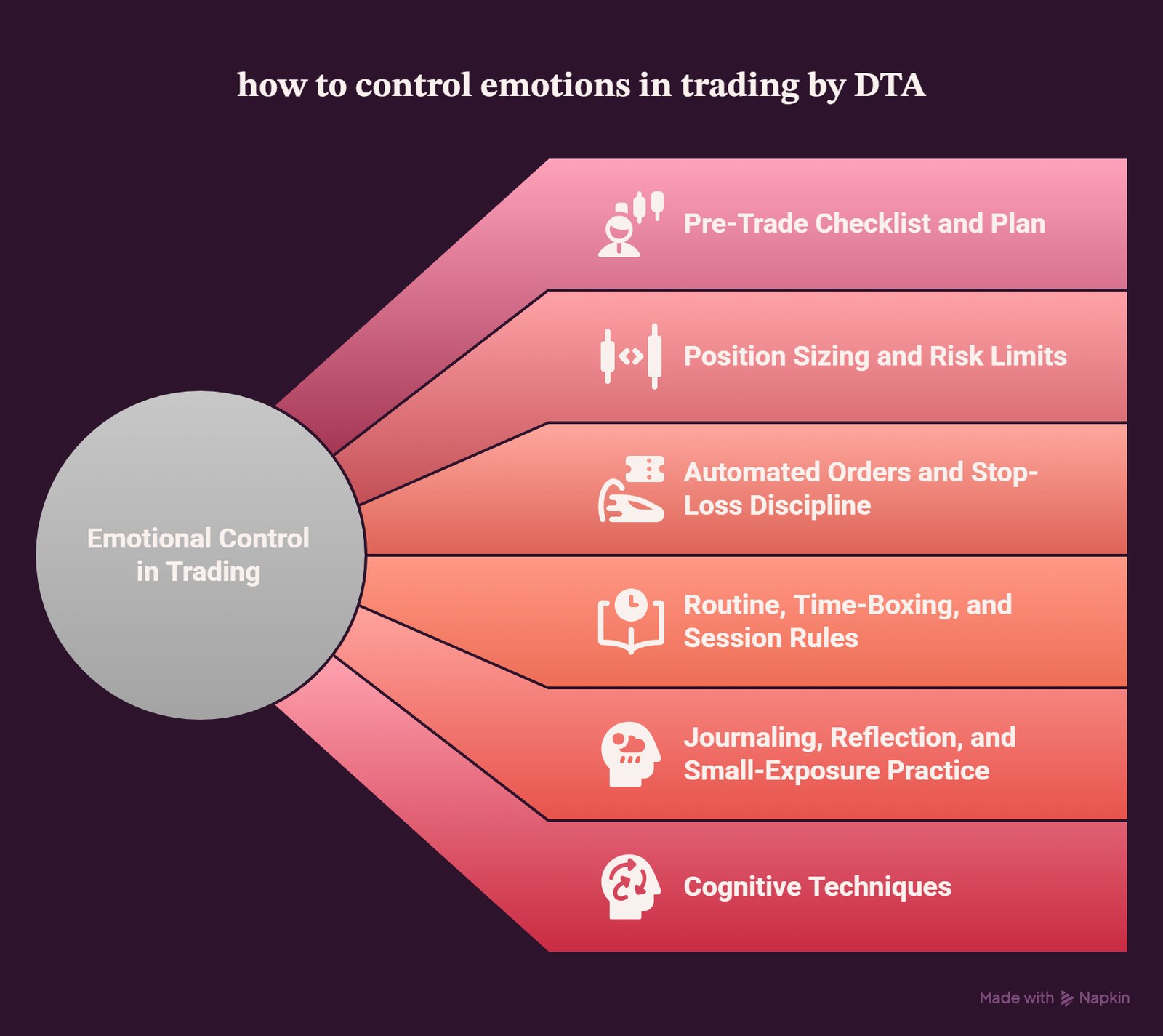
I’ve used these six techniques to convert emotional volatility into repeatable behavior: (1) a strict trade plan and checklist, (2) disciplined position sizing, (3) automated orders and stop discipline, (4) time-boxed routines, (5) journaling and small-exposure practice, and (6) cognitive labeling and reframing. Together they address both the mechanical and psychological drivers of fear and greed.
Step-by-step recap of the actionable process I follow: prepare a pre-session checklist; size positions and set stops before entry; automate orders where possible; use time-boxing and session limits; journal each trade with an emotional rating; and apply immediate troubleshooting steps (stop trading, cooldown, reduce size) when rules break. Repeat weekly reviews to refine the system.
If you try these techniques, tell me what changed in your trading—leave a comment with your experience or questions and I’ll respond. If you want templates for checklists or a sample journal, ask and I’ll share them.