

I have spent years evaluating trading education providers, from university-affiliated programs to browser-based weekend bootcamps. In this article I share the 12 red flags I look for first, why they matter, and the practical checks you can run right away to verify whether a trading institute is genuine or a risk to your time and savings.
Quick summary
- Watch for guarantees of high returns, pressure sales, and opaque curricula — these are common scam signals.
- Verify instructor credentials, regulatory disclosure, and independent reviews before paying.
- Check for transparent performance reporting, sample lessons, and clear refund policies.
- Look for community support, ongoing mentorship, and realistic expectations as signs of legitimacy.
- If you’ve already paid and see red flags, document communications, seek refunds via your bank, and report to regulators.
Why this matters
Trading education can accelerate learning when it’s high-quality, but poor or fraudulent programs cause financial losses and wasted time. Identifying a genuine trading institute protects your capital and helps you learn effective risk management and strategy development.
12 Red Flags to Watch For
1. Promises or guarantees of high returns
Any course or institute that guarantees specific profits or promises “fast, huge returns” is almost certainly misrepresenting outcomes. Markets are noisy and outcomes vary by trader skill and risk tolerance.
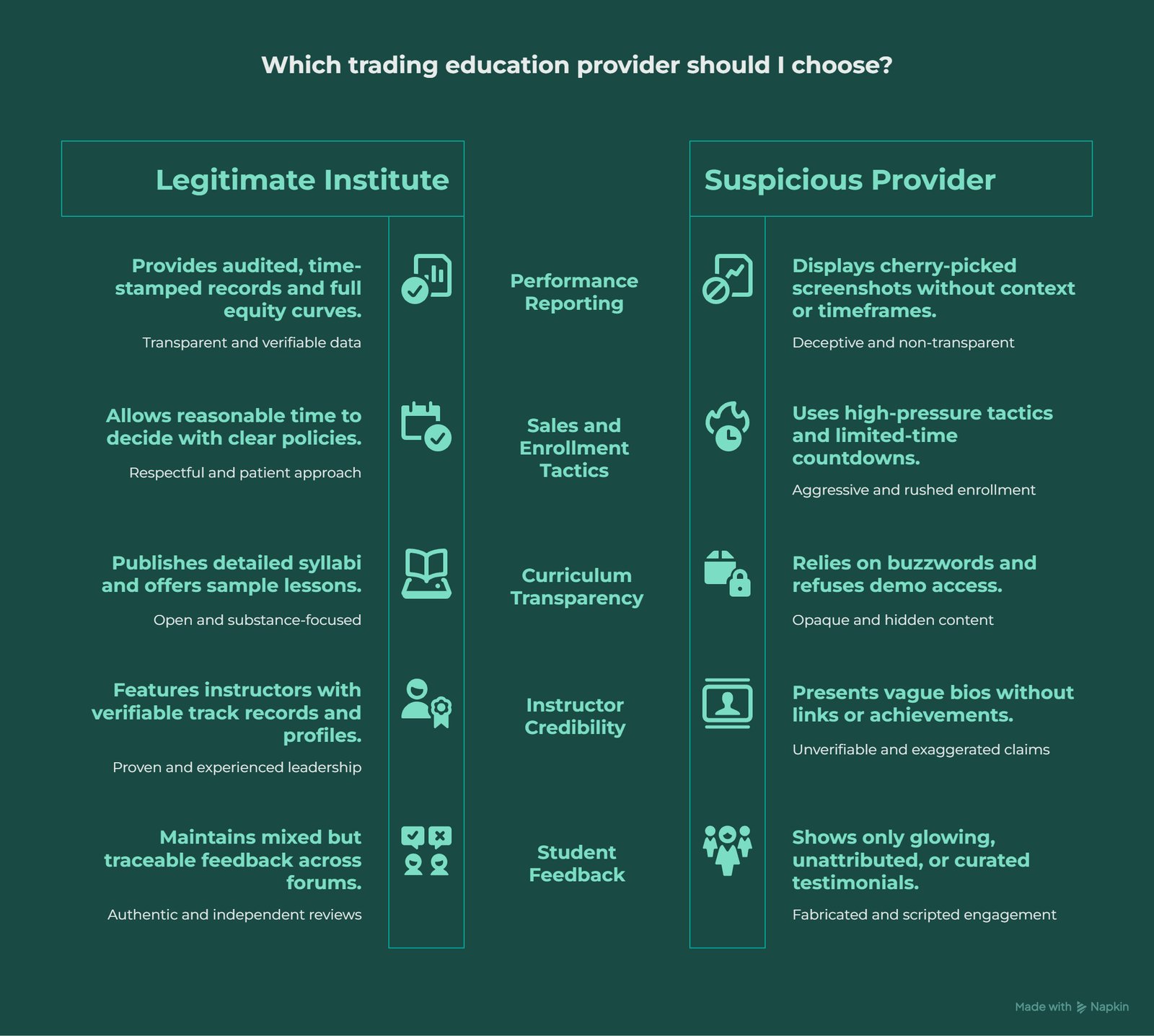
How to verify: Ask for audited, time-stamped performance records and compare with independent benchmarks. If none exist, consider it a red flag.
2. Vague or missing regulatory and accreditation information
Legitimate institutes clearly state regulatory relationships, accreditations, or the status of their legal entity. If this information is missing or evasive, proceed with caution.
How to verify: Search the national regulator’s database for the company name and check business registries for official filings.
3. Opaque curriculum and no sample lessons
Quality programs publish detailed syllabi, learning outcomes, and sample lessons. If the curriculum is described only in buzzwords or the institute refuses to show a demo, they may be hiding a lack of substance.
How to verify: Request a sample module or watch a full recorded lesson. If they refuse, treat that as a warning sign.
4. Hard pressure sales and “limited time” enrollment tactics
High-pressure tactics—persistent calls, countdown timers, or one-on-one sales meetings that rush decisions—are common among low-quality providers trying to close before buyers research.
How to verify: Step back and request written deadlines or cooling-off period details. Genuine providers allow reasonable time to decide.
5. Unverifiable or exaggerated instructor credentials
Instructors should have verifiable track records: public profiles, publications, or industry experience. Vague bios without links or unverifiable achievements are suspect.
How to verify: Google instructor names alongside institution names, check LinkedIn, and look for third-party mentions of their work.
6. No independent student reviews or only curated testimonials
Real programs have mixed but traceable feedback across forums and review sites. If all testimonials are glowing and unattributed, they may be fabricated.
How to verify: Search forums and social media for both positive and negative student experiences and watch for patterns in complaints.
7. Lack of risk-management focus in the teaching
Courses that emphasize “how to win” but ignore position sizing, drawdown control, and psychological resilience are incomplete and potentially dangerous.
How to verify: Scan the syllabus for modules on risk management, position sizing, and . trading psychology.
8. Hidden fees, unclear refund policies, or complex payment routing
Unclear pricing, surprise charges, or routing payments through third parties should raise alarms. Legitimate schools present clear fee structures and transparent refund policies.
How to verify: Ask for a written invoice and refund terms. If the refund policy is unclear or nonexistent, don’t purchase.
9. Cherry-picked or non-transparent performance records
Performance screenshots without context, no timeframes, or only showing winners are deceptive. Real performance reporting includes full records and worst-case periods.
How to verify: Request complete equity curves, trade logs, and methodology for performance calculation. Independent audits are a strong positive sign.
10. Emphasis on recruitment or multi-level incentives
If the institute focuses on you recruiting others, or offers commission-like rewards for enrollee referrals, its business model may rely more on recruitment than education quality.
How to verify: Review compensation structures and ask how instructor pay is derived—is it tuition-based or recruitment-based?
11. Requirement to trade through their proprietary platform or fund only
Requiring students to deposit capital with a proprietary broker or fund that the institute controls can be a conflict of interest and a path to misuse of funds.
How to verify: Insist on the right to use independent brokers and check for segregation of client funds and third-party custody arrangements.
12. Fake or scripted community engagement and testimonial videos
Communities that seem overly curated—no independent threads, repetitive comments, or scripted video testimonials—may be manufactured to create false credibility.
How to verify: Look for organic conversations, timestamps, and multiple platforms where students interact without institute moderation.
Legitimate vs Suspicious: Quick comparison
| Legitimate institute | Suspicious sign |
|---|---|
| Clear instructor credentials and verifiable track records | Vague bios, unverifiable claims, or missing references |
| Transparent curriculum, sample lessons, and measurable outcomes | Buzzword-heavy descriptions and no sample content |
| Published refund policy and transparent fees | Hidden charges and evasive refund terms |
| Independent reviews across forums and social media | Only curated testimonials and no external feedback |
| Focus on risk management and realistic expectations | Guarantees of large returns and pressure to invest immediately |
Five advanced insights (beyond common sense)
- Lead-generation funnels are common: some institutes operate primarily as marketing funnels that sell customer leads to brokers. If the sales process centers on qualifying your deposit amount over your learning goals, you may be a lead rather than a student.
- Third-party payment processors can indicate liability shielding: routing tuition through separate entities or offshore processors can be a method to avoid regulatory scrutiny—check corporate ownership and payment recipients.
- Audited simulated vs. . performance matters: many programs show stellar simulated results; ask whether returns are from simulated environments and whether slippage, commissions, and real account constraints were modeled.
- Mentor-to-student ratios influence outcomes: programs promising one-on-one mentorship but with extremely low mentor headcount relative to students usually de.r group support instead of individualized coaching.
- Community churn is a signal: fast-growing communities with high churn rates often indicate short-.d hype. Monitor forum activity over weeks to gauge sustained engagement versus temporary marketing spikes.
Troubleshooting common scenarios
If I discover a red flag after I’ve enrolled, my immediate steps are practical and evidence-based. First, I document everything: invoices, chat transcripts, emails, and screenshots of misleading claims. This creates a clear record if I need to escalate.
Next, I contact the institute in writing and request a full refund referencing their stated policy. If they refuse, I escalate to my payment provider or bank to dispute the charge, providing the documented evidence.
When funds are tied to proprietary platforms, I explore withdrawal options and check platform terms of service for client fund protections. If withdrawal is blocked, I file complaints with local financial regulators and consumer protection agencies and consider legal advice if material sums are involved.
- Document communications and preserve receipts and screenshots.
- Request a written refund citing the institute’s terms and consumer protection rights.
- File a dispute with your credit card or payment provider if needed.
- Report deceptive practices to regulators and consumer protection bodies.
- Seek peer support in independent forums to confirm patterns of misconduct.
Conclusion
I have used these checks repeatedly to separate worthwhile trading education from risky offers. When evaluating an institute I follow a step-by-step process: verify regulatory and business registration details, review instructor credentials, inspect the curriculum and sample lessons, confirm transparent performance reporting and refund policies, and read independent community feedback.
By systematically applying these steps you reduce the chance of being misled and improve your odds of finding a program that actually advances your trading knowledge. If you’ve had experiences—good or bad—with trading institutes, please share them in the comments so others can learn from your experience.