

Revenge trading is the impulse to take new, often larger or riskier trades immediately after a losing position, with the goal of “getting even.” It is driven by strong emotions, breaks trading rules, and usually increases losses rather than reversing them. This article explains the causes, how to spot revenge trading early, immediate fixes, preventive systems, psychological techniques, and practical rules to recover without compounding errors.
- Revenge trading stems from loss aversion, emotional arousal, and poor risk controls; it reliably increases drawdown unless arrested quickly.
- Immediate countermeasures: stop trading, apply a cooling-off rule, remove leverage, and document the loss in a trading journal.
- Long-term prevention relies on a written trading plan, strict position sizing, automated safeguards, and working on trading psychology.
- Less-obvious insight: structured “recovery trades” with predetermined entry, exit, and max-loss limits perform better than emotional attempts to break even.
What is revenge trading?
Revenge trading is a reactive behaviour where a trader attempts to offset a loss by taking impulsive trades that violate their normal risk rules. It is usually short-term, emotionally charged, and focused on outcome (the lost money) rather than process (a repeatable edge and risk controls).
Why do traders engage in revenge trading?
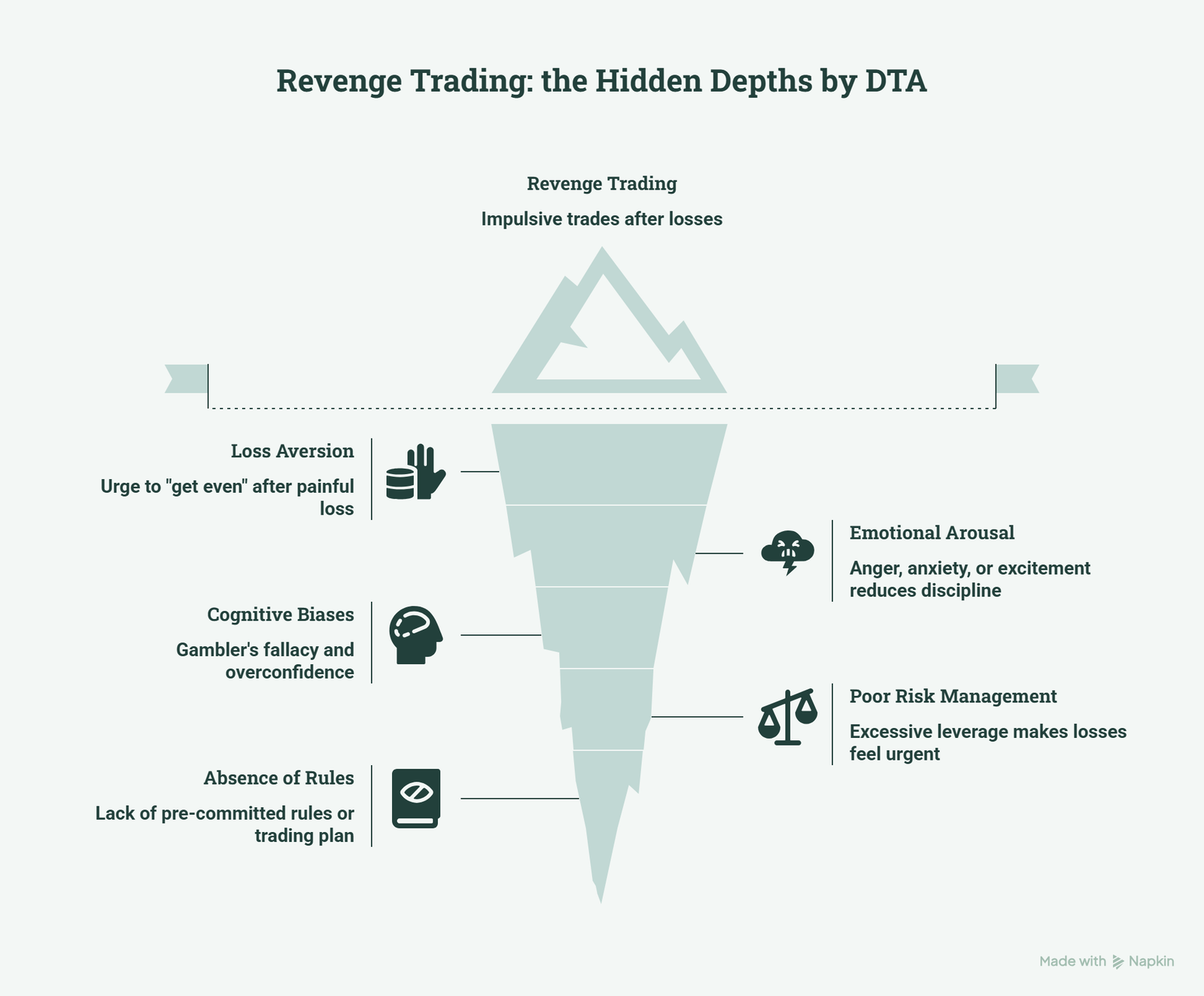
Primary causes include:
- Loss aversion and the urge to “get even” after a painful loss.
- Emotional arousal—anger, anxiety, or excitement—that reduces discipline.
- Cognitive biases such as gambler’s fallacy and overconfidence after a small win or loss.
- Poor risk management or excessive leverage that makes losses feel urgent.
- The absence of pre-committed rules or a written trading plan to enforce sensible behaviour.
Understanding common reasons why losses happen can reduce the blame and help create better defenses against revenge trading. See this overview of why stock market losses happen to separate normal drawdowns from emotional mistakes.
How to recognise revenge trading (early warning signs)
- Placing larger position sizes than usual immediately after a loss.
- Abandoning stop-losses or moving them wider without a rationale.
- Trading outside regular hours, chasing volatile moves, or increasing trade frequency.
- Focusing on “making back” money instead of following predefined entry and exit rules.
- Racing thoughts, inability to step away, or using trades to emotionally “feel better.”
Immediate countermeasures (stop the bleeding)
When the urge to revenge-trade appears, apply these immediate steps:
- Stop trading for a defined cooling-off period (at least one full session or several hours).
- Reduce or remove leverage and circuit-breaker all active positions where appropriate.
- Record the loss and the trade setup in a journal—force a short written reflection before taking any new trade.
- Use pre-set order types and stop orders rather than discretionary market orders. Review how different order types can help enforce risk limits.
- If unsure, call a mentor or peer to get an objective second opinion before re-entering the market.
Preventive structural measures
Preventing revenge trading requires systems and rules that make emotional responses less effective.
- Create a written trading plan that defines allowed setups, position sizing, and maximum daily drawdown.
- Enforce strict position sizing rules and a maximum loss per trade. Practical position sizing rules are explained in this guide to applying the 2% rule and more advanced risk management rules for position sizing.
- Use automated stop-loss and limit orders so exits are pre-committed rather than emotional.
- Limit the number of trades per day and set a maximum daily loss that forces a trading halt if triggered.
- Keep a trading journal to identify repeat patterns and triggers for emotional trading; journaling creates accountability and data for improvement.
Psychological techniques that reduce revenge trading
Technical fixes help, but cognitive and behavioral tools are essential:
- Reframe losses as feedback: focus on process metrics (correct setup, discipline) rather than instant P&L.
- Use simple behavioral rules: pre-trade checklist, forced 10-minute pause after a loss, or a cooling-off walk.
- Practice breathing and short mindfulness techniques to lower arousal before making decisions.
- Work on trading psychology systematically—structured programs to build trading psychology help traders build consistent habits.
- Apply techniques specifically designed to manage fear and greed, such as exposure to small losses under controlled conditions; see methods to manage fear and greed.
Example pre-trade checklist (use before any trade)
- Does this trade match a documented edge or setup?
- Is the position size within the allowed % of equity?
- Where is the stop-loss and take-profit? Are they placed before order entry?
- Am I trading to follow a plan or to recover a prior loss?
Comparison: revenge trading vs structured recovery
| Revenge trading | Structured recovery trade |
|---|---|
| Emotion-driven, undefined risk, often larger-than-normal size | Predefined entry/exit, fixed max loss, same or smaller position size |
| Short-term focus on recouping losses | Process-focused; follows documented trade plan |
Tools and tactical rules
Concrete rules that can be implemented immediately:
- “No-trade” timer: after a loss, ban new trades for a fixed period (e.g., next session).
- Auto-reduce leverage or a kill-switch when daily loss limit is breached.
- Use volatility-aware position sizing—when markets are more volatile, reduce size. See how to handle price swings and manage volatility.
- Use trade automation or alerts that require checklist completion before order execution.
When to seek help or change approach
If revenge trading occurs repeatedly despite rules, consider these steps:
- Review common mistakes in trading and correct process errors; a useful starting point is an overview of common trading mistakes to avoid.
- Consider supervised mentoring, replay sessions, or structured courses to rebuild discipline and edge.
- Re-evaluate goals and timeframe—if short-term trading consistently damages capital and psychology, longer-term investing or simulated practice may be better until discipline returns.
- If emotional control is a persistent problem, a behavioural coach or therapist experienced with performance issues can help.
Five beyond-common-sense insights
- Recovery trades should be treated as normal trades with identical edge and risk rules—if the setup is not present, do not trade simply to recover losses.
- Converting emotional losses into learning signals accelerates improvement: log the emotional state and trigger alongside the technical setup to find patterns.
- Micro-exposure training (small stakes, controlled setups) can desensitise the emotional reaction to losses faster than avoiding trading altogether.
- Automated, rules-based interventions (timers, trade limits, margin locks) outperform willpower—design the environment to make bad behaviour difficult.
- Peer accountability reduces recurrence: a short post-session review with a mentor or trading peer creates social friction against revenge trades and strengthens discipline.
Common questions (quick answers)
Can revenge trading be cured?
Direct answer: Yes—often controllable through rules, practice, and psychological work. Explanation: Combining clear risk rules, cooling-off protocols, journaling, and targeted psychological techniques reduces frequency and severity over time. If losses persist, structured training or mentorship helps accelerate recovery.
How long should a cooling-off period be?
Direct answer: At minimum one full trading session; ideally until the trader is calm and can pass the pre-trade checklist. Explanation: Short pauses (minutes) can reduce impulsivity, but a longer break (hours or the next session) prevents emotionally-driven snap decisions.
Should stop-losses be widened to avoid being stopped out during recovery attempts?
Direct answer: No—widening stops to “avoid being stopped” converts discipline into gambling. Explanation: Proper stop placement tied to setup and volatility keeps risk predictable; using volatility-adjusted sizing is preferable to removing or widening stops arbitrarily.
Conclusion
Revenge trading is an emotional, costly response to losses that can be controlled with clear rules, engineered safeguards, and psychological work. Immediate actions—stop trading, apply a cooling-off period, and document what happened—stop the worst damage. Long-term prevention requires a written trading plan, consistent position sizing, automated protections, and deliberate practice on trading psychology. Implementing these steps reduces emotional reactivity and protects capital.
Questions or experiences to share? Leave a comment below to discuss which countermeasures worked in real trading situations or to ask for help designing a recovery plan.