



Overtrading—taking too many trades, trading without conviction, or increasing size after a loss—is one of the most common reasons traders lose money or experience inconsistent results. This article explains why overtrading happens, how clearly defined rules stop it, and provides a practical rule set you can apply immediately to reduce impulsive activity and protect your capital.
Quick Summary
- Overtrading is driven by psychological forces (fear, greed, boredom), structural failures (no plan, poor risk rules), and market noise; rules convert judgment into repeatable actions.
- Use a written trading plan, fixed risk-per-trade, daily/weekly trade limits, and a trade journal to create friction against impulse trades.
- Apply position-sizing rules such as the 2% position-sizing rule and strict stop-loss discipline to limit damage when mistakes happen.
- Technical checks—trend identification and support/resistance confirmation—reduce false setups; learn the limits of indicators to avoid overreacting to noise.
- Less obvious insight: a “cool-off rule” (forced break after a loss or a streak of quick wins) protects decision quality and reduces revenge trading.
What is overtrading and why it matters
Overtrading is not merely trading frequently. It includes taking low-quality setups, increasing risk after losses, revenge trading, and trading when mentally compromised. The consequences are predictable: higher transaction costs, poor average trade quality, emotional exhaustion, and faster depletion of capital.Why traders overtrade
1. Psychological drivers
Fear and greed are the primary emotional engines. Fear of missing out (FOMO) pushes traders into premature entries, while greed pushes them to increase size or chase setups. Boredom and the desire for excitement also cause unnecessary trading.
2. Lack of a clear plan or objective
Without a written strategy that defines what qualifies as a valid setup, traders rely on impulse. A plan provides objective entry/exit criteria and prevents subjective second-guessing.
3. Poor risk and position-sizing rules
When risk per trade is undefined, traders irrationally increase position size after wins or losses. Weak position-sizing practices convert small mistakes into catastrophic losses.
4. Overconfidence from short-term wins
A brief streak of wins can make traders believe their judgment is superior, leading them to ignore rules. This is often followed by loss-chasing once the market corrects.
5. Noise and misuse of indicators
Reacting to every indicator signal or minor price movement causes frequent low-quality trades. Understanding when indicators fail or produce false signals helps reduce unnecessary entries—see the discussion on the limitations of technical analysis.
How rules prevent overtrading
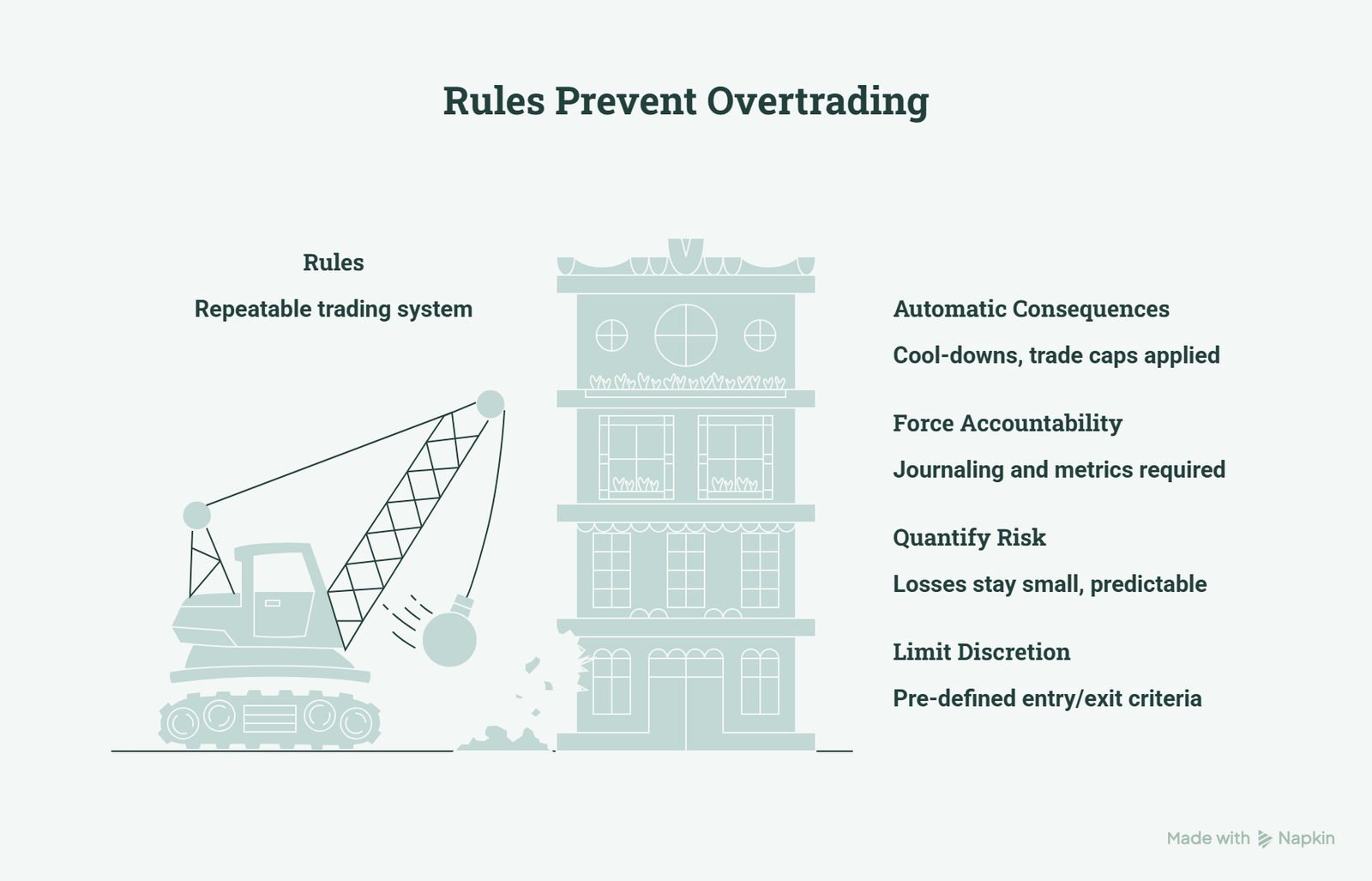
Rules transform subjective judgment into a repeatable system. They create “friction”—momentary pauses and requirements that stop impulsive actions. Rules work because they:
- Limit discretion at the point of decision (pre-defined checklists).
- Quantify risk so losses stay small and predictable.
- Force accountability through journaling and metrics.
- Provide automatic consequences (cool-downs, trade caps) to stop emotional escalation.
Specific rule categories that reduce overtrading
Pre-trade rules
- Only trade setups that meet your documented entry criteria (timeframe, pattern, confirmation).
- Require at least one structural confirmation such as trend alignment or a cleared support/resistance level—learn to identify support and resistance levels effectively.
Risk-management rules
- Set a fixed maximum risk per trade (for example, the 2% position-sizing rule or another percentage aligned with your plan).
- Apply a daily max-loss and a weekly max-loss limit; stop trading for the period if reached.
- Use stop-loss orders and avoid removing them without a documented reason.
- Follow position-sizing and money-management principles detailed in common risk management rules for position sizing.
Activity controls
- Set a maximum number of trades per day and per week to discourage random entries.
- Adopt a “setup cooldown” (e.g., no new trades for 24 hours after three consecutive losses).
- Use trade journals and simple metrics—average risk per trade, win rate, expectancy—to detect creeping overtrading.
Why external constraints help
Rules that add small operational friction—such as requiring a written pre-trade checklist, or a mandatory 15-minute review period before placing a trade—stop knee-jerk actions. This is especially effective for traders who are prone to impulsive behavior during volatile periods.
Practical rule set you can implement today
The following minimal rule set prevents most forms of overtrading while remaining practical for active traders.
- Document your trading plan and keep it visible when trading.
- Risk no more than X% of equity on any single trade (use the 2% rule for beginners).
- Enter only when your checklist is fully satisfied: trend, setup, confirmation, volume/structure confirmation.
- Use a hard stop and define profit targets or trailing rules before entry.
- Maximum of N trades per day (start with 3–5) and M trades per week (start with 10–15).
- Daily max-loss: stop trading for the day after losing Y% of equity.
- Journal every trade immediately: setup, reason, emotions, outcome.
- Forced cool-down: 24–48 hours off after three consecutive losing trades or after a loss exceeding the daily max-loss.
Checks and tools that make rules stick
- Pre-trade checklist (a one-page form you fill before every trade).
- Simple trade journal (spreadsheet or app) that captures entry reason, size, stop, and outcome.
- Automated order types—limit entries and stop-loss orders—to remove manual timing errors; review basic order types to automate discipline.
- Periodic performance reviews to adjust rules based on objective results, not emotions.
Advanced insights (beyond common-sense)
- Micro-rules reduce decision fatigue: break your plan into yes/no micro-criteria. A single “no” stops the trade faster than rationalizing a series of ambiguous checks.
- Trade credit system: give each strategy a monthly “credit” of trade slots. When a strategy exhausts its credit, it must be reviewed before earning more slots—this prevents strategy overuse during noisy markets.
- Use inverse rules to prevent bias escalation: require additional confirmation after a win streak and a mandatory re-check after a loss streak. This balances overconfidence and revenge trading tendencies.
- Calibrated slippage buffer: when markets are volatile, widen stop placement only according to a pre-defined volatility metric (e.g., ATR multiple) to avoid discretionary widening that increases losses.
- Emotional triage: train a simple internal checklist (sleep, nutrition, distractions) and ban trading if any critical element fails—decisions under physiological stress are a major cause of overtrading.
Common objections and how to handle them
“I’ll miss opportunities if I limit trades.”
Quality beats quantity. Rules focus you on higher-probability opportunities; missing low-quality setups preserves capital for better trades.
“Markets change—rules will make me rigid.”
Rules should be updated through controlled review, not on-the-fly. A monthly or quarterly refinement process keeps rules adaptive without enabling impulsive changes.
“I can override a rule when market conditions feel right.”
Allowing overrides quickly erodes discipline. If an override is necessary, require it to be documented and reviewed later so overrides become exceptions, not defaults.
How to evaluate whether your rules are working
- Track key metrics: trades per day/week, average risk per trade, win rate, average reward-to-risk, and expectancy.
- Compare periods before and after implementing rules to measure change in performance and psychological stress.
- Use the trade journal to identify whether impulsive trades still occur and which rule failed to prevent them.
Conclusion
Overtrading is both a behavioral and a structural problem. Psychological urges create the pressure to trade, and weak systems convert that pressure into damaging activity. Rules—simple, enforceable, and measurable—are the practical antidote. Start with a concise trading plan, fixed risk-per-trade, trade caps, stop-loss discipline, and a mandatory trade journal. Add cool-off periods and micro-rules to handle emotional spikes. Monitor metrics and refine rules deliberately.
Try one new rule this week and evaluate its effect after five trades. Share your experience, questions, or specific situations in the comments so other traders can learn from your adjustment process.
Understanding core chart concepts such as market structure and improving your psychological control with a focus on mastering trading psychology and practical techniques to manage fear and greed will make your rules more effective over time.