


I created and reviewed multiple stock market courses to build a single, repeatable curriculum that actually teaches people how to invest and trade. In doing so I focused on skills that produce consistent outcomes: reading financial statements, measuring risk, building a portfolio, and executing trades with discipline.
My goal in this article is to outline the exact modules and practical exercises I believe belong in a complete course so you — whether beginning or advancing — can compare offerings and know what to expect.
- Quick summary
- Core foundations: market structure, order types, and how prices form.
- Fundamental analysis: financial statements, valuation, and business quality.
- Technical analysis: chart patterns, indicators, and trade execution rules.
- Risk management: position sizing, drawdown controls, and diversification.
- Portfolio construction: asset allocation, rebalancing, and tax-aware planning.
- Advanced topics: options, fixed income basics, algorithmic ideas, and behavioral finance.
- Practical labs: case studies, simulated trading, and graded assignments with feedback.
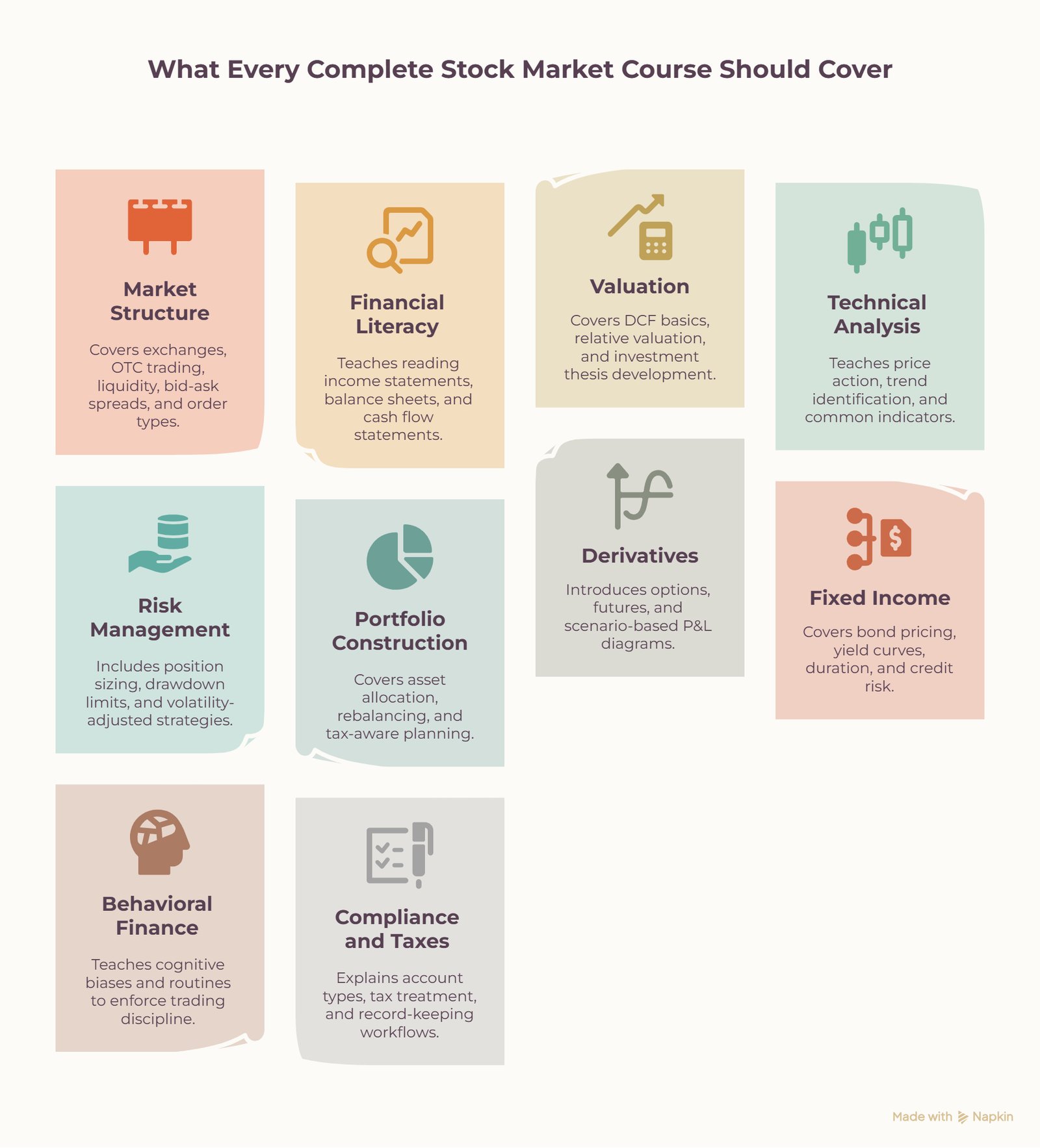
Curriculum Essentials
1. Market Structure and Order Types
Every course must begin with how markets work: exchanges, OTC trading, liquidity, bid-ask spreads, and the mechanics of order types (market, limit, stop, stop-limit). These basics remove confusion when students enter a trading platform.
Teaching execution mechanics prevents costly mistakes like market-impact trades and misunderstood slippage.
2. Foundational Financial Literacy
Students should learn to read the three core statements — income statement, balance sheet, and cash flow statement — with hands-on examples from real companies.
Include ratio analysis (P/E, EV/EBITDA, ROE, current ratio) and exercises that compare similar firms to show how valuation changes with business quality.
3. Valuation and Investment Thesis Development
Cover discounted cash flow (DCF) basics, relative valuation, and framework for building a clear investment thesis: catalyst, margin of safety, time horizon, and exit criteria.
Courses should require students to submit short investment memos that are critiqued, not just multiple-choice quizzes.
4. Technical Analysis and Trade Execution
Teach price action, support/resistance, trend identification, and common indicators (moving averages, RSI, MACD) with emphasis on signal context and confirmation.
Include strict trade plans that define entry, stop, target, and position size before execution. Practicing this in a simulator builds discipline.
5. Risk Management and Position Sizing
Risk is the central skill. Topics must include volatility-adjusted position sizing, Kelly criterion basics, maximum drawdown limits, and how to use stops effectively.
Real-world scenarios showing portfolio ruin risk versus consistent small losses help students internalize risk-first thinking.
6. Portfolio Construction and Asset Allocation
Teach modern portfolio concepts at a practical level: diversification across asset classes, correlation, rebalancing rules, and tax-aware strategies for different accounts.
Include long-term planning modules that translate goals, time horizon, and risk tolerance into actionable allocations.
7. Derivatives and Income Strategies
Introduce options (calls, puts, spreads), futures basics, and covered-call vs protective-put use cases. Explain margin, assignment risk, and scenario-based P&L diagrams.
Demonstrate simple income strategies and when they are appropriate for investors vs traders.
8. Fixed Income Fundamentals
Cover bond pricing, yield curves, duration, credit risk, and how bonds behave differently from equities during market stress.
Provide examples of using bonds and bond ETFs in defensive allocations and cash management.
9. Behavioral Finance and Trading Psychology
Teach cognitive biases (loss aversion, confirmation bias), common emotional mistakes, and specific routines to enforce discipline (journaling, pre-trade checklists).
Include exercises that simulate stressful decisions so students can practice behavior under pressure.
10. Compliance, Taxes, and Record-Keeping
Explain KYC basics, account types (taxable, IRA/TFSA equivalents), tax treatment of capital gains and dividends, and the importance of accurate records for performance assessment.
Show practical workflows for keeping an annual tax summary and integrating cost-basis tracking with trades.
Practical Components Every Course Must Include
Live Labs and Simulated Trading
Simulators and paper trading with real-time data let students practice order entry, risk controls, and trade management without financial risk.
Courses should include graded trading assignments: define a thesis, place trades in simulation, and write a post-trade review.
Case Studies and Investment Memos
Include downloadable templates for investment memos and case studies that replicate past market events (2008 credit crisis, 2020 sell-off) so learners analyze outcomes and strategy adjustments.
Feedback and Community
Peer review, instructor feedback, and an active forum accelerate learning. Look for courses that provide line-item critiques on assignments rather than one-size-fits-all responses.
| Fundamental Analysis | Technical Analysis |
| Focuses on company financials, valuation, and long-term catalysts. | Focuses on price, volume, momentum, and shorter-term timing. |
| Useful for buy-and-hold investors and valuation-based decisions. | Useful for trade timing, entries/exits, and short-to-medium-term strategies. |
| Examples: DCF, ratio analysis, annual reports. | Examples: moving averages, RSI, support/resistance tests. |
Assessment and Progression
A complete course should have measurable milestones: quizzes after modules, graded memos, simulated-trade performance, and a final capstone that requires building a diversified model portfolio or a defined trading strategy with backtested evidence.
Certificates should reflect demonstrated ability, not just lesson completion.
Advanced Insights (Five Beyond-Common-Sense Facts)
- Liquidity risk often causes larger realized losses than theoretical volatility; teaching slippage modeling reduces strategy overfitting.
- Simple risk-parity adjustments (volatility parity) can outperform naive equal-dollar allocations across different market regimes.
- Corporate financial footnotes and non-GAAP adjustments frequently contain the clearest signals of aggressive accounting that headline metrics miss.
- Options position Greeks (especially theta and vega) matter more to trade outcomes than directional delta in short-term strategies.
- Behavioral interventions (pre-trade checklists and mandatory cooling-off rules) materially reduce impulse trades and improve long-term returns in novice traders.
Troubleshooting Common Course and Learning Problems
I’ve seen students stall for predictable reasons; here’s how I address the most common issues from my teaching and practice.
Problem: Overwhelm from Too Much Theory
I break theory into micro-lessons and attach each to a practical exercise. If a student feels lost, I recommend completing one simulation trade tied to that lesson before moving on.
Problem: Poor Trade Execution Despite Knowing Strategy
Execution failures are almost always psychological. My approach is to require a pre-trade checklist and a post-trade journal entry for at least 30 trades. That habit reveals execution gaps quicker than additional study.
Problem: Backtests Look Great but Live Results Lag
I force students to add realistic friction in backtests: slippage, commission, partial fills, and overnight gaps. If performance collapses, we iteratively simplify the strategy and increase robustness tests.
Problem: Lack of Feedback and Isolation
I encourage pairing students for peer reviews and schedule weekly office hours. In my experience, two short instructor-led reviews are more effective than one long lecture.
Troubleshooting Checklist
- Run a 30-trade simulated journal to identify execution gaps.
- Add slippage and commission to all backtests before trusting results.
- Limit weekly new material to what you can test in simulation within seven days.
- Use a pre-trade checklist for every discretionary trade for at least one month.
- Solicit at least two independent reviews of each investment memo.
Selecting a Course: What to Look For
When evaluating courses, prioritize those that show sample assignments, grading rubrics, and instructor credentials with verifiable experience. Avoid programs that promise “guaranteed returns” or rely heavily on unverified backtests without friction modeling.
Look for courses that integrate tax and compliance considerations into portfolio decisions and provide an active community for ongoing learning.
Resources and Next Steps
If you want to dive deeper, consider these practical next steps: practice with a reputable simulator, write an investment memo for one idea per week, and track all trades in a journal focused on decision reasoning and emotions.
For targeted reading, explore materials on valuation, volatility-adjusted position sizing, and behavioral finance to complement hands-on practice. Internal guides like our how to start investing and risk management guide detail these steps with templates.
Conclusion
I designed my ideal course around clear, assessable skills: understanding market structure, reading financials, building and executing a plan, and managing risk. In my experience, students who practice with simulations and receive structured feedback progress far faster.
Step-by-step recap: learn market mechanics and order types, master financial statements and valuation, practice trade execution with a strict plan, apply robust risk management and position sizing, build and rebalance a portfolio, and complete graded case studies and simulated trades for feedback.
If you have questions about building or evaluating a course, or want to share what worked for you, leave a comment below ..I read and respond to feedback.