


Is a stock market course worth the fee? I asked myself that before paying for my first structured investing class, and I still revisit that question whenever new programs pop up. A course is not just a price tag; it packages curriculum, instructor time, community access, and often ongoing resources into a single decision.
In this article I lay out a practical cost framework so you can compare courses to self-study, mentorship, and hands-on practice. I focus on measurable inputs and realistic outcomes so the decision becomes less about hype and more about expected value.
- Quick summary
- Use a simple ROI-style framework: total cost, measurable outcomes, time to proficiency, and ongoing costs.
- Paid courses can speed learning and reduce mistakes, but are not automatically worth the fee.
- Evaluate instructor track record, curriculum alignment, practice opportunities, and community support.
- Consider alternatives: books, free courses, simulated trading, or a one-on-one mentor.
- Five advanced insights are included to go beyond common-sense comparisons.
How to evaluate cost versus value
Break down the total cost
Start by listing every expense the course incurs. That includes the tuition fee, required software or data subscriptions, travel or hardware costs, and any exam or certification charges. Don’t forget ongoing fees for community access or follow-up modules.
Estimate time investment in hours. Time is money: multiply expected hours by a sensible hourly rate for you to reflect opportunity cost. This gives a fuller picture than sticker price alone.
Define measurable outcomes
Decide what success looks like before you buy. Examples: consistent profitable trades over six months, ability to build a diversified portfolio, or passing a certification exam. Measurable outcomes let you calculate a simple ROI or break-even horizon.
Prefer outcomes tied to behaviors (e.g., reduced trading mistakes, disciplined position sizing) because these are more durable than short-term gains that could be luck-driven.
Cost framework: step-by-step
1. Map inputs and outputs
Inputs: tuition, time, tools, and emotional cost. Outputs: expected incremental profit, expenses avoided (fewer mistakes), and transferable skills like risk management. Assign reasonable numeric estimates where possible.
For example, if a course costs $600, you estimate it reduces avoidable losses by $300 in year one and increases net returns by $500, the simple first-year net benefit is $200 minus the time cost.
2. Calculate time-to-proficiency
Different goals require different learning curves. Tactical trading strategies may require months of practice, while understanding fundamentals might take weeks. A course that halves your time-to-proficiency can be worth a higher fee than one that offers incremental speed improvement.
Estimate how long it will take to reach the outcome you defined, and include that in your ROI timeline.
3. Evaluate credibility and ongoing support
Look for verifiable instructor results, transparent syllabi, and active forums or office hours. Courses with living communities and feedback loops reduce the chance that you absorb incorrect habits.
Ask whether the program provides practice opportunities like simulated portfolios, . mentoring, or graded assignments. Practical feedback increases the likelihood of converting course content into profitable behavior.
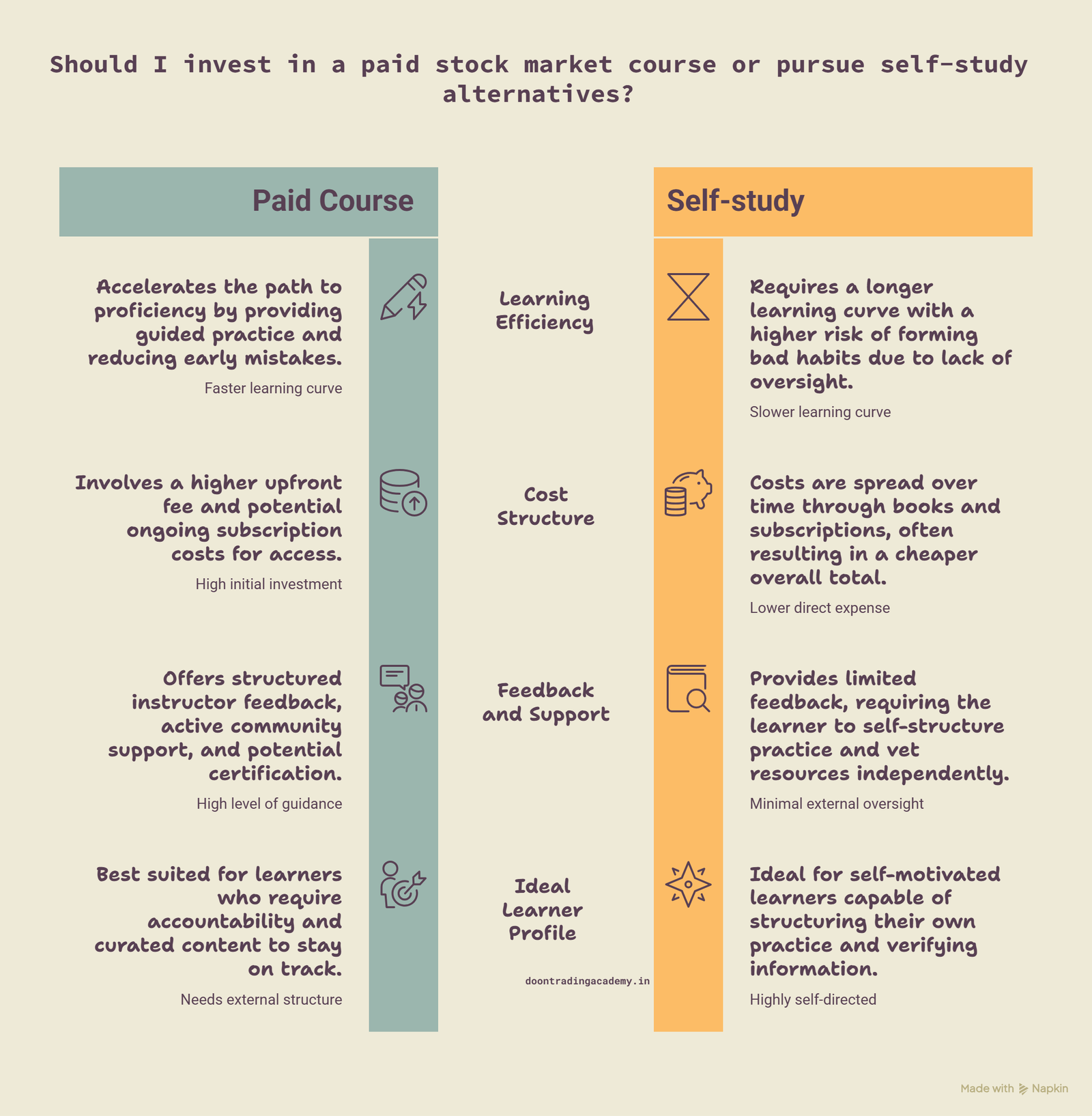
Comparison table
| Paid Course | Self-study / Alternatives |
|---|---|
| Structured curriculum, instructor feedback, community support, possible certification | Lower direct cost, flexible pace, broader source material, limited feedback |
| Higher upfront fee, potential ongoing subscription | Costs spread over time (books, subscriptions), often cheaper overall |
| Faster path to guided practice and fewer early mistakes | Longer learning curve, higher risk of forming bad habits |
| Good for learners who need accountability and curated content | Good for self-motivated learners who can structure practice and vet resources |
Red flags and green flags for course selection
Green flags
- Clear syllabus with learning objectives and time estimates.
- Instructor track record with verifiable performance or transparent case studies.
- Practice components: simulations, graded assignments, or mentor reviews.
- Reasonable refund policy or trial period.
- Active community where alumni discuss real outcomes.
Red flags
- Guaranteed returns or unrealistic profit claims.
- Lack of independent reviews or only anonymous testimonials.
- High-pressure sales tactics and time-limited offers designed to rush decisions.
- Curriculum that lacks hands-on practice or assessment.
Advanced insights: five beyond-common-sense facts
- Formal courses often have hidden recurring costs: data feeds, premium charting tools, or paid mentorship tiers that can double the initial fee over a year.
- The marginal value of instructor time is highest in the first 30–90 days of learning, when feedback corrects beginner mistakes that otherwise become entrenched.
- Peer communities amplify learning efficiency by creating accountability loops; students with active peer reviews tend to reach proficiency faster than those relying on passive video lessons alone.
- Certification value varies widely by audience: for retail investors, certification rarely increases returns directly, but it does improve credibility if you plan to teach or consult.
- Simulated trading accelerates conceptual understanding but often underestimates emotional costs; courses that integrate real-money micro-experiments close that gap and better predict real-world performance.
Troubleshooting
If I paid for a course and it under-de.red, the first thing I did was catalog gaps between promised outcomes and actual content. I created a short list of missing skills and then sought targeted resources to fill those gaps.
If the course content is shallow
I prioritized supplemental materials: focused books, research papers, and targeted video modules. I also reached out in the community to find alumni who had applied the material successfully and asked for concrete examples.
If the mentorship or feedback is poor
I requested one-on-one time or specific assignment reviews. If those were unavailable, I formed a peer study group to exchange feedback and simulate mentor critique. Peer feedback often bridges the gap when instructor bandwidth is limited.
If I can’t afford the course
I break the learning into micro-goals and use free or low-cost alternatives: public courses, library books, simulated trading, and selective paid tools. I budget for a minimal viable paid investment such as a short mentorship session to validate my approach before committing to full tuition.
Representative forum quote (anonymized): “A lot of what I learned came from the . sessions, not the videos. The community kept me honest when I was tempted to overtrade.” — forum participant
Conclusion
I believe a stock market course can be worth the fee when it meaningfully reduces time-to-proficiency, provides corrective feedback early, and offers practice that maps to the outcomes you value. I look for transparent instructors, measurable goals, and a plan to translate lessons into small real-money experiments.
Recap of the step-by-step process I use: list all costs and time commitments, define measurable outcomes, estimate time-to-proficiency, evaluate instructor credibility and practice opportunities, compare alternatives with a two-column cost-benefit view, and run a micro-experiment to validate learning before committing more resources.
If you have experience with a course or are weighing options, I invite you to share your thoughts and questions in the comments so we can compare notes and help others decide whether a particular program is worth the fee.