


I often get asked whether a certificate from a stock market course will open doors or if it is just a piece of paper. In my experience, the short answer is: it depends on the certificate, the employer or client, and what you do with the knowledge after the course.
I wrote this to help you decide whether investing time and money in a stock trading certification or an online investing course makes sense for your goals, and to show practical steps to make any certificate count.
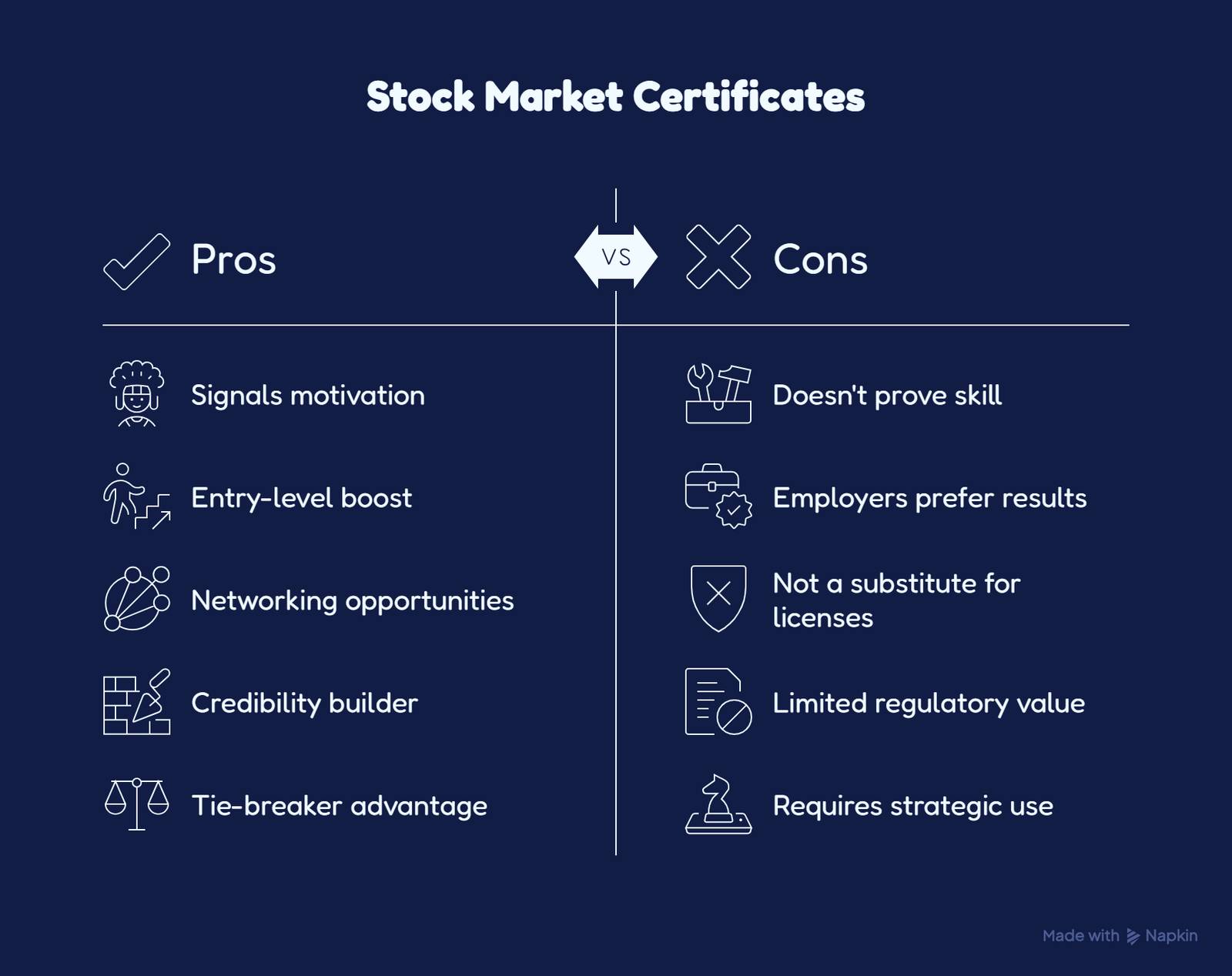
- Certificates can signal motivation and familiarity with concepts but rarely prove real trading skill on their own.
- Employers weight accredited credentials and demonstrable results more heavily than short course certificates.
- Portfolio, projects, simulated track record, and networking are what turn a certificate into opportunity.
- Choose courses with assessments, instructor feedback, and recognized partners if you want credibility.
- There are strategic ways to extract value from certificates even if the credential itself isn’t decisive.
How certificates function: signal versus skills
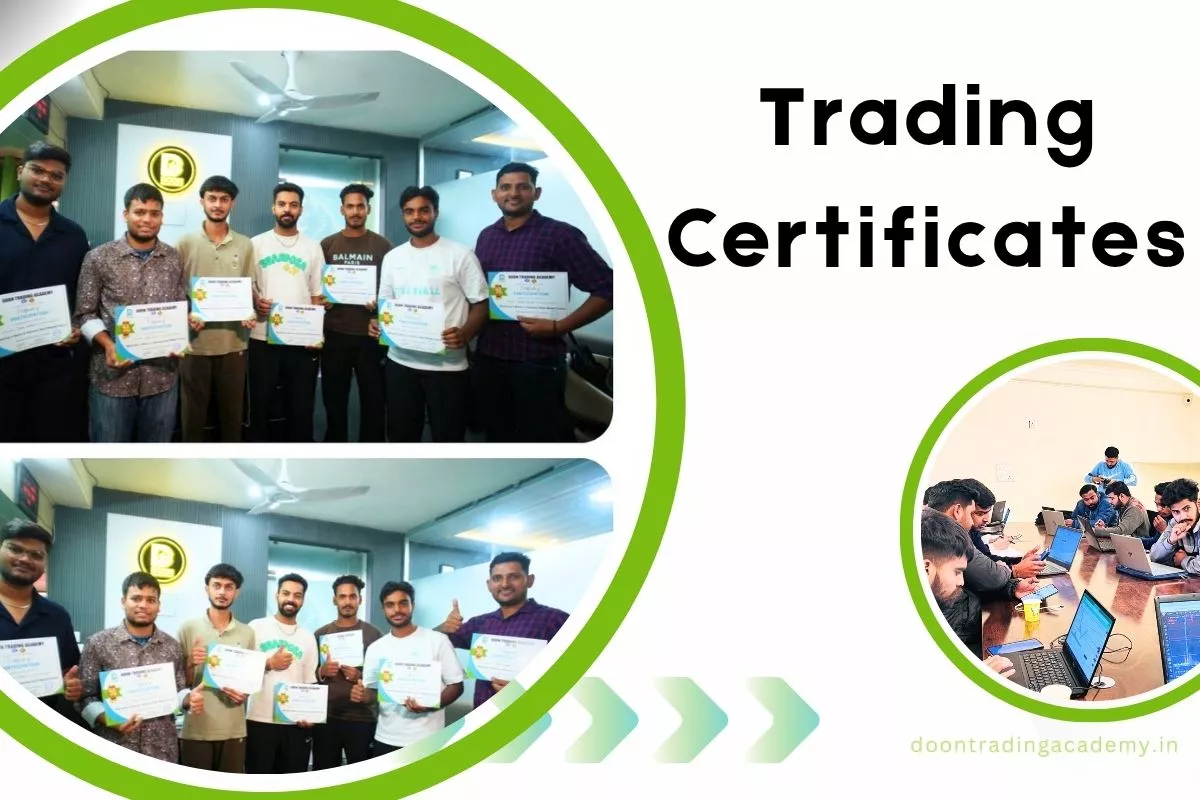
Certificates primarily act as signals. They show that you spent time learning terms, frameworks, and tools such as technical indicators, fundamentals, or financial modeling.
However, the stock market rewards applied skill rather than book knowledge. A certificate doesn’t guarantee you can manage risk, execute under stress, or generate repeatable returns.
Who cares about certificates?
Employers and hiring managers
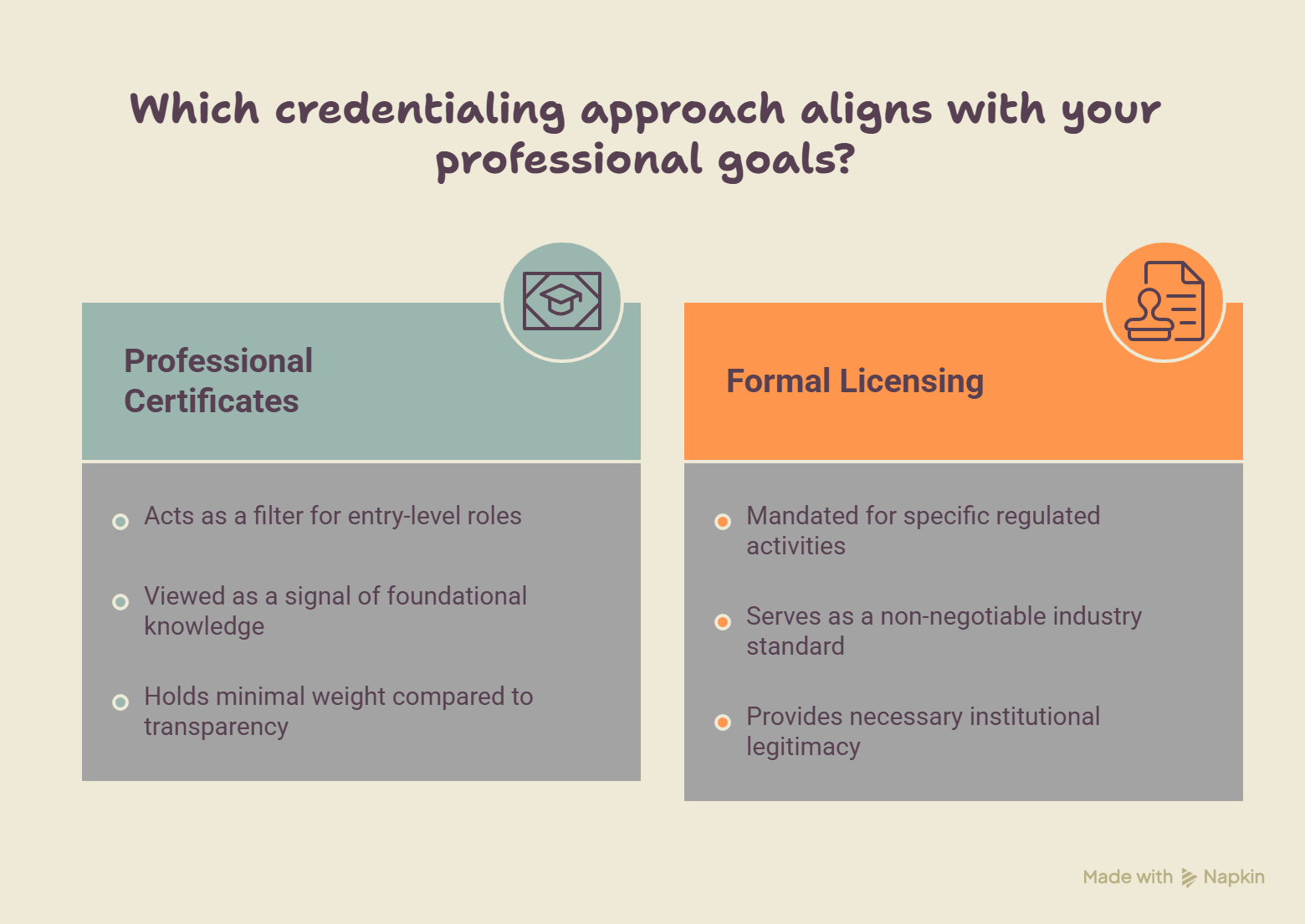
Hiring teams use certificates as one of many filters. Well-known professional credentials or university-affiliated certificates can move you up the shortlist, especially for entry-level roles.
For senior trading, portfolio management, or analyst roles, firms prefer proven results, internships, or quantitative assessments over generic certificates.
Clients and retail investors
Retail clients may care less about the certificate and more about your transparency, documented track record, and how you communicate strategy and risk.
Regulators and compliance
Some regulated activities require recognized licenses or certifications; course certificates rarely substitute for formal licensing like Series exams or CFA where applicable.
What certificates prove and what they don’t
| What certificates can prove | What certificates usually don’t prove |
|---|---|
| Basic theoretical knowledge of valuation, technical analysis, and order types | Actual profitable trading ability under . market conditions |
| Commitment to learning and ability to complete a structured course | Emotional discipline and risk management in real-time trading |
| Familiarity with specific platforms, tools, or workflows taught in the course | Depth of judgment or domain expertise beyond the course scope |
| Exposure to industry-standard terminology and trading workflows | Regulatory qualifications required for licensed or regulated roles |
How to make a certificate actually matter
Think of a certificate as the start of a credibility-building process rather than the end goal. Concrete steps help convert a credential into opportunities.
- Build a documented track record: keep a trading journal, screenshots, and verified performance of small, risk-controlled . trades or paper trades with clear timestamps.
- Complete project-based assessments: publish valuation models, backtests, or case studies from your course — these are more persuasive than a badge.
- Network with instructors and classmates: referrals and introductions often outweigh the certificate itself.
- Choose courses with assessments and proctored exams: these carry more credibility than self-paced, no-exam modules.
- Link certificate learnings to tools recruiters value: Excel financial modeling, Python backtests, or Bloomberg/Refinitiv familiarity.
- Continue learning: combine short-course certificates with recognized credentials (CFA, CFP, Series) where relevant to your career path.
Five beyond-common-sense insights
- Not all certificates are equally visible: platforms that integrate with professional profiles or have institutional partners (university extensions, recognized exchanges) produce higher employer recall than anonymous online badges.
- Assessment design matters more than duration: a short course with a rigorous, scenario-based capstone beats a long course with no testing in terms of demonstrable competence.
- Certificates that include supervised . trading labs accelerate learning transfer: simulated markets with oversight reproduce emotional elements absent from recorded lectures.
- Employers often use certificates as tie-breakers: when two candidates have similar experience, a relevant, up-to-date certificate (plus project evidence) can tip the decision.
- Search engines and LinkedIn amplify signals: sharing course projects, linked portfolios, and meaningful posts increases the practical value of a certificate far more than the credential alone.
Troubleshooting: common issues and fixes
Problem — “My certificate didn’t get me an interview.”
Fix: Translate what you learned into demonstrable outputs. I created a short, public demo portfolio and a one-page case study that recruiters could review in under five minutes; that got interviews faster than the certificate alone.
Problem — “My certificate isn’t recognized by employers.”
Fix: Pair the certificate with relevant, verifiable work. In my experience, adding a GitHub repo of backtests or a Google Sheet showing trade logs and risk metrics made my learning tangible to hiring managers.
Problem — “I feel underqualified despite finishing a course.”
Fix: Treat the certificate as a step. I repeated key modules, joined study groups, and practiced strategy execution in a simulator until I could demonstrate consistency, not just theory.
Problem — “I can’t tell if a course is worth it.”
Fix: Look for these features before enrolling: transparent curriculum, instructor credentials, proctored assessments, project-based capstone, and community or placement support. I skip courses that lack at least two of these elements.
Conclusion
I view stock market course certificates as useful tools when used strategically. They matter more as evidence of effort and as a conduit to projects, networks, and demonstrable outputs than as standalone proof of trading ability.
Step-by-step recap: pick a reputable course with assessments, complete project-based work, build a verifiable portfolio or trading log, network with professionals, and combine short-course credentials with recognized licenses where your target roles require them.
If you’ve had success turning a certificate into a job or client, or if you’re still unsure which course to pick, share your experience or questions in the comments — I’ll read and respond.