


I’ve explored both online and offline stock market courses in India to understand which format de.rs better learning, practical skills, and long-term results. In my experience, the right choice depends on your goals, schedule, budget, and how you learn best.
Below I compare formats across curriculum quality, hands-on practice, mentorship, costs, and outcomes so you can pick the course that matches your needs.
- Quick summary
- Online courses offer flexibility, lower cost per hour, and ongoing access to recorded content.
- Offline courses provide stronger real-time mentorship, structured accountability, and better networking opportunities.
- Hybrid/cohort-based programs combine the best of both and are increasingly popular in India.
- Practical, simulator-based practice and . trading sessions are more important than format for skill retention.
- Check faculty experience, sample classes, placement support, and refund/assessment policies before enrolling.
What each format typically offers
Online stock market courses (e-learning)
Online courses range from short video modules to multi-week cohort programs with . sessions. They often include recorded lessons, downloadable resources, quizzes, and community forums.
Most platforms support asynchronous learning, so you can study at your own pace and revisit complex topics. Many providers also offer simulators or paper trading integrations to practice strategies.
Offline stock market courses (classroom/workshop)
Offline courses are scheduled classes held in cities, often with . demonstrations, group assignments, and in-person mentorship. They can be weekend workshops or multi-week classroom programs with hands-on sessions.
Classroom settings create peer accountability, in-person networking, and immediate feedback during . trading demos or Q&A rounds.
Pros and cons — concise view
- Online pros: Flexible timing, often cheaper, lifetime access to recordings, scalable content, good for self-paced learners.
- Online cons: Lower external accountability, variable interaction quality, possible information overload without practice.
- Offline pros: Structured schedule, direct mentorship, stronger networking, clearer progression and accountability.
- Offline cons: Higher cost, travel/time constraints, limited replays unless recorded.
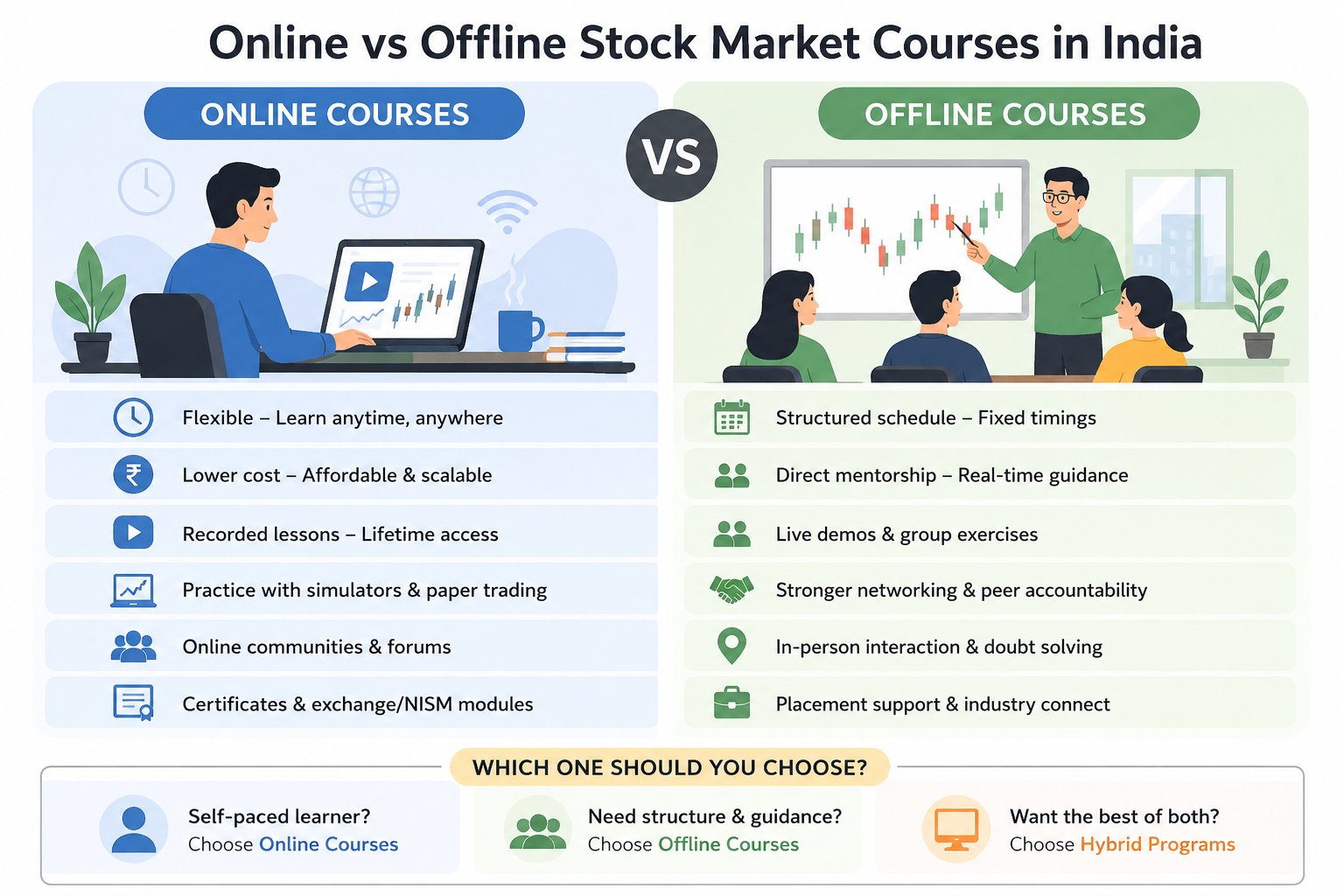
Table: Side-by-side comparison
| Dimension | Online vs Offline |
| Cost | Online: Lower fees, subscription models. Offline: Higher one-time fees, sometimes includes printed materials and in-person facilities. |
| Flexibility | Online: Study anytime. Offline: Fixed schedule, better for disciplined timelines. |
| Mentorship | Online: Mentor access may be limited to office hours or forums. Offline: Direct, real-time guidance during classes. |
| Hands-on practice | Online: Simulators, recorded .-trading sessions. Offline: Live demos, group trading exercises, instant feedback. |
| Networking | Online: Community groups and forums. Offline: Stronger in-person networks and peer accountability. |
| Certification & placements | Online: Certificates, sometimes partnered with exchanges or NISM training. Offline: Placement drives and local industry connect events. |
How to evaluate course quality
Whether online or offline, these checks matter most:
- Faculty track record: Look for instructors with verifiable market experience and demonstrated teaching ability.
- Curriculum depth: Ensure courses cover fundamentals, technical analysis, risk management, and ./practice sessions.
- Practice opportunities: Simulator access, paper trading, or . trade reviews are essential for skill transfer.
- Student outcomes: Ask for alumni performance stories, internships, or placement statistics where applicable.
- Refund and assessment policy: Clear trial classes, refund windows, and assessments indicate confidence in de.ry.
Cost and ROI considerations in India
Course fees in India vary widely — from a few thousand rupees for short e-courses to lakhs for intensive certification and placement programs. When evaluating ROI, consider the cost per learning hour, access to . markets practice, and whether the program offers internships or job assistance.
For many learners, a low-cost online course plus disciplined simulator practice can produce comparable results to an expensive classroom program—provided you maintain accountability.
Choosing by learning style
If you prefer self-paced study
Choose well-structured online courses with clear module progression, lifetime access, and active community support. Look for programs that include scheduled . sessions to keep you on track.
If you learn best in-person
Prefer offline classroom workshops or blended programs where instructors can correct mistakes during . demonstrations. Seek small class sizes to ensure personalized feedback.
Practical steps to decide (actionable checklist)
- Define your goal: long-term investing vs short-term trading vs algorithmic strategies.
- Ask for a syllabus and sample lesson: check depth and practical exercises.
- Request demo classes or trial access before paying.
- Verify instructor credentials and student testimonials.
- Confirm practice tools: simulator, broker integration, or .-trading room access.
- Compare total cost, duration, and expected weekly time commitment.
Troubleshooting common problems (first-person parts included)
Problem: I signed up but I’m not completing modules.
I overcame low completion rates by setting a weekly schedule and joining a study group. Blocking specific time slots and treating classes as appointments helped me stay accountable.
Problem: The course content feels theoretical and I can’t apply it.
My solution was to demand more practice: I asked for simulator access and requested trade review sessions. If a provider cannot demonstrate hands-on practice, I moved to a different program that included . trade analysis.
Problem: I’m confused by too many strategies and noisy community advice.
I focused on one core strategy for 60 days—paper trading it exclusively—before adding others. Narrowing the scope prevented analysis paralysis and helped me track what actually worked.
Advanced insights — beyond common sense
- Cohort-based online programs often outperform self-paced video libraries in long-term retention because scheduled peer interactions create accountability similar to classrooms.
- Completion rates for massive open online courses (MOOCs) are low, but courses that integrate . trading rooms and graded assignments can increase measurable skill gains by over 2x.
- Hybrid models that combine recorded theory with periodic in-person or . webinar clinics de.r better networking and feedback loops—this is becoming the dominant format in India’s top providers.
- Regulatory credentials such as NISM modules are increasingly offered as part of online packages; verifying such certifications can be a proxy for curriculum rigor.
- Practice on simulated environments with realistic order-book behavior (latency, slippage) matters more than raw hours spent; realistic simulation shortens the transfer learning gap to . markets.
Real-world signals and community sentiment
Across forums and community groups in India, I’ve noticed recurring themes: budget-conscious learners choose online modules and follow them with months of simulator practice, while career-switchers often invest in offline or placement-linked programs for faster industry entry.
Community feedback often focuses not on “format” alone but on mentorship quality, access to . trade reviews, and post-course support.
Where to look next (resources and internal links)
For a structured comparison of specific providers, see our detailed course comparison. If you want help matching a course to your goals, read our guide on how to choose a stock market course or join the upcoming webinar listed on our events page.
Conclusion
I believe the best choice depends on your objectives, discipline, and need for mentorship. For flexible learning at lower cost, online courses are excellent. For structured guidance, stronger networking, and immediate feedback, choose offline or hybrid programs.
Step-by-step recap: first define your goal (investing, trading, or career change), then review sample lessons and instructor credentials, verify practical tools (simulator or . trading room), compare total cost and time commitment, and finally choose the format that ensures you consistently practice and get feedback.
If you’ve tried both formats, I’d love to hear about your experience—please leave a comment below or ask questions and I’ll respond with recommendations tailored to your situation.